@SignOfficial $SIGN #SignDigitalSovereignInfra
Every country already has some form of identity system. It may look messy — different databases, agencies, banks, and manual processes — but it exists. The real challenge is not creating identity from scratch, it’s connecting what already exists into something that actually works.
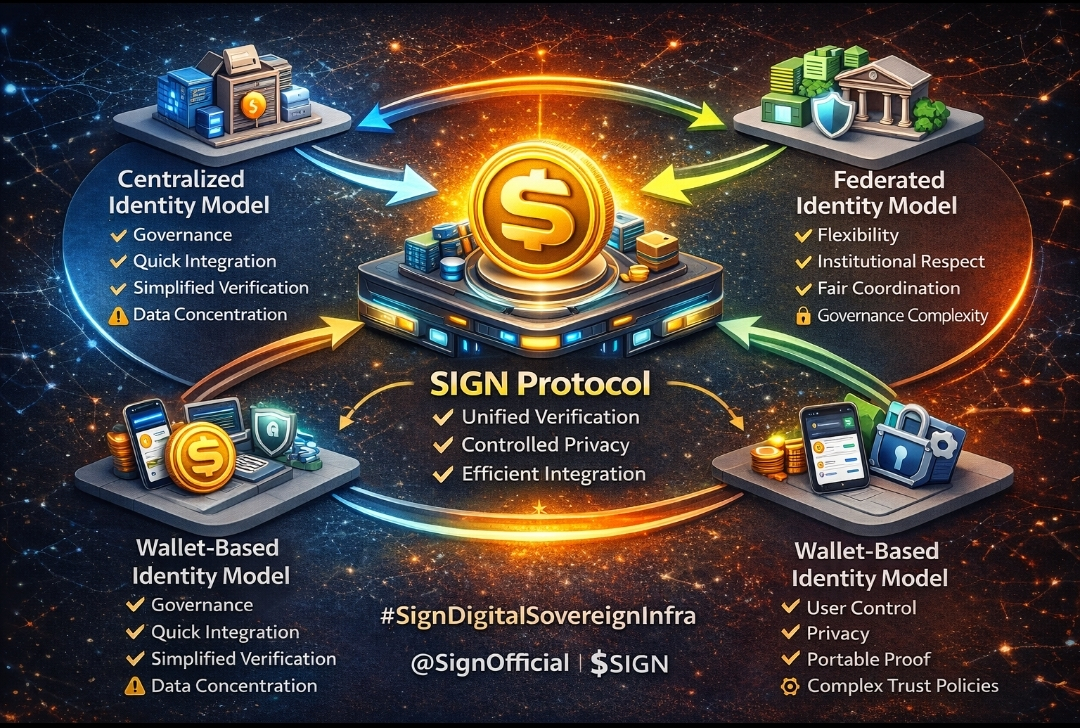
Most national systems fall into three directions. A centralized model creates one source of truth. Deployment is a breeze, quick and straightforward. The downside? It centralizes both power and data. This approach is undeniably efficient, yet it also creates a single point of failure, making it vulnerable to overextension. Alternatively, there's the federated model. Here, systems remain distinct, communicating via a common interface. While this method honors established structures, it also adds layers of complexity and frequently routes visibility through a central access point.
The third approach focuses on identity systems that use wallets.
Within this framework, users maintain their credentials, revealing only the essential information for a specific interaction. This strategy mitigates data exposure and grants individuals enhanced control. Nevertheless, its implementation is more intricate, and achieving broad functionality necessitates considerable coordination.
The reality is none of these models work alone. Countries need a mix of all three. Governance from centralized systems, flexibility from federated systems, and privacy from wallet-based models.
This is where @SignOfficial and $SIGN become relevant. Rather than rebuilding current systems, the focus is on the connecting layer. What's the ultimate goal?
To make verification portable, manageable, and effective, all while keeping sensitive data under wraps.
It's what true digital sovereignty is all about.

#signdiditalsovereigninfra $BTC