
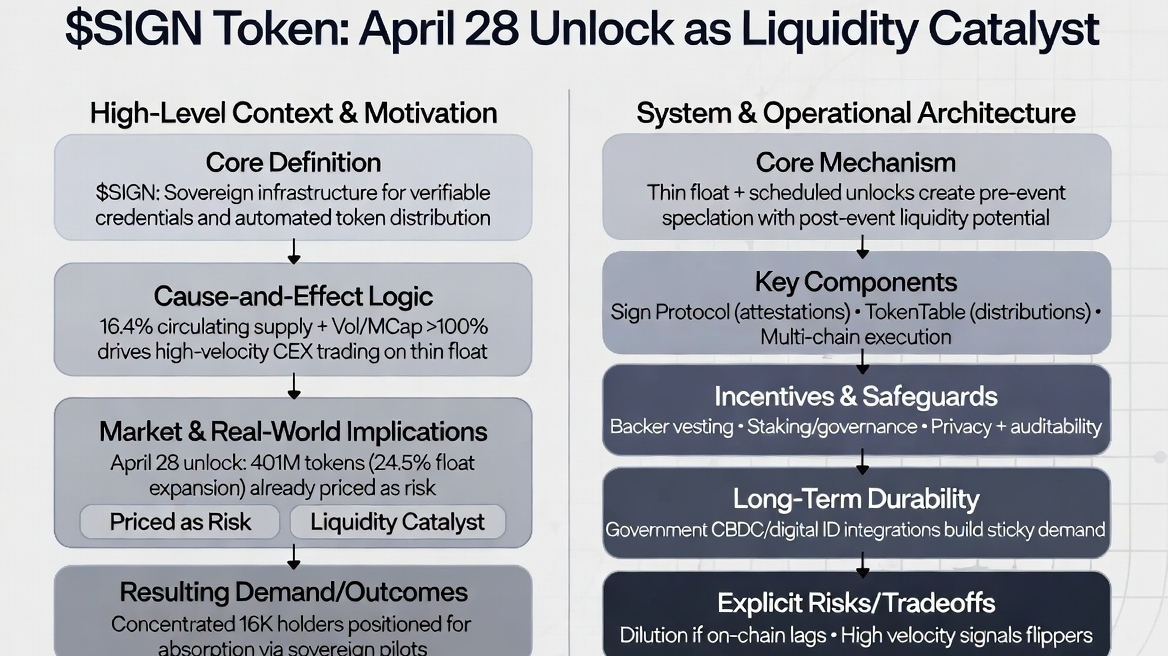

I've been quietly watching $SIGN for months now, the kind of project that doesn't scream for attention but keeps pulling me back in with how its token actually trades versus what the protocol is quietly becoming. After staring at the charts, the unlock calendar, and the on-chain hints, here's the non-obvious thing that's shifted my view from curious to genuinely convicted: the market has already fully priced in the fear of the April 28 backer unlock, but it's completely missing how that same event is likely to unlock real liquidity and participation that the protocol has been building toward all along. This isn't hopium – it's the mechanics of a 16.4% float that's been churning at ridiculous velocity while real-world credential work keeps compounding in the background.
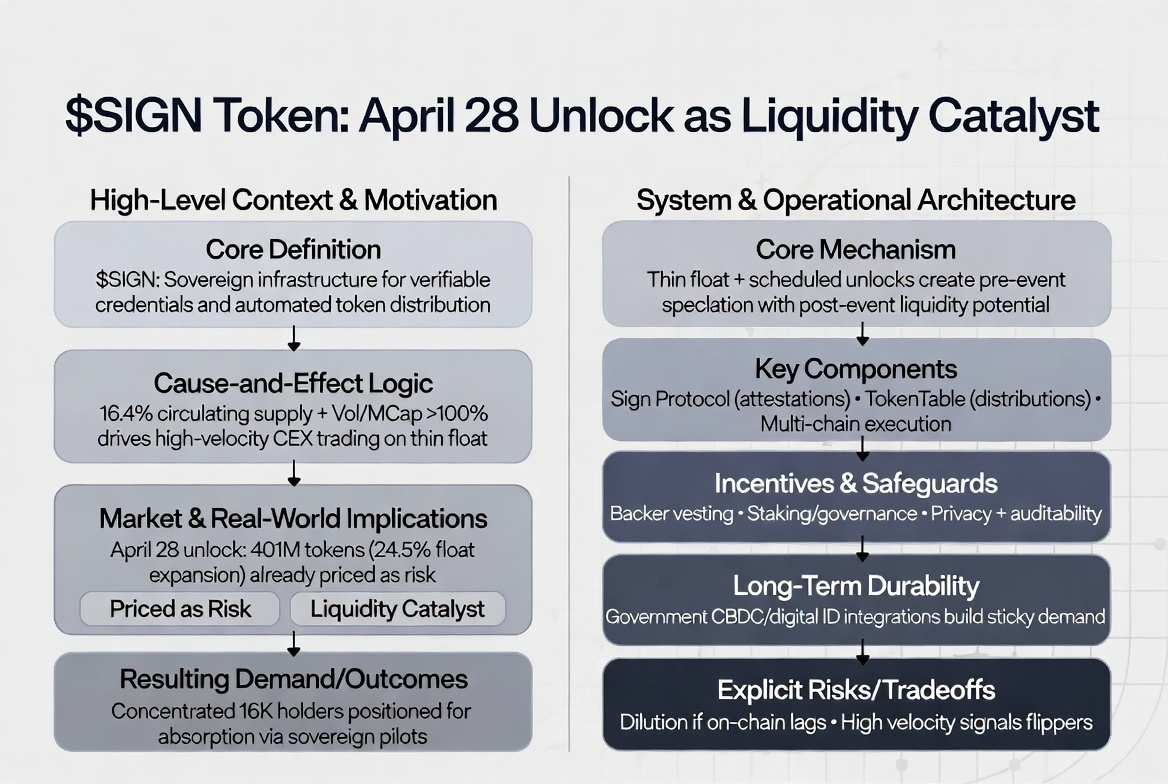
Let me walk you through what I've been seeing in the numbers, the way I actually process them when I'm thinking about putting more skin in the game.
First, that massive FDV to market cap gap. We're sitting at roughly $52 million market cap on 1.64 billion circulating tokens out of a 10 billion max supply, which puts the fully diluted valuation around $316 million. To me, that 6x spread isn't a red flag anymore it's the exact math of asymmetric upside if the attestation layer starts pulling in even modest usage from the government and enterprise pilots Sign has been shipping. The forward read is simple: every token that enters circulation doesn't just dilute; it expands the pool of participants who now have skin in the game to actually use the protocol for credential verification and token distribution. If even a fraction of those new holders engage, the velocity flips from speculative churn to utility demand.
Second, the volume behavior tells its own story. 24-hour trading has been running $50–80 million lately, which on a $52 million market cap is north of 100% turnover most days. On the surface that looks like pure flipper energy, but step back and it reads as concentrated conviction big money rotating in and out of a thin float on Binance and Upbit without blowing the order books apart. The implication going forward? When the April unlock lands, that same liquidity infrastructure is already in place to absorb supply instead of cratering price. It's the rare case where high velocity today becomes a feature, not a bug.
Third, the holder count at around 16,300 wallets. Tiny footprint, right? Yet that's exactly why the setup feels special to me. This isn't a widely distributed meme coin with retail FOMO; it's a concentrated base of believers who have stuck around through the 30% drawdown in the last week and the 75%+ drop from last September's highs. Low distribution means any genuine protocol traction a new sovereign integration, a big attestation schema going live moves the needle fast because there simply aren't enough sellers left at these levels to meet fresh demand.
Fourth, the unlock itself: 401 million tokens hitting on April 28, about a 24.5% step-up to the current float, valued at roughly $13 million today. Most analysts I see online are treating this as automatic selling pressure. I've come to view it differently after mapping the schedule this is the largest single relative expansion until deep into the decade, but it's also the moment when backers (who've been locked in) get tokens that can now flow into staking, governance, or ecosystem incentives. History on similar infra tokens shows that post-unlock absorption often happens faster when the project has actual product pulling revenue (Sign reported solid attestation volume and early revenue traction in prior disclosures). The price weakness we've seen the past week looks less like panic and more like the market front running the obvious narrative so it can get positioned for the less-obvious outcome.
Fifth, the price structure itself. Trading down hard recently but holding the $0.03 zone with decent bids to me this feels like the exact shakeout that clears weak hands right before a supply event that historically marks inflection points for these kinds of protocols. The token has already endured multiple prior quarterly unlocks without structural breakdown; each time the dip has been the entry before the next leg of ecosystem growth.
Of course there's a real counterargument, and I sit with it every time I look at the position: if the attestation numbers don't accelerate meaningfully in the next quarter, all the high volume today was just hot money rotating, and the unlock becomes the dilution everyone fears. Fair point. The data doesn't show explosive on-chain growth in public dashboards yet that's the part that still keeps me measured.
What would confirm my thinking over the coming months? Price holding or grinding higher through the April 28 window, holder count ticking up steadily, and any visible uptick in credential schemas or distribution volume on SignScan coinciding with stable to rising volume to market cap. That would tell me the protocol is finally converting its sovereign infrastructure narrative into token level demand faster than the supply schedule can dilute it.
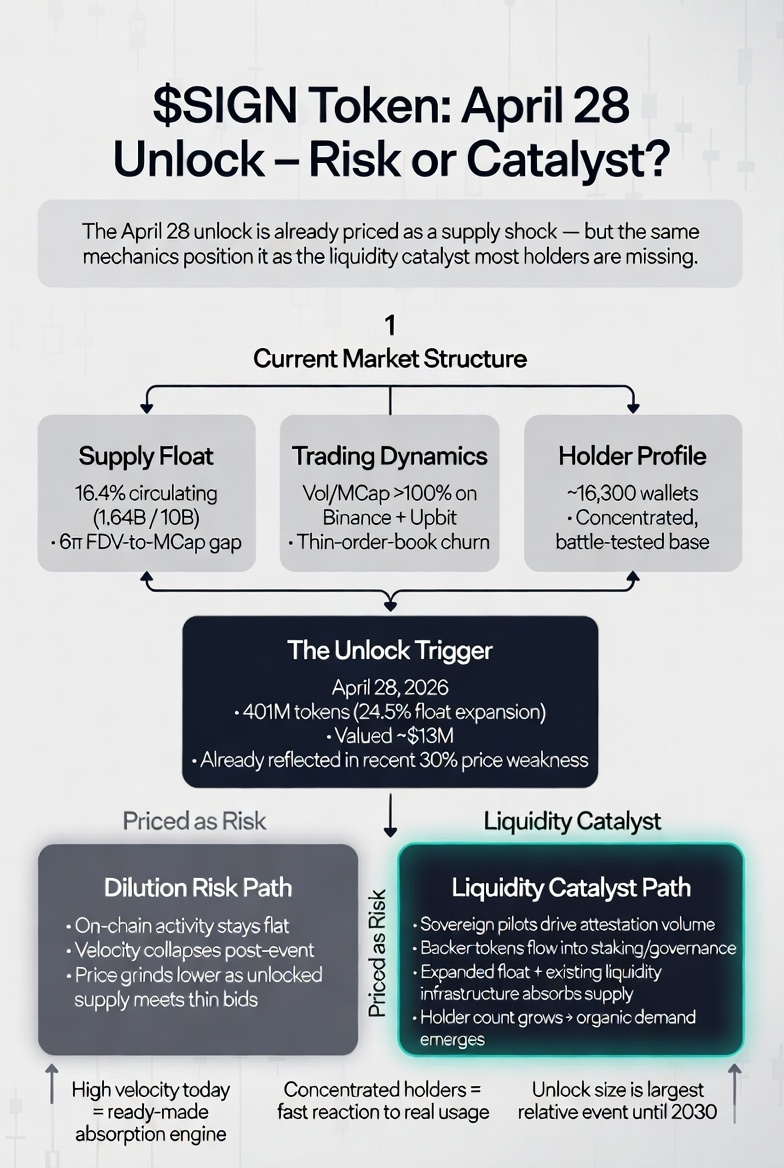
What would prove me wrong? A clean break below current levels post-unlock with volume collapsing and no corresponding rise in on-chain activity that would mean the market was right and the utility case is still too early.
Right now, though, after months of watching this thing trade, the setup just feels mispriced in a good way. The fear is in the price, the conviction is in the wallets that matter, and the unlock everyone is scared of might be the very thing that finally widens the float enough for real participation to show up. I'm comfortable staying long here. The data keeps pointing the same direction for me.
@SignOfficial #SignDigitalSovereignInfra $SIGN
