
Over the past year something important has started to change in crypto.
It is no longer just about users interacting with apps or chasing the next trend.
Entire systems are being built at the same time across different regions.
Governments are testing digital currencies, institutions are exploring tokenized assets, and startups are building new layers on-chain.
On the surface it looks like progress.
But underneath there is a quiet problem.
These systems are not naturally aligned with each other.
A record created in one environment often means nothing in another.
A verified user in one platform has to prove themselves again somewhere else.
A contribution made in one ecosystem does not carry forward into another.
Everything resets.
Trust does not travel.
That gap is small at first. But once systems start scaling, it becomes a serious friction point.
This is where @SignOfficial started to make more sense to me.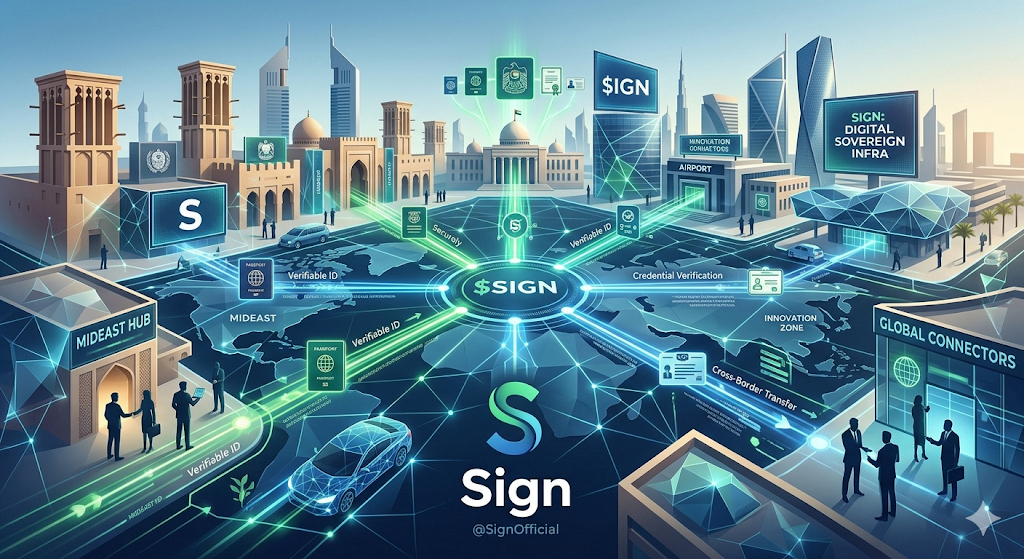
Instead of trying to own identity or force everything into one structure, Sign focuses on something more practical.
It focuses on making trust portable. Not just creating data, but making sure that data can be verified across different environments without starting from zero each time.
That sounds simple, but it changes how systems connect.
Because real infrastructure today is not built in one place. It is spread across chains, storage layers, and private systems.
Some parts need transparency.
Some parts need privacy.
Some parts need to persist long term without relying on a single provider.
Sign leans into that reality instead of trying to simplify it.
Attestations can exist across multiple layers. They can be anchored on-chain, stored in decentralized systems, and still remain usable in controlled environments where institutions need compliance.
It is not a perfect or clean setup, but real systems are not clean.
They are layered and sometimes messy, and that is exactly why they break.
What makes this more relevant now is how quickly regions like the Middle East are moving.
There is a strong push toward digital economies, not just at the startup level but at the government level as well.
Different systems are being built at the same time, and sooner or later they will need to interact.
That is where most current solutions fall short.
Because they solve problems inside one system, not between systems.
Sign takes a different route.
It allows credentials and records to move across environments in a verifiable way.
So instead of rebuilding trust every time, systems can rely on proofs that already exist.
That reduces friction not only for users, but also for institutions that need consistency across platforms.
This becomes even more important when you look at how value is distributed.
Most token distributions today still rely on surface level signals. Wallet activity, task completion, or simple filters.
It works to some extent, but it does not truly identify quality or real participation. It is still a form of guessing.
With $SIGN, distribution can be tied to verified credentials instead of assumptions.
That means access and rewards can be based on actual proof of contribution or role.
It is a more structured way to move value, especially in ecosystems that are trying to grow in a sustainable way.
Of course this direction is not easy to execute.
It requires reliable attesters, shared standards, and systems that can handle data across multiple layers without losing consistency.
One weak point can create confusion, and in complex environments that risk is always present.
But the idea behind it feels grounded.
Not another attempt to replace everything.
Not another isolated solution.
Just a way to make sure that when trust is established once, it does not disappear the moment systems expand.
As more regions continue building their own digital infrastructure, this kind of continuity will become more important than people expect.
Because growth is not just about building new systems. It is about making sure those systems can actually work together.
#SignDigitalSovereignInfra is less about ownership and more about making sure trust can survive across systems that were never designed to connect.
$SIGN
