
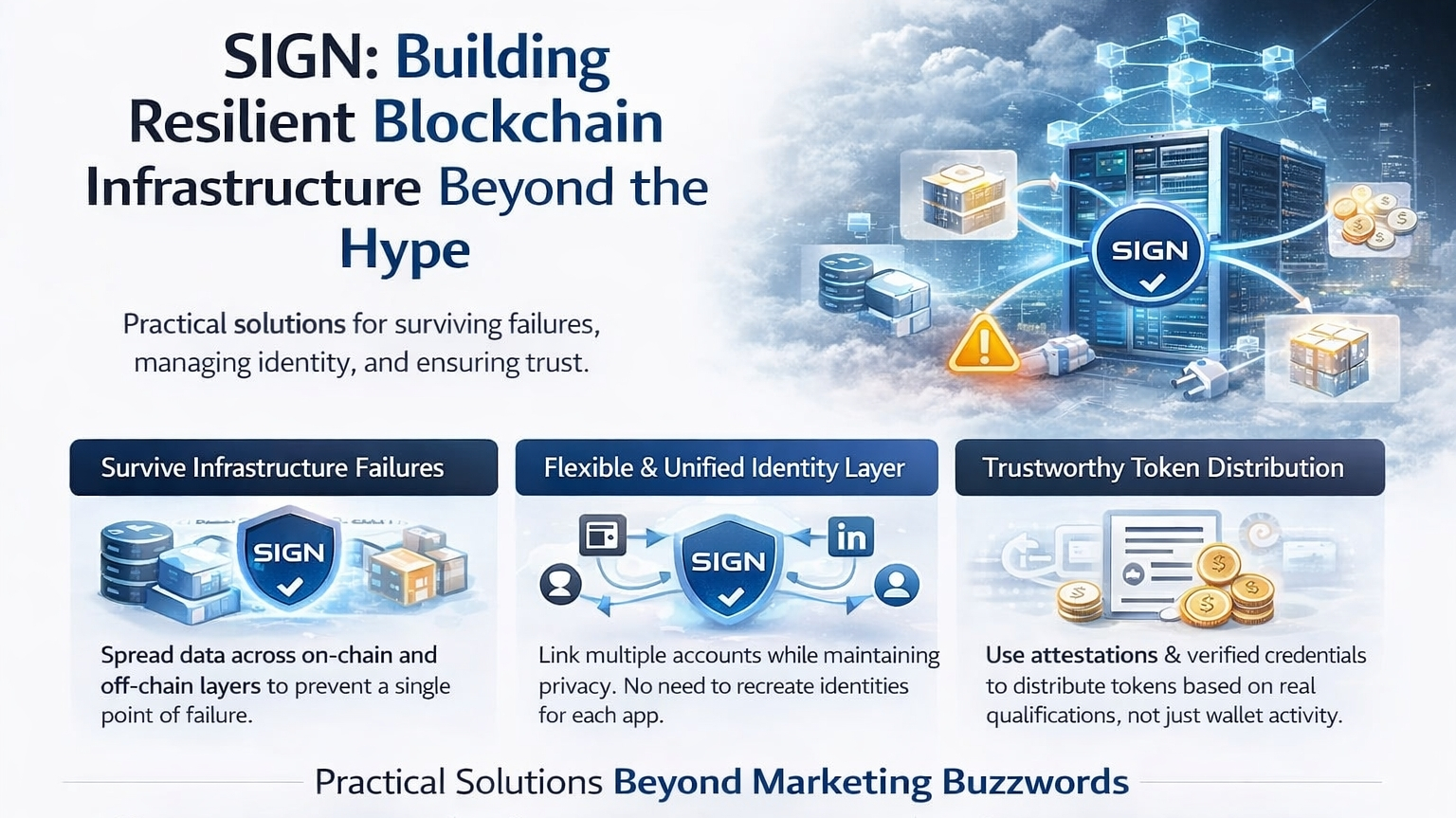
@SignOfficial #SignDigitalSovereignInfra $SIGN
I used to think most of the “trust layers” being built in crypto were focusing on the wrong problem. Everyone hypes up identity, credentials, and attestations—which all sound incredibly important and look great in a pitch deck.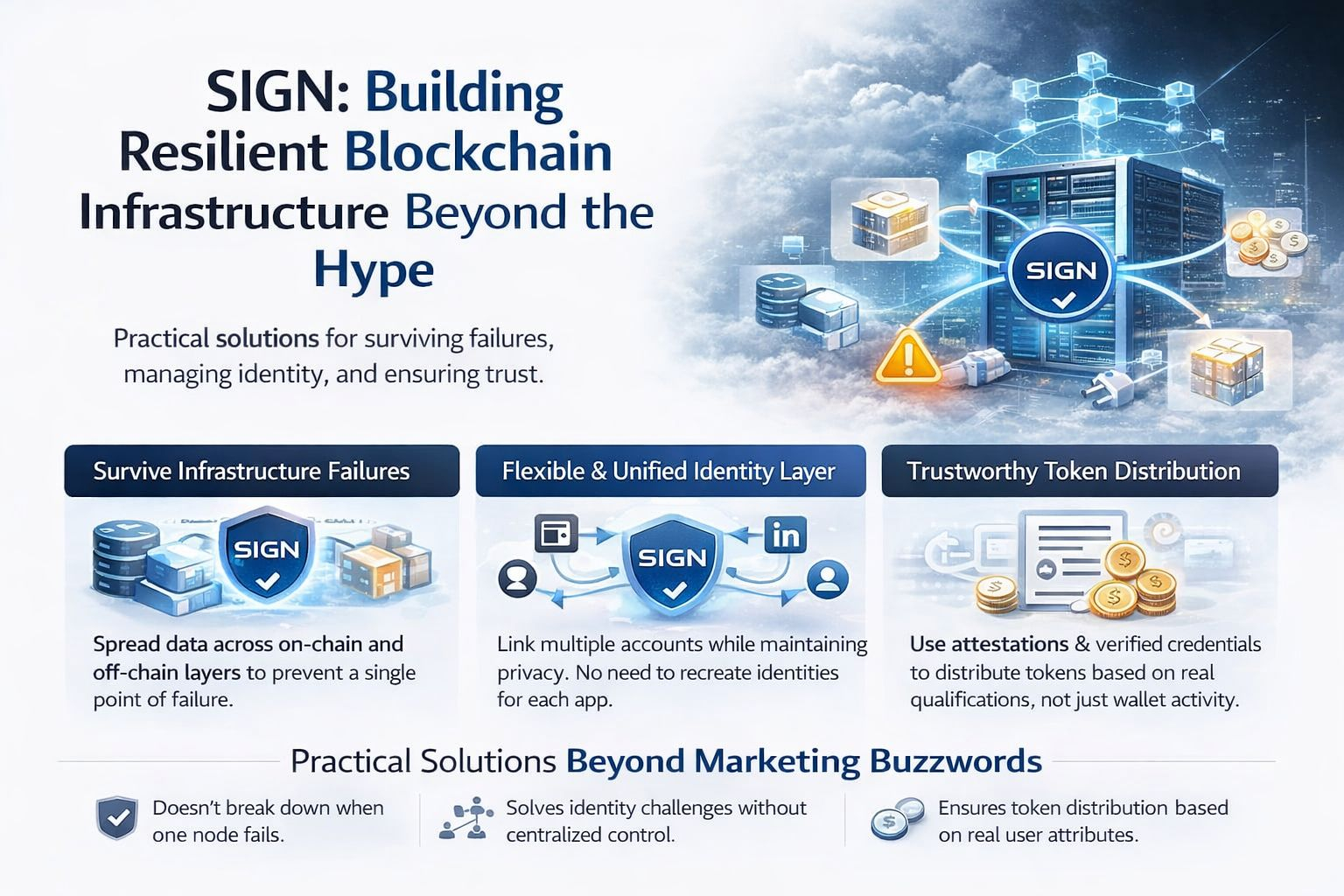
But that’s not where the system actually breaks.
It breaks when something goes down. A database crashes, an indexer falls behind, or a block explorer simply stops resolving data for ten minutes. Suddenly, nobody knows what’s real anymore. I’ve seen this happen more times than I’d like to admit. You have a system that’s technically “on-chain,” but in reality, everyone is reading it through some centralized API. The second that API hiccups, chaos ensues. Balances look wrong, claims fail to verify, and users immediately panic, asking if their funds are gone.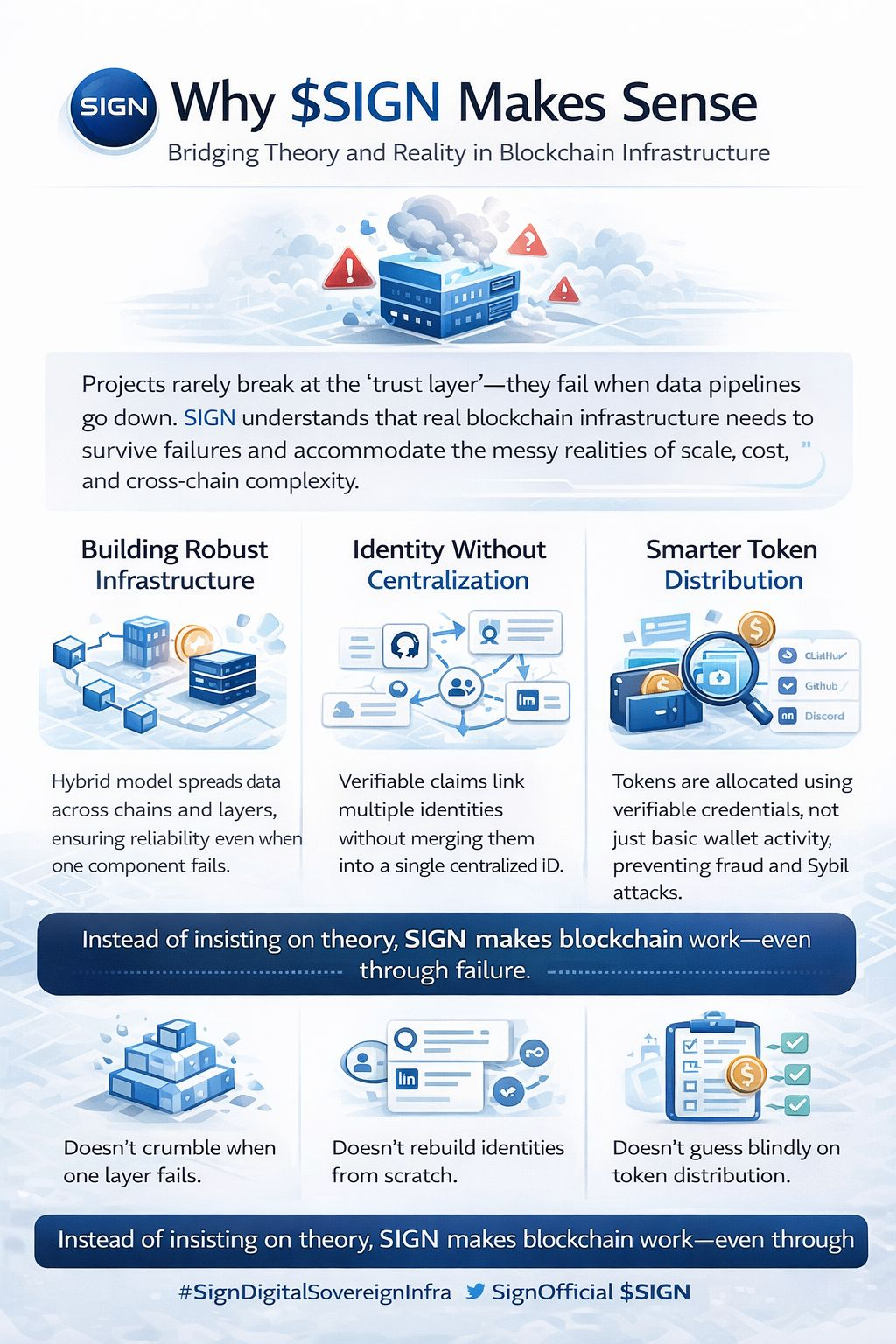
That 5–10 minute window? That’s where trust actually breaks. Not in theory, not in whitepapers. Right in that moment.
That’s exactly why Sign started making so much sense to me. They aren’t pretending that data lives in one pristine, clean environment. Instead, they treat data like something that needs to survive failure across different layers. If you’re building something people will actually use, that is the core requirement.
Instead of forcing everything onto a single chain or storage system, Sign spreads it out. They use public chains for verifiability, layers like Arweave for persistence, and even private setups when necessary. Sure, it’s messy. But let’s be real—production systems are messy. This hybrid model of on-chain anchors and off-chain payloads isn't a compromise; it’s the only practical way to handle scale, cost, and privacy simultaneously. Anyone telling you to "just keep everything 100% on-chain" clearly hasn't tried running a real app at scale.
Then there’s the nightmare of identity.
Honestly, it's a mess. You probably have a few different wallets, a GitHub account, a Discord handle, and maybe a LinkedIn profile. None of these platforms talk to each other, and every dApp tries to stitch together its own identity system—usually doing a terrible job.
I used to think the fix was simple: just unify everything into one master ID. But that falls apart fast. Who owns it? Who verifies it? Who has the power to revoke it? You just end up recreating the exact centralized control problems we were trying to escape in the first place.
Sign completely avoids that trap. Instead, they use schemas—structured definitions that essentially say, “this specific claim means this.” Different identities can then attach to those claims. So, rather than forcing you into one single identity, they let you connect your multiple existing identities through verifiable claims. It functions more like a graph than a static profile. It sounds like a subtle shift, but it removes a massive amount of friction. You don’t have to "migrate" your identity; you just prove how the different pieces of your digital life connect.
Apply this to token distributions, and it changes everything.
The current airdrop meta is completely broken. Bots farm everything, Sybil attacks are the baseline, and teams try to patch the holes with lazy heuristics like wallet age or social tasks. It’s all surface-level, and you’re still just guessing who is actually real.
With Sign, you can tie your distribution logic to attestations instead of raw wallet activity. That’s a massive shift. Instead of rewarding a wallet simply because it interacted with a contract 20 times, you can explicitly say, “this wallet has a verified developer credential.” It’s a completely different signal that is exponentially harder to fake.
Think about how grant programs run right now: messy spreadsheets, manual reviews, CSV files flying everywhere, and last-minute filtering. With this model, you can define eligibility as a strict set of attestations—education, past contributions, verified participation—and just distribute it deterministically through TokenTable. No chaos, no guesswork.
But let's not pretend it's perfect.
This does introduce a completely different kind of complexity. Now, you need reliable attesters. You need schemas that the community actually agrees on. And you have to verify all of this across multiple chains. None of that is trivial.
And that brings it back to the bigger picture. I don’t think Sign is trying to “solve identity” or fix trust in some grand, utopian way. They are doing something much more grounded. They are building systems where:
Records don’t just vanish when one layer fails.
Identities don’t need to be rebuilt from scratch for every app.
Token distributions don’t rely on blind guesswork.
And honestly? That’s enough.
Will it hold up under real, sustained pressure? I don’t know. Running infrastructure across multiple chains, storage layers, and real-world integrations is heavy—way heavier than most teams anticipate. One bad upgrade, one broken indexer, or one misaligned schema, and things can still get weird fast.
But the direction feels right. It’s less about replacing the entire stack, and more about making sure things don’t completely shatter when they inevitably break.
#SignDigitalSovereignInfra $SIGN
