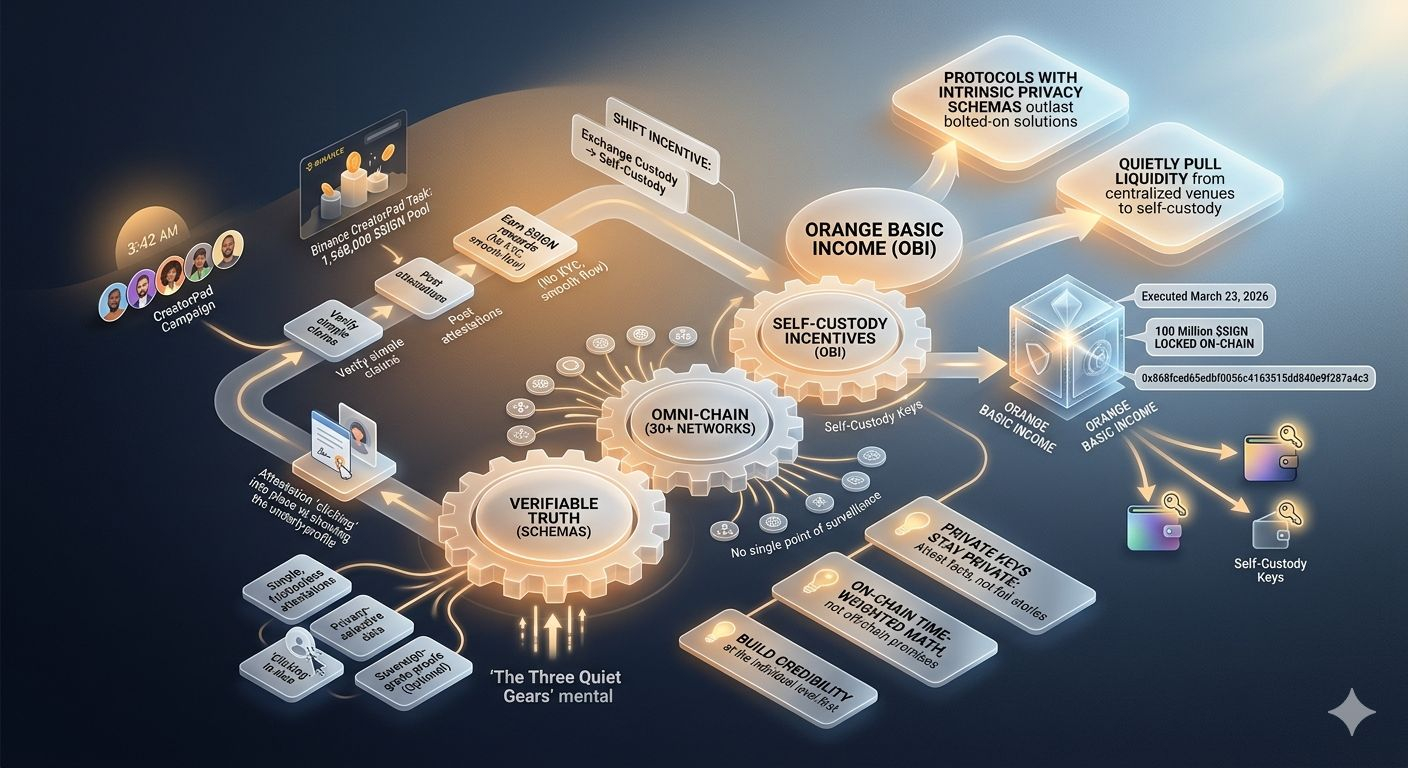
3:42 AM and this OBI lockup finally clicked
I closed a small position two nights ago, the kind that leaves your screen glowing while the rest of the house sleeps. Poured coffee, opened the SIGN dashboard out of habit, and there it was — the Orange Basic Income smart contract had executed on March 23, 2026. One hundred million $SIGN tokens locked on-chain, rewards now flowing to wallets that simply hold their own keys over time. No fanfare. Just quiet code doing what it promised. It still matters today because it quietly shifted the incentive from exchange custody to self-custody, right in the middle of a loud market cycle.
wait — this executed two nights ago
I’d been grinding through the Binance CreatorPad tasks the week before, posting attestations, verifying simple claims, collecting $SIGN rewards without once touching a leaderboard. The flow felt almost too smooth. Sign in, attest, done. No KYC theater, no extra signatures screaming for attention. That’s when the privacy-versus-verification tension hit me. SIGN lets you prove something happened — a credential, a holding period, a task completed — without broadcasting your entire wallet history. The OBI program takes it further: it rewards you for staying self-custodied, using on-chain time-weighted math instead of off-chain promises. Hmm… I caught myself staring at my own multisig, wondering if I’d actually leave the tokens there long enough to qualify.
The first actionable insight came early in the task. Default usage is dead simple — one-click attestation schemas handle the verification layer while your private keys stay private. Advanced users can build their own schemas for sovereign-grade proofs, but the protocol doesn’t force you there. It’s deliberate. Most of us benefit first from the frictionless side; nations and institutions get the heavy infrastructure later. That order feels backwards from most projects, yet it’s why the CreatorPad campaign distributed its pool so cleanly.
honestly the part that still bugs me
Here’s the mini-story that stuck. Last Thursday I was verifying a cross-chain attestation for a CreatorPad milestone. The dashboard refreshed, background checks ran invisibly, and my $SIGN reward landed before I even finished typing the post. No gas spikes, no privacy leaks. It reminded me of the old days when on-chain actions felt clunky and exposed. SIGN flips that: verification is public and immutable, but the underlying data stays selective. You attest the fact without attesting the full story. That balance is the quiet power I keep coming back to.
I sketched a simple mental model while the coffee cooled — three quiet gears. First gear: attestation schemas for verifiable truth. Second: omni-chain deployment across thirty-plus networks so no single point of failure or surveillance. Third: self-custody incentives like OBI that reward you for controlling the keys. Turn all three together and you get something rare — trust without total transparency. The flywheel isn’t loud growth hacks; it’s compounding credibility at the individual level first.
Two timely examples keep looping in my head. The CreatorPad rewards pool announced March 19 showed creators earning through real usage, not hype. Then the OBI deployment four days later locked real capital on-chain to back long-term holders. Both moves happened while prices fluctuated and Twitter noise peaked. Neither needed a press release to work. They just executed.
the moment the dashboard refreshed
Still, genuine skepticism creeps in around 4 AM. Does a time-based reward actually protect privacy, or does it just create another observable on-chain behavior that whales can game? I’ve seen enough incentive programs where the “long-term” signal becomes its own trade. SIGN’s approach feels more measured than most, yet the market will test it. Will early creators keep attesting quietly, or will the noise eventually demand louder proofs?
I keep reflecting on how this feels different from the usual cycle. Most protocols chase virality and then retrofit privacy. SIGN started with the hard part — verifiable yet selective — and is letting usage teach the rest. The sovereign infrastructure for nations is still the long play, but the daily reality for traders and creators is already here: attest once, hold your keys, earn without explaining yourself.
Two strategist-level thoughts linger as the sky lightens. First, protocols that solve privacy-versus-verification at the schema level will outlast those that bolt it on later. Second, self-custody incentives like OBI could quietly pull liquidity off centralized venues without anyone announcing a “decentralization event.” Both feel understated, almost boring. That’s probably why they might actually scale.
If you’ve been running your own attestations or testing the OBI eligibility, drop your thoughts below. I’m still tweaking my own setup and curious how it lands for others living on-chain.
One open question keeps me up: what happens when the first nation-state runs its own SIGN schema — does the privacy layer hold, or does scale finally force the trade-off everyone’s been avoiding?