

I will be honest… i used to think the Internet had already fIgured out trust.
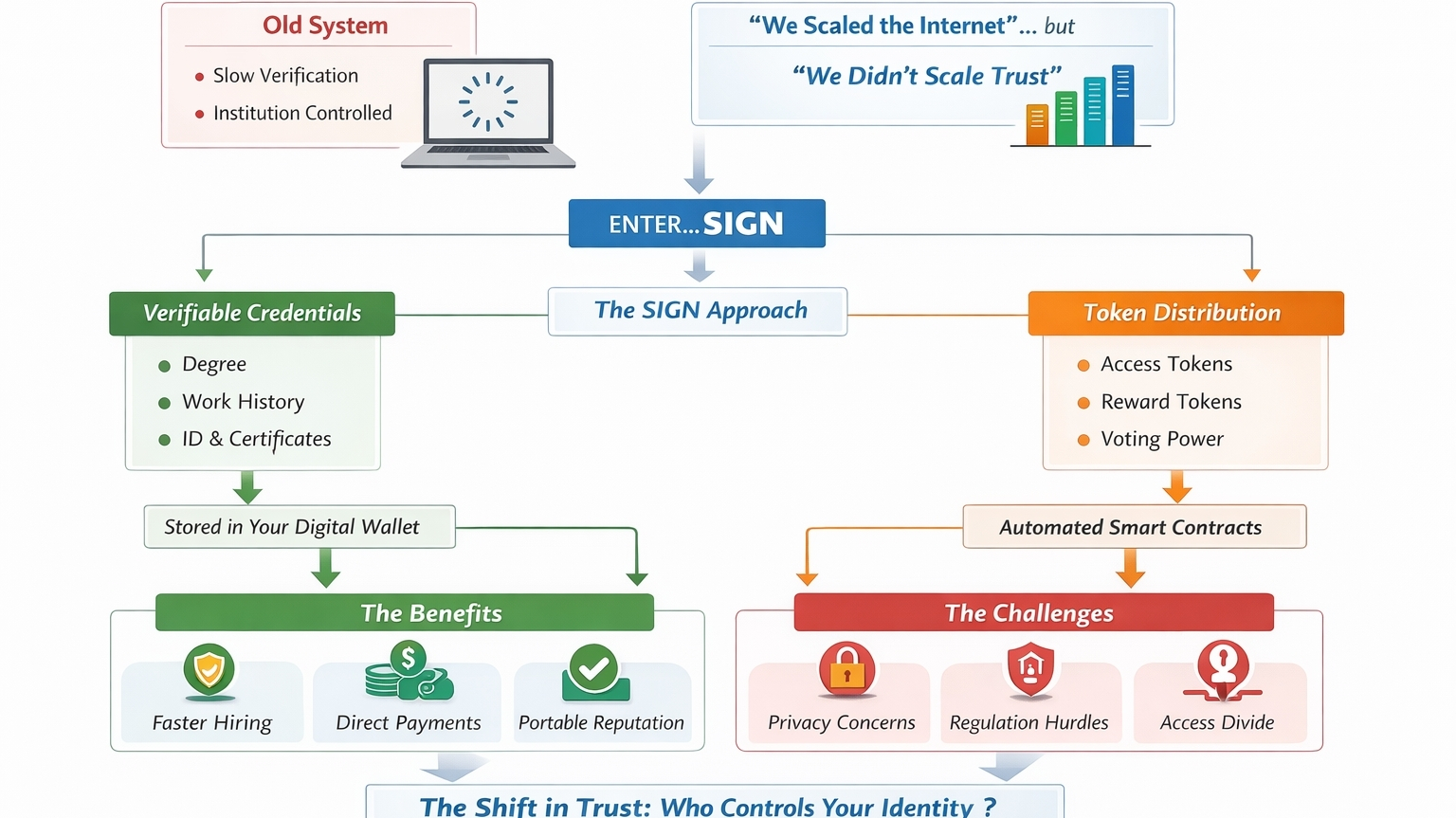
like yeah, we have got logIns, verifIcations, platforms, all that. feels smooth on the surface. but the moment you actually need to prove something real degree, experience, Identity the whole thing Slows down like it’s 2005 again.
I lIterally dealt with this not long ago. Uploaded documents, waited… checked email… nothing. That weird sIlence where you don’t even know if anyone looked at your stuff. That’s when it hit me:
we scaled the Internet.
we didn’t Scale trust.
And that’s exactly why $SIGN started making sense to me.
At first I thought it was just another “identity on blockchain” thing. You know the type… big claims, clean diagrams, sounds impressive but doesn’t really change your day to day.
But the deeper I looked, the more it felt different.
right now, your proof is scattered everywhere. Your university has your degree. some company has your work history. platforms own your reputation. every time you need to show something, you basically start from zero.
It’s annoying… but more than that, it’s inefficient.
SIGN flips that whole flow.
instead of asking someone to verify you again and again, your credentials become Proofs. Real ones. cryptographically signed, stored with you, and instantly verifiable anywhere.
No emails.
No waiting.
No “we’ll get back to you.”
Just… done.
and yeah, that sounds like a small upgrade until you really think about what changes because of it.
because once trust becomes instant, everything built on top of it speeds up too.
Hiring. Payments. Access. Reputation.
all of it stops dragging.
but here’s where it gets more Interesting and honestly a bit Uncomfortable.
this isn’t just about identity.
It’s about control.
right now, you don’t really own your credentials. You rely on institutions to confirm them. SIGN basically says: what if you carried your proof yourself?
That’s a big shIft.
your degree isn’t something your university sends it’s something you hold. your work history isn’t locked in a platform it travels with you.
And when those credentials connect with tokens (not just money, but access, rewards, permissions)… things start getting kinda wild.
like imagine your skills automatically unlocking opportunities.
Or your reputation triggering rewards without anyone approving it manually.
That’s not just efficient. that’s a different system.
and honestly, I think people are underestimating how big that shift is.
especially here… like in Pakistan.
There’s insane talent. No question. But proving that to global clients? That’s where things get messy. so people rely on platforms to act as “trusted middlemen”… and yeah, they take their cut.
now imagine you don’t need that.
your credentials are verified globally.
your reputation is portable.
anyone can check it Instantly.
that’s not just convenience. That’s leverage.
But let’s not pretend this is all perfect because it’s not.
Privacy is a real concern.
Just because something is secure doesn’t mean you want everything visible. You don’t want to expose your entire identity just to prove one detail. That’s where stuff like zero-knowledge proofs comes in proving something without revealing everything else.
Cool idea. Still maturing though.
Then there’s regulation… and yeah, we all know how slow that moves. Different countries, different rules, constant uncertainty. That alone can slow adoption a lot.
And another thing people don’t really talk about enough access.
Not everyone has stable internet. Not everyone understands wallets. If this stuff only works for people who are already ahead, then what are we really fixing?
That part matters more than the tech, in my opinion.
Still… what makes SIGN interesting is that it’s not just theory anymore.
Millions of credentials already processed. Billions in tokens distributed. Tens of millions of users. That’s not a small experiment.
It’s being tested in the real world.
And yeah, the market noticed too. You don’t get big moves for no reason something is clearly happening under the surface.
But hype doesn’t mean success.
We’ve all seen projects look strong… and then disappear.
So I’m not sitting here saying “this is guaranteed.”
What I am saying is this:
If something like SIGN actually works at scale… it becomes invisible.
You won’t think about it.
You’ll apply for something approved instantly.
You’ll prove something verified instantly.
You’ll earn something distributed automatically.
No friction. No waiting.
That’s real infrastructure.
And the crazy part?
It’s not really about tech at that point.
It’s about trust.
For a long time, we trusted institutions to tell us what’s real. Governments, universities, platforms… they’ve been the source of truth.
SIGN challenges that.
It says maybe the system itself can handle trust.
And I don’t think we’ve fully decided how we feel about that yet.
Some people are already comfortable trusting code. Others… not even close.
Both sides make sense.
But something is definitely shifting.
So yeah, this isn’t just about credentials or tokens or blockchain hype.
It’s deeper than that.
It’s about who controls your identity.
Who verifies your story.
Who decides if you’re legit.
Right now, that power mostly sits with institutions.
SIGN is basically saying: maybe it shouldn’t.
And honestly… I’m still figuring out where I stand on that.
Because changing technology is easy.
Changing what people trust?
That’s the hard part.