

I've spent enough time in this space to know the difference between a project that says it's building infrastructure and one that actually is.
Most of them announce partnerships and disappear. The roadmap gets updated, the Discord stays active, the price pumps for a week, and then nothing. You've seen it. I've seen it.
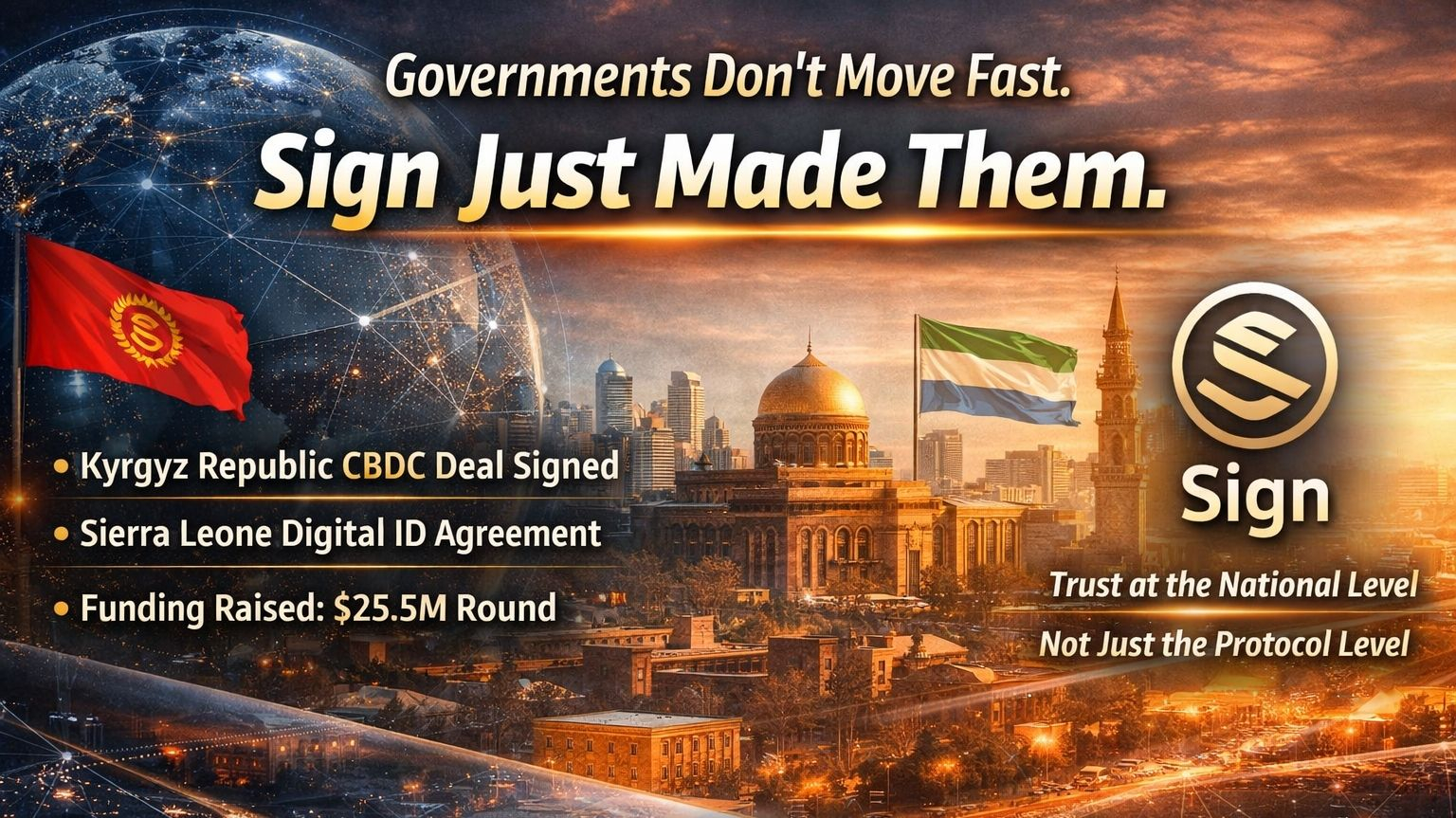
So when I say Sign is different I'm not saying it because the chart looked good for a moment. I'm saying it because they signed a technical service agreement with the National Bank of the Kyrgyz Republic. Not a letter of intent. Not a memorandum of interest. An actual agreement to build the country's central bank digital currency, the Digital SOM, with cross-border stablecoin infrastructure attached.
That deal was signed in October 2025 between Sign's CEO and the Deputy Chairman of the National Bank of the Kyrgyz Republic. The goal is to reduce transaction latency, cut operational costs, and build a foundation for blockchain-enabled public services across a country of 7.2 million people.
That's not a side project. That's a government saying: we trust this infrastructure with our money system.
And it didn't stop there. A few weeks later Sign signed an MoU with Sierra Leone's Ministry of Communication, Technology and Innovation to develop the country's blockchain-based digital ID and stablecoin payment infrastructure. Two sovereign deals in two weeks. You don't see that often.
Now here's where I slow down. Because excitement is cheap and context is everything.
What Sign is actually building is something most people mislabel. They hear "attestation protocol" and glaze over. But strip the jargon and the concept is simple. An attestation is a portable, verifiable proof that can travel across systems and time. It encodes a statement, binds it to an issuer, and makes it verifiable later. That's it. Your degree, your identity, your transaction history — any of it can become a proof that doesn't need a middleman to confirm every single time someone asks.
The reason governments care about this is because they've been running on paper trust for decades. Databases that don't talk to each other. Agencies that request the same documents over and over. Citizens who have to prove things they already proved five years ago.
Sign's architecture covers three foundational systems: a new money system for CBDCs and stablecoins, a new identity system for verifiable credentials at national scale, and a new capital system for programmatic allocation of grants, benefits, and compliant capital programs.
That's not one product. That's an entire operating layer for how a country runs its digital infrastructure.
I find myself thinking about what that actually means at ground level. A citizen in Sierra Leone gets a digital ID issued once, cryptographically signed, and permanently verifiable by any system connected to Sign's attestation layer. They don't re-prove it at the bank, at the border, at the benefits office. The proof travels with them.
That shift is bigger than most people are willing to say out loud.
But I also keep a running list of things that can go wrong. And with Sign, the list isn't short.
The token's all-time high was $0.1282 back in September 2025. It's currently sitting around $0.034, which means it's down over 73% from that peak. So if you came in at the top, you're hurting. That's a real number. Not something to brush aside with "long-term vision" talk.
There's also a token unlock coming — 290 million SIGN representing about 21% of circulating supply, the largest dilution event since April 2025. That kind of supply hitting the market creates pressure regardless of how good the fundamentals look. I'm not going to pretend otherwise.
And sovereign deals are notoriously slow. Governments move at government speed. Sign's own documentation acknowledges that the path to real infrastructure is never linear. Regulatory complexity, political shifts, procurement cycles any one of those can stall even the most legitimate project for months.
What keeps me watching though is the funding trajectory. Sign closed a $25.5 million investment round in October 2025 led by YZi Labs, with IDG Capital also participating. Before that, in January 2025, they had already closed a $16 million Series A also led by YZi Labs. The same lead investor coming back for a second round is a signal. Institutions don't double down on noise.
With that capital Sign is now hiring specialists in zero-knowledge proofs and cross-chain interoperability. That's not marketing spend. That's technical build-out. And zk-proofs matter here specifically because the hardest problem in identity infrastructure isn't verification. It's privacy-preserving verification. Proving you qualify for something without revealing everything else about yourself. That's the hard version of this problem and Sign is staffing for it.
The on-chain numbers also tell a story. Active addresses and total value locked in Sign-enabled contracts rose 120% since mid-2025. That's usage, not just price speculation.
Here's the thing I keep coming back to though.
Trust at the national level is a different category of problem than trust at the protocol level. A DeFi dApp that gets hacked loses users. A government digital ID system that gets compromised loses something harder to rebuild: the belief that the state can protect your identity. The stakes are asymmetric. One bad incident in a live sovereign deployment sets back the entire sector.
So when I evaluate Sign I'm not just asking whether the tech works in a test environment. I'm asking whether it holds when a government's infrastructure is under real stress, with real adversaries, at real scale.
That answer we don't have yet. Nobody does. The deployments are new. The pressure tests haven't happened in the wild.
Sign describes itself as dual-focused: a B2G infrastructure provider and a B2C ecosystem builder through its protocol and SuperApp. That dual track is smart in theory and genuinely difficult in practice. B2G sales cycles take years. B2C requires retention and UX that most infrastructure teams aren't built for. Doing both simultaneously while managing sovereign partnerships across multiple continents is an operational stretch.
I'm not saying they can't pull it off. I'm saying I watch carefully when a project tries to win on two very different fronts at the same time.
What I do believe is that the problem Sign is solving is real, the demand from governments is real, and the execution so far is more concrete than what I typically see at this stage. Two sovereign agreements, two funding rounds, on-chain metrics moving upward.
Whether that translates to token price recovery in the near term, I genuinely don't know. Too many variables. Unlock pressure, macro conditions, how fast these government deployments actually get rolled out.
What I know is this. The projects that end up mattering aren't the ones that peaked in a bull cycle. They're the ones still building when everyone else got bored and moved on.
Sign is still building.
Whether you position around that is your call. Just make sure you understand what you're actually investing in not the token chart, but the infrastructure thesis underneath it. Because that's where the real bet lives.