
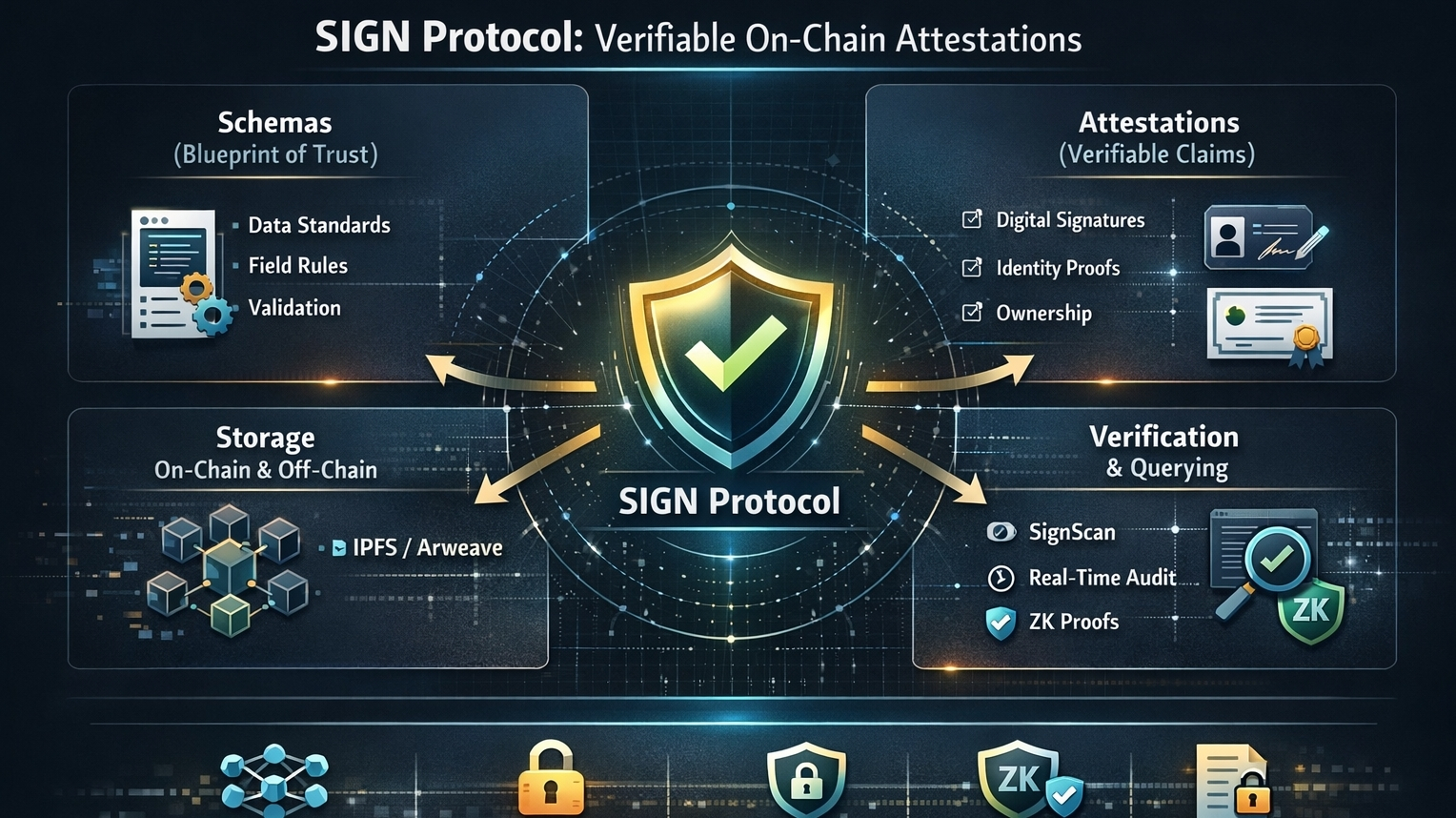
In the evolving landscape of Web3, trust is no longer derived from centralized authorities but from verifiable data and cryptographic proofs. SIGN Protocol provides a standardized infrastructure that enables this shift by allowing users to create, store, and verify attestations across multiple blockchains.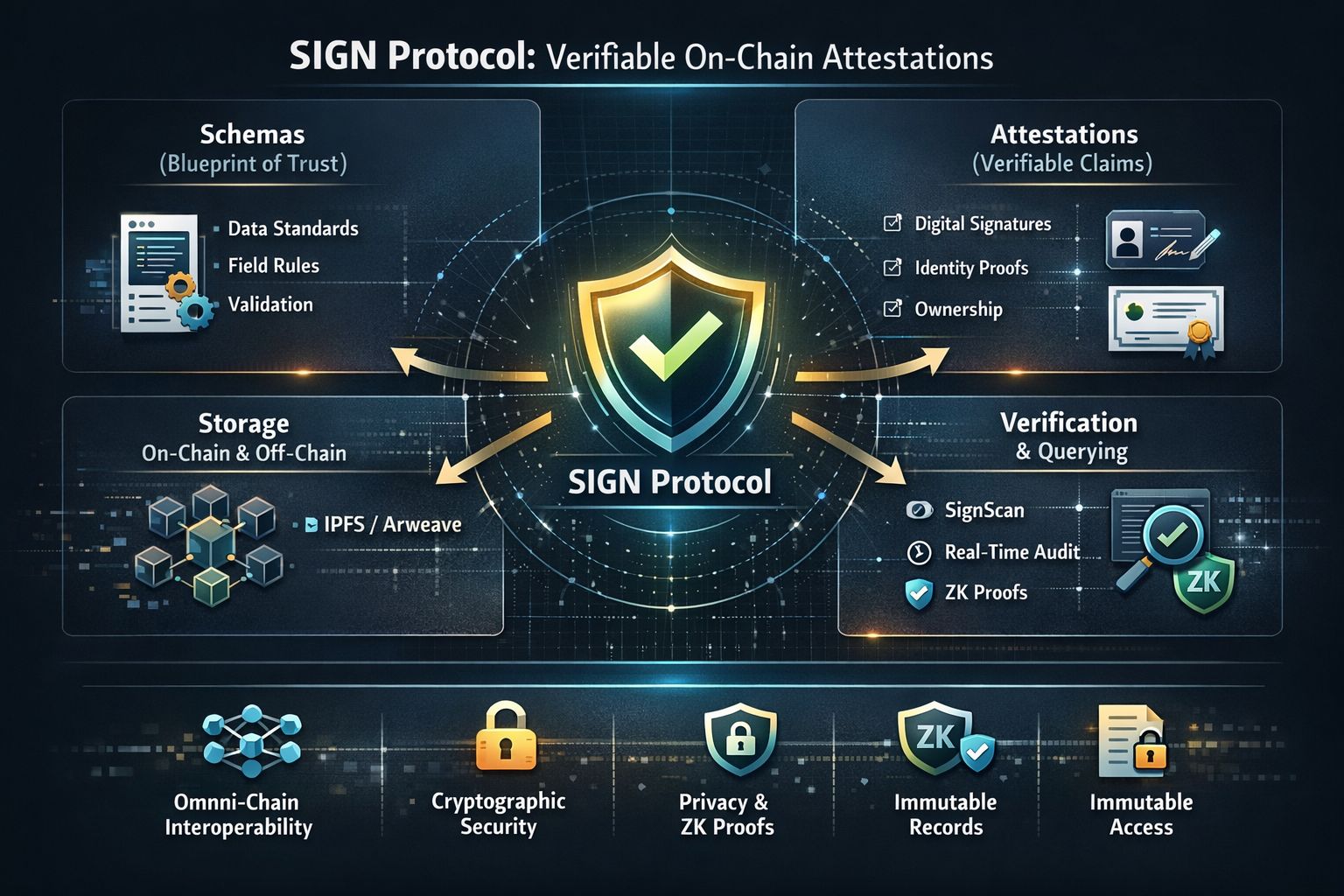
At its core, it functions as an evidence and attestation layer, transforming claims into structured, verifiable, and reusable digital proofs.
What is SIGN Protocol?
SIGN Protocol is an omni-chain attestation protocol that enables users, developers, and institutions to create and verify claims across different blockchain ecosystems.
Instead of relying on intermediaries, it leverages:
Digital signatures
Decentralized storage (such as IPFS and Arweave)
Blockchain anchoring
Zero-knowledge proofs
This approach turns data into portable and verifiable proof, similar to a decentralized digital notary system.
Core Components of SIGN Protocol
1. Schemas (The Blueprint of Trust)
Schemas define the structure and meaning of attestation data. They act as templates that specify:
Data types
Field structures
Validation rules
Versioning
By standardizing data formats, schemas ensure that attestations are consistent, machine-readable, and interoperable across systems.
2. Attestations (Verifiable Claims)
An attestation is a digitally signed statement that confirms a fact or claim.
In SIGN Protocol, attestations are:
Structured according to schemas
Signed using cryptographic keys
Stored on-chain or off-chain
This allows anyone to independently verify the authenticity of a claim without relying on trust.
3. Storage Flexibility (On-Chain & Off-Chain)
SIGN Protocol supports hybrid data storage:
On-chain: Provides immutability and transparency
Off-chain: Offers scalability and cost efficiency
This design balances security and performance, enabling support for both small and large datasets.
4. Verification & Querying
The protocol enables efficient querying and validation of attestations, allowing users to:
Retrieve data across chains
Verify claims programmatically
Audit historical records
This ensures that attestations remain accessible, transparent, and verifiable in real time.
Key Features
• Omni-Chain Interoperability
Operates across multiple blockchains, allowing seamless verification regardless of the network.
• Cryptographic Trust
Every attestation is secured with digital signatures, ensuring tamper-proof authenticity.
• Privacy & Selective Disclosure
Supports advanced cryptographic techniques that allow users to share only necessary information.
• Standardized Data Structures
Schemas provide a universal format, making attestations reusable across applications.
• Immutable Audit Trails
Creates permanent and transparent records that enhance accountability.
Use Cases
1. Digital Identity & Credentials
Enables issuance of verifiable identities, certificates, and licenses.
2. Token Distribution & Governance
Supports transparent airdrops, rewards, and decentralized governance mechanisms.
3. Compliance & Auditing
Allows organizations to record regulatory checks as verifiable data.
4. Reputation Systems
Transforms user activity into verifiable on-chain reputation.
Why SIGN Protocol Matters
Traditional systems depend on centralized verification, leading to inefficiencies and trust limitations. SIGN Protocol introduces a decentralized trust layer where:
Claims are independently verifiable
Data is portable across platforms
Trust is based on cryptographic proof rather than intermediaries
This approach enables a more open, transparent, and reliable digital ecosystem.
Conclusion
SIGN Protocol is redefining trust in Web3 through verifiable on-chain attestations. By combining structured schemas, cryptographic signatures, and cross-chain infrastructure, it converts data into trusted digital evidence.
As decentralized technologies evolve, such systems will play a critical role in enabling secure identity, transparent governance, and trustworthy digital interactions, forming the backbone of a trustless internet.
#SignDigitalSovereignInfra #blockchain #BinanceSquareFamily #Web3 #Binance