Bitcoin is currently trading around $66,000, which already tells you one important thing: this is still one of the most watched assets in the world, even after the huge run-up and the pullback from its peak. It is no longer just a niche crypto trade. Bitcoin now sits in the middle of a much bigger financial conversation, and its price reflects that.
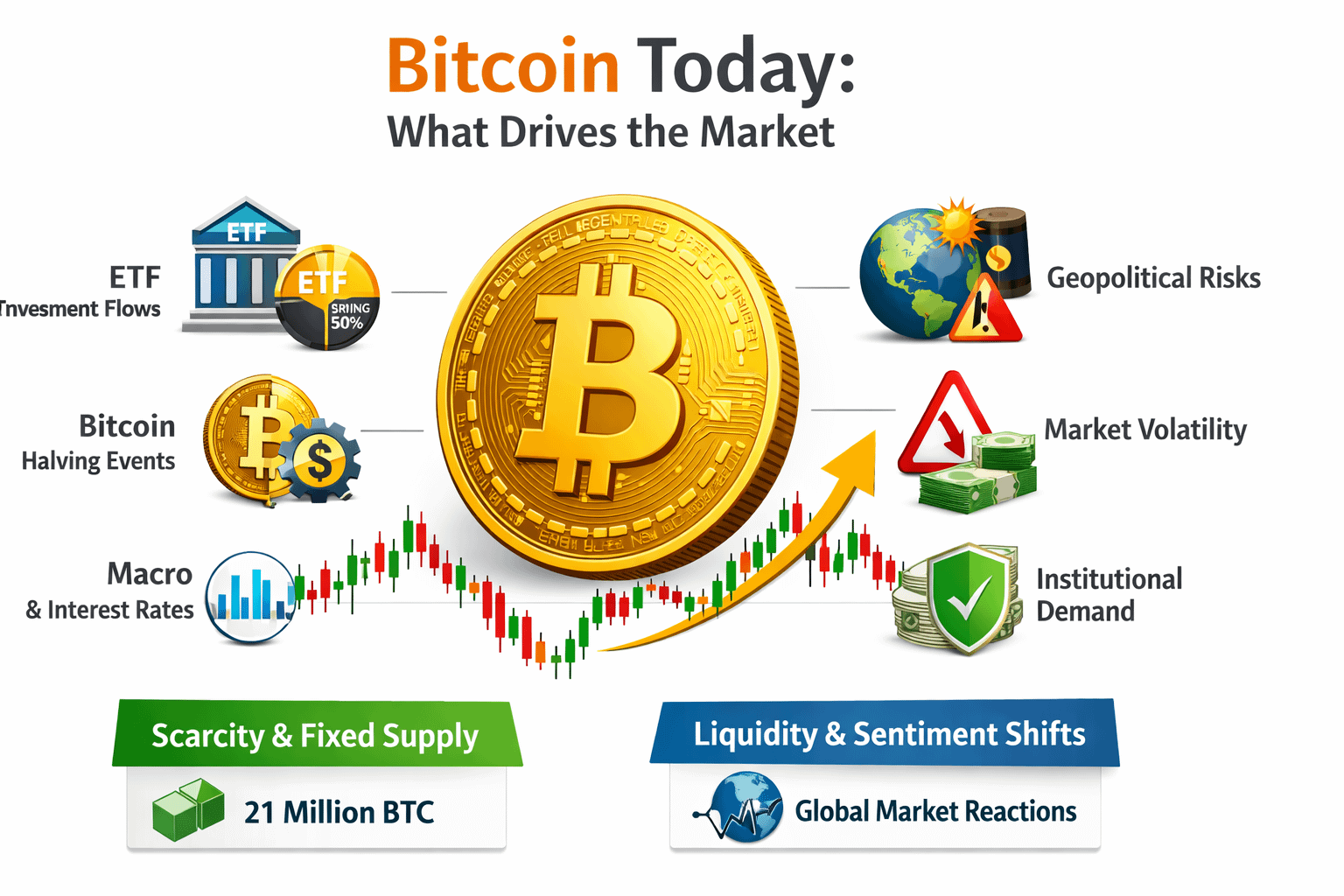
A few years ago, Bitcoin moved mostly on crypto-native momentum. Hype, leverage, exchange flows, and retail excitement were doing most of the work. That is not the full picture anymore. Today, Bitcoin reacts to a much broader set of forces. Institutional money matters more. ETF flows matter more. Interest rates matter more. Global risk sentiment matters more. The market has grown up, even if the volatility never really left.
One of the biggest turning points came when the U.S. approved spot Bitcoin ETFs. That changed access in a very real way. A lot of investors who were never going to open a crypto wallet or move coins across exchanges suddenly had a simple and familiar way to get exposure. That made Bitcoin easier to buy, easier to hold, and easier to fit into a traditional portfolio. It was not just a headline event. It changed the structure of demand.
That matters because Bitcoin’s price is not driven only by belief. It is driven by who can access it, how easily they can access it, and how much capital can flow into it without friction. The ETF era made Bitcoin feel less like a side market and more like an asset that Wall Street now has to take seriously.
At the same time, Bitcoin still has its original supply story working in the background. The halving reduced the amount of new Bitcoin entering circulation, which is always a major event for the market. It does not guarantee a rally, and anyone saying it does is oversimplifying things, but it does tighten supply over time. When demand stays strong or even improves while new issuance drops, the market pays attention.
Still, supply alone does not explain Bitcoin’s price. Macro conditions play a huge role now. Interest rates, inflation expectations, central bank signals, and broader market risk appetite all affect how investors behave. When rates stay high, money tends to be more cautious. Risk assets feel heavier. Bitcoin is not immune to that. It may have its own long-term identity, but in the short run it still trades inside a global financial system shaped by liquidity and sentiment.
That is why Bitcoin can look strong over a long arc but still feel unstable day to day. In one week it can rally on optimism, then drop sharply on macro fear, geopolitical tension, or liquidation pressure. That does not mean the asset is broken. It means Bitcoin has become big enough to react to the same kinds of stress that hit other major markets.
This is where a lot of people get confused. They try to explain every Bitcoin move with one narrative. Sometimes they blame ETFs. Sometimes they point only to macro. Sometimes they reduce everything to halving cycles. In reality, Bitcoin’s price usually sits at the intersection of all of these things. Supply matters. Access matters. Liquidity matters. Sentiment matters. None of them work alone.
That is also why Bitcoin remains such a fascinating asset to watch. It still carries the core long-term thesis that made people pay attention in the first place: limited supply, global portability, and independence from traditional monetary systems. But it now trades in a market that is more institutional, more interconnected, and more demanding than before. The easy narratives no longer hold up as well.
Right now, Bitcoin trading near the mid-$60,000 range suggests a market that still sees strong value in the asset, but not with blind confidence. The excitement that once pushed it to record highs has cooled, yet the market has not abandoned it. That middle ground is important. It tells you Bitcoin is no longer just a speculation story. It is being priced as a serious asset, but one that still has to earn its stability.
The clearest way to read Bitcoin prices today is this: the asset has matured, but the volatility remains. ETF access brought in new demand. The halving reduced fresh supply. Macro conditions continue to set the tone. And because all three are active at the same time, Bitcoin remains powerful, fragile, and extremely sensitive to the mood of the market.
That is what makes Bitcoin different. It is not dead when it drops, and it is not invincible when it rallies. It is simply one of the clearest reflections of how modern markets price scarcity, risk, and belief in real time.