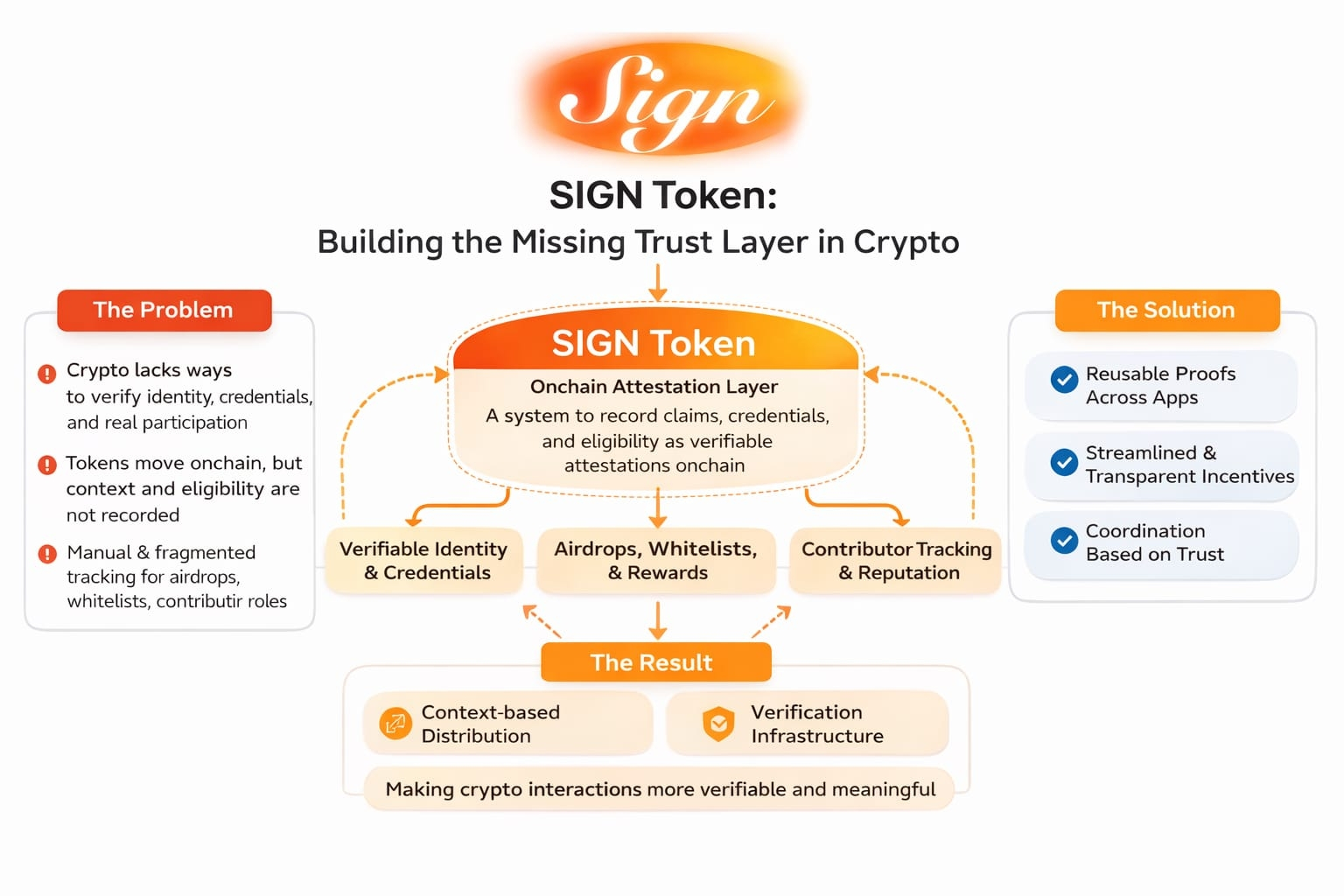
Crypto has always been good at recording movement,but much less effective at recording meaning. A wallet can show that tokens moved,but it rarely explains why they moved,whether the recipient was eligible,or what conditions were met. As the industry shifts toward coordinating real work funding contributors,distributing incentives,and organizing decentralized groups this missing layer becomes more than an inconvenience. It becomes a structural limitation. This is the gap SIGN is trying to address.
The idea behind SIGN is relatively straightforward:create a system where claims,credentials,and eligibility can be recorded as verifiable attestations onchain,and then reused across applications. Instead of every protocol rebuilding its own fragmented logic for whitelists,airdrops,or contributor tracking,attestations act as shared pieces of truth. If someone has already proven something once,that proof can travel with them. In that sense,SIGN feels less like a typical token project and more like infrastructure for coordinating trust.
This matters now because crypto is entering a phase where capital allocation is becoming more selective. Airdrops are no longer just marketing events;they’re attempts to reward real participation. DAOs are trying to identify meaningful contributors rather than passive token holders.Even outside governance,projects need ways to verify identities,credentials,and behavior without relying on centralized databases. SIGN’s approach to attestations fits directly into this shift.It provides a framework for encoding context alongside transactions,which is something the base layer of most blockchains does not handle well.
The broader ecosystem around SIGN reinforces this positioning.Tools like TokenTable suggest a focus on structured token distribution,while EthSign points toward document verification and agreement layers. Together,they form a stack that revolves around one core idea:making offchain intent and agreements legible and enforceable in an onchain environment. The token itself appears to function as a coordination mechanism within this system,rather than a simple store of value. Its role is tied to usage,participation,and potentially governance,though the exact boundaries of that role still carry some ambiguity.
From an investor’s perspective,the strength of SIGN lies in its alignment with a real and growing need. Distribution infrastructure and identity layers are not as visible as DeFi or NFTs,but they are increasingly critical. If crypto is to support more complex system grants,payroll,reputation then something like attestations becomes necessary. However,this also introduces a challenge. Infrastructure projects often depend on adoption by other builders,which can take time and is difficult to predict. The token’s value,therefore,is indirectly tied to how widely these tools are integrated.
For builders,SIGN offers a modular way to outsource trust. Instead of designing custom verification systems,they can plug into a shared attestation layer. This reduces redundancy but also introduces dependency. If the ecosystem around SIGN fails to reach sufficient scale,its usefulness becomes limited. There’s also a broader philosophical risk:encoding identity and reputation onchain raises questions about privacy,permanence,and potential misuse. Not every form of verification should be immutable,and navigating that balance will be critical.
The opportunity is clear,but so are the uncertainties.SIGN operates in a space that doesn’t yet have a dominant standard. Competing approaches to identity and reputation are emerging,and it’s not obvious which model will gain traction. The token itself does not automatically capture the value of the network unless its role is tightly integrated with usage. Without that alignment,there’s a risk of disconnect between the infrastructure and the asset tied to it.
What stands out is that SIGN is not trying to solve a surface level problem. It is addressing something more foundational:how to make crypto interactions more meaningful and verifiable without relying on centralized intermediaries.That’s a difficult problem,and the path to adoption is unlikely to be linear.But it’s also a problem that becomes harder to ignore as the industry matures.
The practical takeaway is that projects like SIGN should be evaluated less on short term narratives and more on whether they become embedded in how systems actually operate. If attestations become a standard building block for distribution,identity,and coordination,then the underlying infrastructure gains real weight. If not,the token risks existing in a space where the idea is sound but the usage never compounds.For participants in the market,the key is to watch not just the token,but the behavior it enables and whether that behavior starts to matter.
@SignOfficial $SIGN #signdigitalsovereigninfra