
In crypto, attention almost always goes to what is visible first. Price, volume, listings, token unlocks, hype cycles, and social momentum dominate the conversation. These metrics move fast and are easy to track, which is why they attract so much focus. But the systems that tend to matter most over the long term are rarely the loudest ones. They operate quietly in the background, solving structural problems that most people overlook. One of the most important yet underappreciated categories today is verification infrastructure.
Web3 was built on the idea of trustless systems, where intermediaries are removed and code replaces human judgment. However, in practice, the reality is more complicated. Across ecosystems, the same issues keep appearing: fake identities, sybil attacks, airdrop farming, bot-driven governance, and the absence of a reliable reputation layer. As a result, protocols often struggle to distinguish between genuine users and those exploiting the system. This creates a fundamental gap where even in a trustless environment, some form of trust verification becomes necessary.
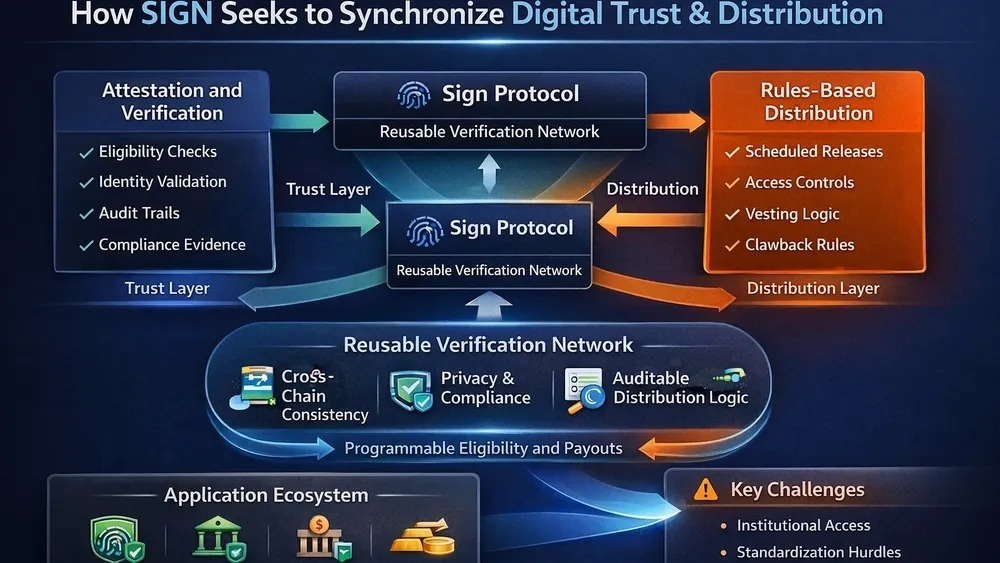
This is where verification infrastructure comes in. Its role is simple in concept but powerful in impact: to prove that a user is genuine without compromising their privacy. By doing so, it enables a more balanced and fair ecosystem. It helps ensure that one user corresponds to one valid identity, improves the fairness of airdrops, strengthens governance mechanisms, and builds meaningful on-chain reputation systems. Projects like SIGN operate within this space, focusing not on hype or visibility, but on strengthening the integrity of the ecosystem itself. They may not be flashy or meme-driven, but they have the potential to become a foundational layer for Web3.
In every cycle, new blockchains emerge promising faster speeds, lower fees, and better scalability. While these improvements are valuable, they often overlook a deeper question: how reliable is the user and identity layer? If governance can be manipulated, if bots dominate reward distribution, and if reputation can be easily faked, then even the most advanced blockchain remains fundamentally flawed. Verification infrastructure addresses these root-level issues. It does not necessarily make systems faster, but it makes them more trustworthy and fair, which is ultimately more important for long-term adoption.
Looking at Web3 as a stack, blockchains form the base layer, smart contracts and dApps make up the execution layer, and applications like DeFi, NFTs, and SocialFi sit at the top. However, a critical piece has been missing: a robust identity and reputation framework. Verification infrastructure fills this gap, connecting all layers and ensuring that incentives remain aligned. Without it, systems are easily exploited, incentives break down, and genuine users become discouraged. With it, value is distributed more fairly, communities become stronger, and developers gain access to more reliable data.
Despite its importance, this sector remains undervalued. The reason is simple: it does not generate hype. Verification infrastructure is harder to explain, slower to monetize, and less appealing for short-term speculation. As a result, it is often ignored by retail investors. However, builders and long-term capital are increasingly paying attention to this space because they recognize it as a necessity rather than a trend.
The market itself is gradually maturing. The focus is shifting away from simply finding the next big blockchain and toward deeper layers such as data authenticity, identity verification, and on-chain reputation. These may seem less exciting on the surface, but they are essential for enabling the next phase of adoption. In the future, competition will not only be about speed and cost, but also about how effectively a system can verify and trust its own participants.
Ultimately, the future of crypto is not just about faster transactions or cheaper networks. The real question is whether the system can reliably identify and trust its users. If the answer remains no, growth will always face limitations. But if the answer becomes yes, Web3 can evolve into a far more robust and scalable ecosystem. Projects like SIGN are working on this silent but critical layer, and sometimes, the most powerful innovations are the ones that make the least.