
@SignOfficial #SignDigitalSovereignInfra $SIGN
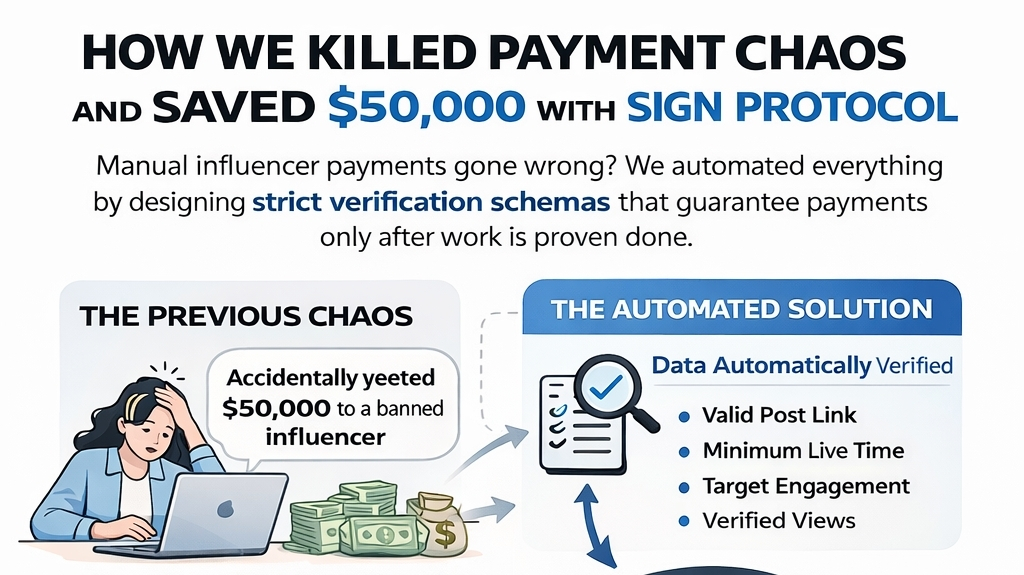
Let’s be real, nothing ruins a Tuesday afternoon quite like realizing you just accidentally yeeted $50,000 into the void. That was us on February 3rd. Our finance controller, Sarah, was staring at her screen in sheer panic because we had just paid an influencer who straight-up ghosted us. We were running massive influencer campaigns across Southeast Asia, and our process was... well, "classic crypto startup chaos" is putting it nicely. It was a mess. An influencer would post, someone on our team would screenshot it, drop the pic in Slack, tag Sarah, and pray. Sometimes we got legit analytics, but other times we got blurry screenshots that looked like they were taken with a potato. Sometimes the post was already deleted by the time the payment cleared. Sarah was juggling fifteen of these manual payments a day, and inevitably, she ended up paying a TikToker whose account had been nuked for policy violations three days prior. The money was gone, and the campaign was dead.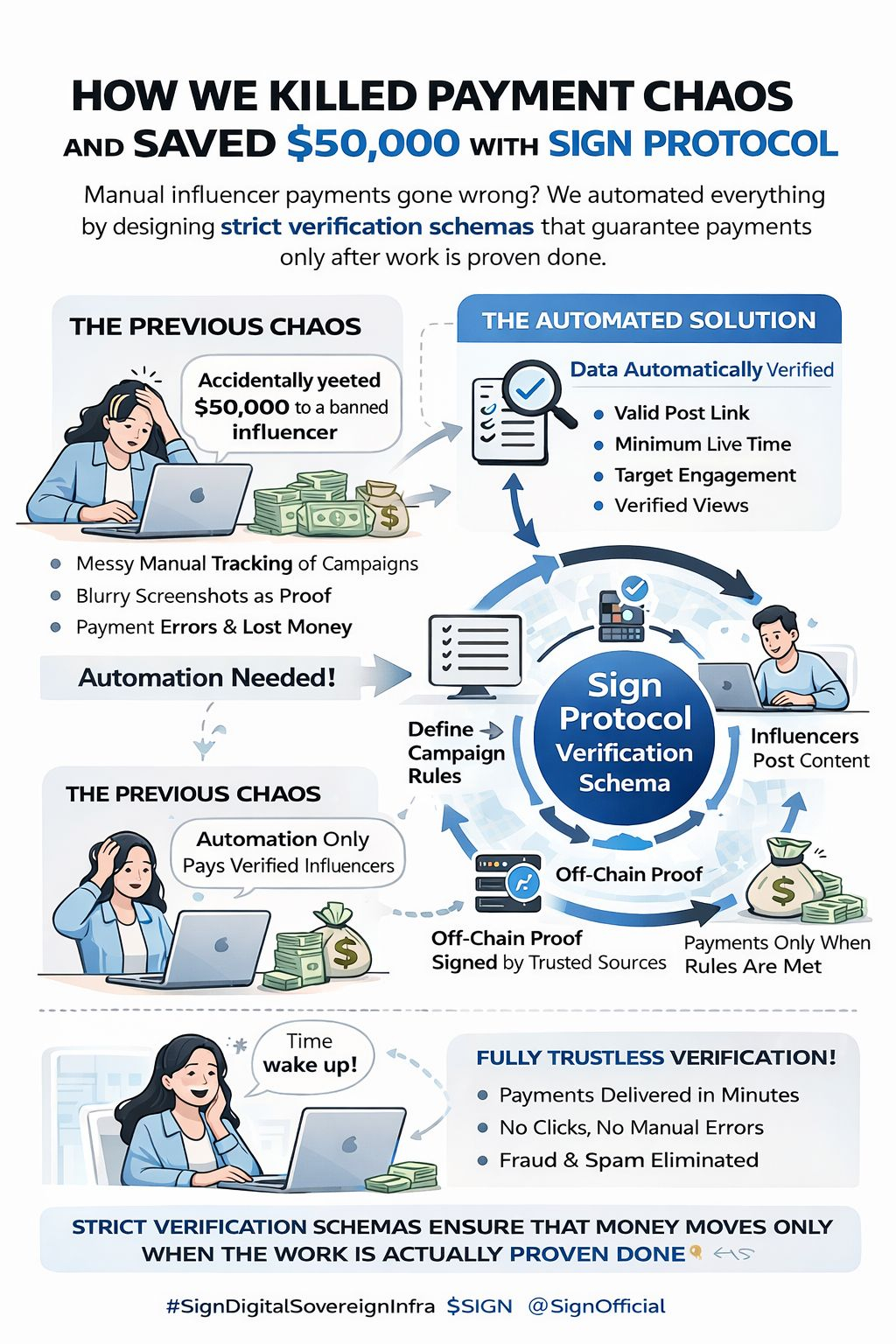
Enter our CEO, who walked over to my desk with that look and dropped a bomb: "Fix this. I don’t want 'faster manual clicking.' I want actual automation. Money only moves when the work is actually proven done." Challenge accepted. I spent days looking into crypto payment tools. Most of them were just shiny interfaces that still required some poor soul to click "approve." Smart contracts were great for simple binary stuff, but they completely fell apart when faced with the messy reality of influencer marketing. I had to figure out if a post was live, if the views were real, and if it hit our targets. Then I stumbled onto Sign Protocol and their schema design framework. It was a total lightbulb moment. Instead of writing crazy complex code, you just define a super strict format for proof. If the incoming data matches your exact rules, the money moves. No human eyeballs needed. The system just validates the facts.
I sat down with the team to figure out what actually mattered for a campaign to be successful. We cut all the fluff and boiled it down to four non-negotiables: a platform-verified post URL, a minimum 12-hour live duration, a target engagement rate, and a third-party audit proving the views weren't bot traffic. Translating this into Sign Protocol was surprisingly easy. I mapped out our rules into a schema with specific fields for the campaign ID, post URL, timestamp, engagement rate, audit hash, and recipient address. I named it 'InfluencerCampaignVerification_v1'. We put the heavy proof data off-chain to save on gas fees, and kept the attestation hash on-chain so nobody could tamper with it. But I didn't just YOLO it into production. I spent days trying to break it in a sandbox. I found a few bugs, like the system freaking out over decimals, and instead of tweaking the live schema, I made a clean version two. I established a strict rule to never edit a live schema mid-flight because it ruins the audit trail.
Pitching this to the team was spicy. Our campaign manager, Lisa, argued that I was replacing her judgment with a robot and worried about auto-rejecting influencers who were late but still delivered. I gently reminded her about the $50k mistake and explained that we weren't losing human judgment; we were just moving it to the design phase. We decide upfront what counts as valid, rather than relying on whoever is the least tired on a Tuesday afternoon. Sarah thought I was trying to automate her out of a job, so I had to show her that this actually upgraded her role. She wasn't a button-clicker anymore; she was the architect of the rules who could audit everything instantly on-chain without digging through ancient Slack threads. We ran a test in late February with half the campaigns running manually and the other half automated. The results were almost embarrassing for the old system. Manual payments took four days and had three disputes, while the automated schema payments took four minutes with zero disputes.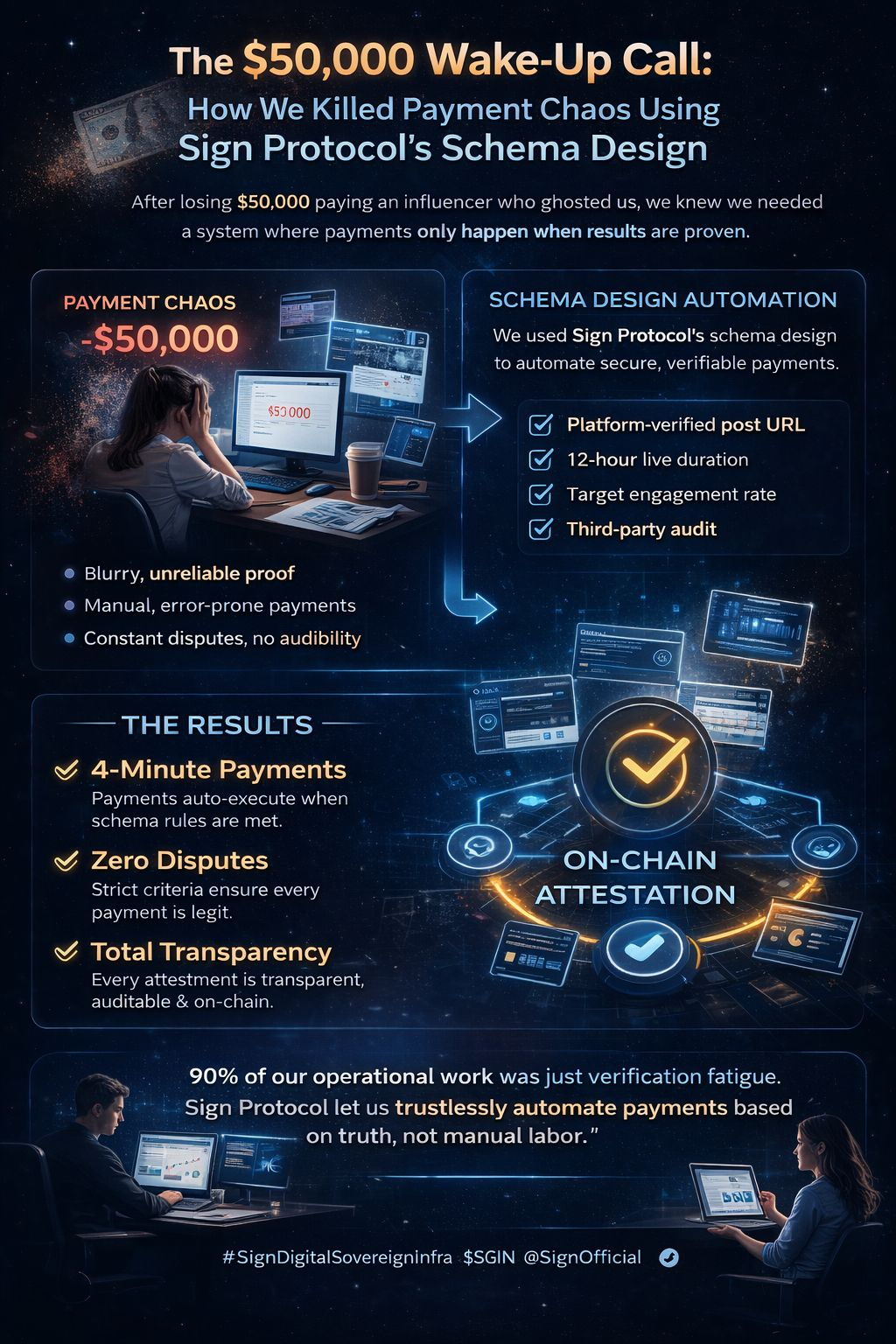
By March 5th, we went all-in. The crazy thing this whole ordeal taught me is that most of our "operational work" wasn't really work. It was just "verification fatigue"—humans double-checking the same dumb facts because we didn't have a system that could trustlessly verify them. And it’s not just us doing this. Sign Protocol is scaling like crazy, with their schema adoption jumping from four thousand to four hundred thousand in a year. They've moved over $4 billion through Token Table, bringing crypto back to its actual promise: trustless verification where value moves automatically based on truth, not just because someone said so. Our campaign team is smaller now, but their jobs are way cooler. They design schemas and look for fraud instead of copying and pasting links into spreadsheets. If you're going to try this, my biggest advice is to keep it simple, start with one core rule, test the hell out of it, and never edit live schemas. Garbage rules in means perfectly automated garbage out. Honestly, using "free" manual tools ended up costing us $50,000 and the sanity of six people. Building actual infrastructure via schema design isn't a magic wand, but it forces you to be honest about what verification actually costs and what you actually value.
#SignDigitalSovereignInfra $SIGN
