Sign Protocol becomes more interesting the moment you stop trying to fit it into a clean category and start looking at the problem it is actually dealing with. Most crypto projects try to simplify themselves into neat narratives like identity, infrastructure, compliance, or payments, but that framing often hides the real issue underneath. The deeper problem is not about what these systems are called, it is about how badly they handle continuity. Today, most digital systems can verify something once, but they fail the moment that proof needs to be reused somewhere else. The meaning gets lost, the context disappears, and suddenly what was verified just minutes ago has to be rebuilt again from scratch. This is the kind of friction that does not show up in pitch decks but defines the real user experience. That is where Sign Protocol starts to feel different. It is not just about creating attestations or storing data, because that part is already solved in many ways. The real challenge is whether that proof can remain useful after it is created. Can it move across systems without losing its structure, its intent, or its reliability? Can it carry enough clarity that another system can act on it without needing humans to step in and manually interpret what it means? Most systems fail here. They treat verification as a final step instead of the beginning of a process. So even though something gets verified, it does not translate cleanly into action. Access decisions become inconsistent, rewards require additional checks, compliance turns into manual review, and everything slowly drifts back into inefficiency. What makes this more than just a technical inconvenience is that it creates a constant break in trust. Not because the data is wrong, but because it cannot be used with confidence once it leaves its original environment. One system might validate a claim, but another system cannot rely on it without rechecking everything. That gap is where friction grows. It is where users repeat the same steps, where teams rebuild the same logic, and where processes that should be seamless turn into fragmented workflows. Sign Protocol seems designed around reducing that exact gap, focusing less on the act of proving something and more on preserving its meaning while it moves through different layers. This is also why the project feels heavier compared to most crypto narratives. It is not built around excitement or quick adoption cycles, it is built around solving something that is structurally broken. There is no flashy moment where everything suddenly looks revolutionary. Instead, the value shows up quietly when systems start behaving consistently, when decisions can be traced clearly, and when outcomes no longer depend on hidden manual steps. That kind of reliability is not easy to market, but it is what determines whether infrastructure actually works in the long run. At the same time, this is not something that can be judged based on design alone. Crypto has seen many projects that looked complete in theory but failed when exposed to real conditions. The real challenge is not defining the problem correctly, it is surviving the complexity that comes with it. Real systems are messy. They include exceptions, conflicts, changing rules, and unpredictable interactions between different components. This is where most well-structured ideas start to break down, because maintaining both flexibility and integrity at scale is extremely difficult. That is why the real test for Sign Protocol is not whether it sounds coherent or well-positioned. It is whether it can handle those messy conditions without losing the structure of trust it is trying to preserve. When multiple systems interact, when rules evolve over time, when different participants rely on the same proof for different outcomes, the system needs to maintain consistency without forcing everything back into manual verification. If it cannot do that, then it risks becoming just another layer that adds complexity instead of removing it. What makes this worth paying attention to is that the project seems aware of that challenge. It does not treat trust as something static that sits inside a database, but as something that needs to move, adapt, and still remain reliable. That is a much stronger starting point than simply focusing on storing or verifying information. Because in practice, the value of proof is not in its existence, but in its ability to influence real outcomes without being questioned every step of the way. There is still a level of caution here, and that is necessary. The crypto space has made it clear that clean ideas do not automatically translate into durable systems. Many projects can explain their purpose in a way that sounds convincing, but very few can maintain that clarity when exposed to scale and real-world complexity. So the focus should not be on how well Sign Protocol defines the problem, but on how it performs when that problem becomes real and unavoidable. If it can maintain continuity, if it can allow proof to carry meaning instead of resetting at every step, then it moves beyond being just another narrative in the market. It becomes something more foundational, something that reduces friction in a way that actually matters. And in a space where most solutions still rely on repetition and manual intervention, that kind of shift is not just useful, it is necessary.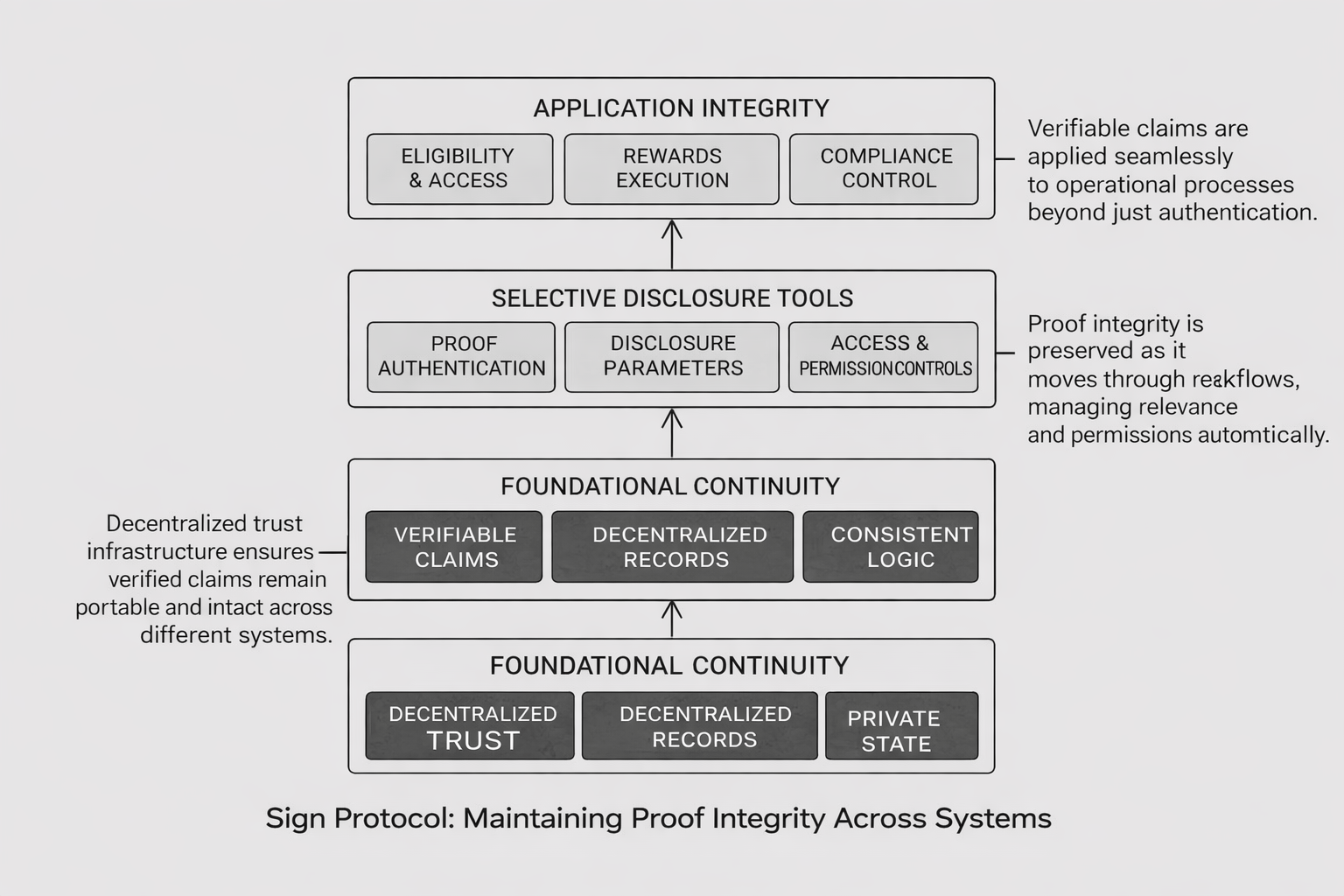

Articolo
When Proof Stops Resetting and Starts Carrying Meaning Across Systems

--
Disclaimer: Include opinioni di terze parti. Non è una consulenza finanziaria. Può includere contenuti sponsorizzati. Consulta i T&C.