
My father spent three weeks completing paperwork for a small land purchase when I was young, and honestly the bureaucracy involved made absolutely no sense to anyone going through it 😂
Weeks of back and forth between government offices just to confirm the seller had the legal right to sell. And after all of that the deed ended up In a drawer where it sat for years because that is simply how land ownership works in most of the world. Paper Drawers Offices that open whenever they feel like it.
Been going through TokenTable,s real world asset tokenizatiOn architecture this week thinking about that drawer, and the promise here is genuinely real. Put land titles onchain. Make ownership transparent. Make transfers instant. Make provenance permanently verifiable. Those outcomes are technically achievable and the architecture backing them is serious.
The part i cannot stop thinking about is what happens in the space between the blockchain and the drawer.
What bugs me:
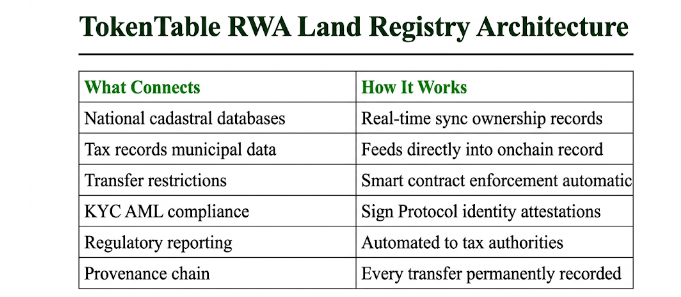
tokenTable connects directly to existing government land registries and property databases through direct integration, not replacement. Realtime synchronisation of property ownership records. Cadastral systems, tax records, and municipal property information all feeding into the onchain record simultaneously. When ownership transfers onchain the registry is supposed to reflect it. When the registry updates the onchain record is supposed to follow.
The compliance layer sitting on top of this is genuinely well designed. Transfer restrictions enforced automatically by smart contract. Whitelisting ensures only verified eligible parties can acquire specific asset classes, with KYC and AML compliance integrated directly through Sign Protocol identity attestations on every transfer. Automated regulatory reporting flows to tax authorities and land registries without manual processing. Every ownership transfer recorded permanently in a complete provenance chain that nobody can quietly rewrite.
For a government managing millions of land parcels, hundreds of thousands of annual transfers, and chronic disputes over contested ownership, this architecture points in exactly the right direction. The inefficiency in current land registry systems is real and expensive, and the cost of that inefficiency falls hardest on people with the fewest resources to fight disputes through legal channels. Sierra Leone has 66% financial exclusion partly because property rights are unreliable. 73% of citizens hold identity numbers but only 5% hold actual ID cards. Without documented property rights citizens cannot use land as collateral for credit. TokenTable connected to Sign Protocol's attestation infrastructure directly addresses this failure at the distribution layer.
according to Sign Foundation TokenTable already serves 40 million plus users. DOGS distributed 130 million dollars plus to 30 million plus users. KAITO distributed 30 million dollars to 150,000 users verified through X handles. The distribution infrastructure works at verified commercial scale. Real world asset tokenization extends that same infrastructure to physical government assets.
what keeps nagging me;
Two systems~ One asset ~ Two records.
The onchain record and the government registry record are not the same thing. They are connected by a synchronisation process. And a synchronisation process has latency. And latency means there is always a window where the blockchain says one thing and the registry says something else.
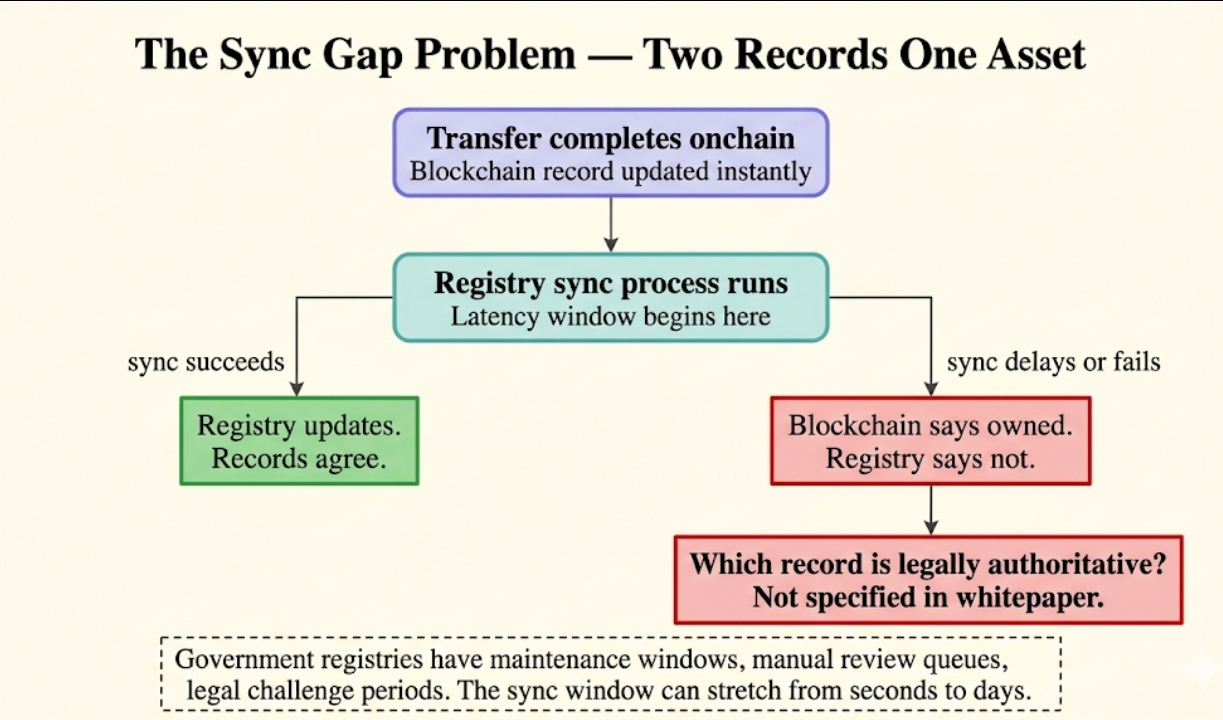
In normal operation that window is probably short. A transfer completes onchain. The registry sync runs. The registry updates. Seconds or minutes. Fine.
But government registries are government systems. They have maintenance windows. They have manual review queues for high-value transfers. They have legal challenge periods in certain jurisdictions where a transfer can be disputed before it gets recorded. They have legacy database infrastructure that does not always respond on demand. So the sync window can stretch. And while it is stretched the blockchain and the registry actively disagree about who owns the property.
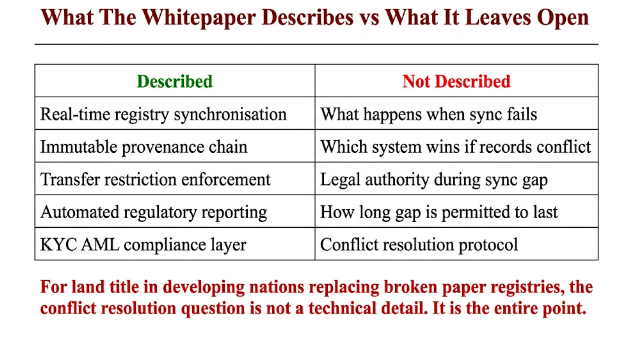
The whitepaper describes registry integration as real-time synchronisation and covers the technical architecture for that sync at a high level. What it does not describe anywhere is the conflict resolution protocol. What happens when sync fails. Which system is legally authoritative if they disagree. How long the legal gap window is permitted to stretch before a transfer is considered legally incomplete.
That is not a technical detail. For land title infrastructure in environments where this is meant to replace corrupt or dysfunctional paper registries, the answer to that question is the entire point of the deployment.
What they get rIght
The immutable provenance chain is genuinely the most powerful part of the architecture and it deserves direct acknowledgment. Every ownership transfer recorded permanently. Every transaction in the complete history of an asset visible and verifiable by any authorised party. Nobody can quietly rewrite who owned what and when. That capability alone eliminates an entire category of land fraud that currently costs developing economies billions annually and destroys individual families who cannot afford years of legal proceedings to recover stolen property rights.
the compliance automation layer is equally serious. Transfer restrictions encoded directly into smart contracts mean regulatory requirements are mathematically enforced rather than administratively managed. an transfer that violates whitelisting rules simply cannot execute. That is a fundamentally different level of enforcement reliability than any paper based or early digital registry system has ever achieved.
SIgn tenet of evidence maketh governance applies directly here. Attestations answer who approved what, under which authority, when, according to which rules. applied to land title transfers that creates accountability trails that manual systems cannot produce and that courts can use as primary evidence rather than supporting documentation.
WHAT WORRIES ME?
in the sync gap window a buyer completing a transfer onchain holds a blockchain record of ownership and no corresponding registry entry. They cannot prove ownership to a bank, a court, OR any government office that treats the registry as the legal source of truth. The blockchain record is technically correct and legally invisible at exactly the same moment. If the registry updates first and the onchain record lags, someone could potentially sell a property based on a registry record the blockchain has not yet caught up with. Dual records. Dual claims. Neither system aware the other has a conflict.
For land title in a developing nation where this infrastructure is replacing a broken paper system, the legal authority question is not an edge case to be resolved later. It is the foundational question that determines whether the entire deployment is legally meaningful or just technically impressive.
Honestly dont know if blockchain-based land title tokenization actually resolves the legal authority problem that makes land disputes so destructIve in developing economies, or whether it adds a second record that creates entirely new disputes whenever it disagrees with the first one.
what's your take the right architecture for finally making land ownership reliable or an technically impressive system that defers the hardest legal question to implementation teams??🤔