
last year i helped a cousin move from one city to another. not a big distance just enough to make things unsettled. for a few days his life was split across two places. half his belongings were already in the new apartment the rest still sitting in the old one. he kept needing things that were always in the other location.
he said something that stuck with me. the hardest part isn’t leaving or arriving. it’s this weird middle state where nothing fully belongs to you anymore.
i kept thinking about that while reading how Sign handles the bridge between its private CBDC infrastructure and its public blockchain stablecoin system. because that in between state is exactly what this bridge is trying to solve. and technically it’s one of the more interesting parts of the entire system.
but it also leaves behind some questions.
what they got right:
here is what the bridge actually does at the technical level.
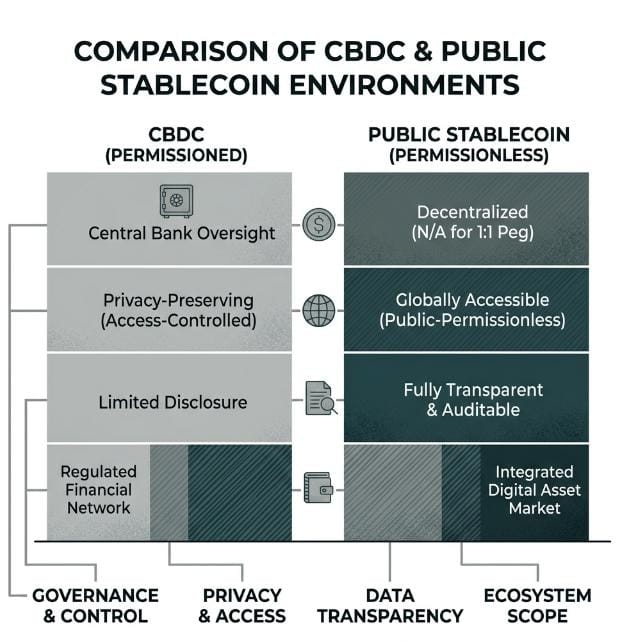
the Sign stack runs two parallel systems. on one side sits the Hyperledger Fabric X CBDC infrastructure permissioned, privacy-preserving, central bank controlled, designed for financial operations that require confidentiality. on the other side sits the public blockchain stablecoin system transparent, globally accessible, integrated with the broader digital asset ecosystem.
these are not just different environments. they operate on completely different assumptions. one protects privacy by default. the other exposes data by default. yet real users will need both.
the bridge exists for that exact reason. it allows value to move between these two systems when needed.
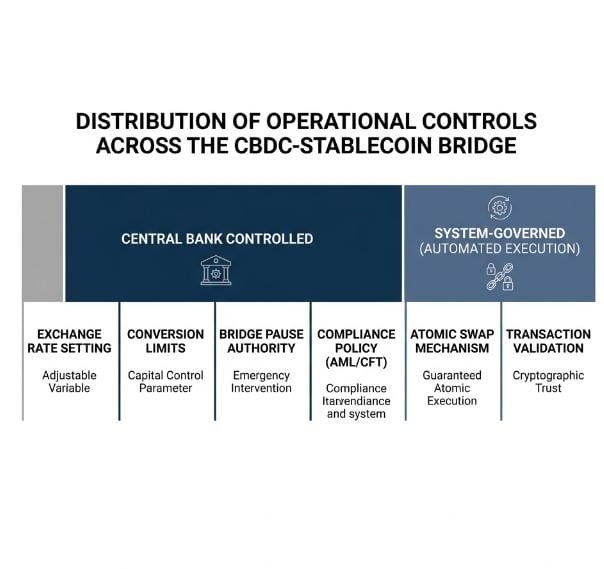
this is where the atomic swap design becomes important. the conversion happens as a single indivisible action. either both sides complete or nothing happens. there is no in between state where value is lost or partially transferred. from a technical trust perspective, that’s strong.
the compliance layer is also well thought out. AML and CFT checks are not bypassed during bridging. the system treats these conversions like any other financial activity. that matters if this is meant to operate in real regulatory environments.
what bugs me:
the atomic swap guarantees execution. it does not guarantee fairness of terms.
and that distinction matters more than it first appears.
the central bank controls the exchange rate between CBDC and stablecoin. this is explicitly stated. it also controls conversion limits and has the authority to pause the bridge entirely.
so while the system ensures that your transaction executes exactly as defined, it does not give you any say in how those terms are defined in the first place.
you are guaranteed a fair process, not a fair deal.
i tried to find any governance structure around how these rates are decided. anything about transparency, oversight, or user recourse. didn’t really see it clearly defined.
my concerns though:
to be fair, central banks controlling exchange rates is not new. that’s already part of traditional finance.
but this system makes that control more direct and more programmable.
in traditional markets, exchange rate decisions exist in a broader context. they are debated, observed, and influenced by external pressures. there is friction.
here, the rate feels like a variable in a system. adjustable. immediate. without a clearly described process around how or why changes happen.
and the conversion limits start to look a lot like capital controls. again, not inherently wrong. but when presented as just another parameter, it hides the policy weight behind it.
the bridge is technically elegant. maybe even one of the cleanest ways to connect private and public financial systems.
but it creates a strange dynamic.
you can fully trust the mechanism
while having no influence over the conditions
and that leaves me wondering whether this is true interoperability
or just a very well engineered corridor where one side still decides how wide the door opens.
$SIGN #SignDigitalSovereignInfra @SignOfficial