

I’ve been watching $SIGN every single day for a while now, the way you do when something keeps refusing to behave like the rest of the low-float crowd. Most of the conversation around it is the same predictable script: April 28 unlock coming, backers getting their slice, dilution incoming, better sit on the sidelines. I get why that story feels safe. But after staring at the same price tape and volume numbers that everyone else sees, I keep landing on a quieter, more stubborn conclusion the market is already pricing this token as if the utility demand is real, even while it’s still trading like a classic vesting overhang play.
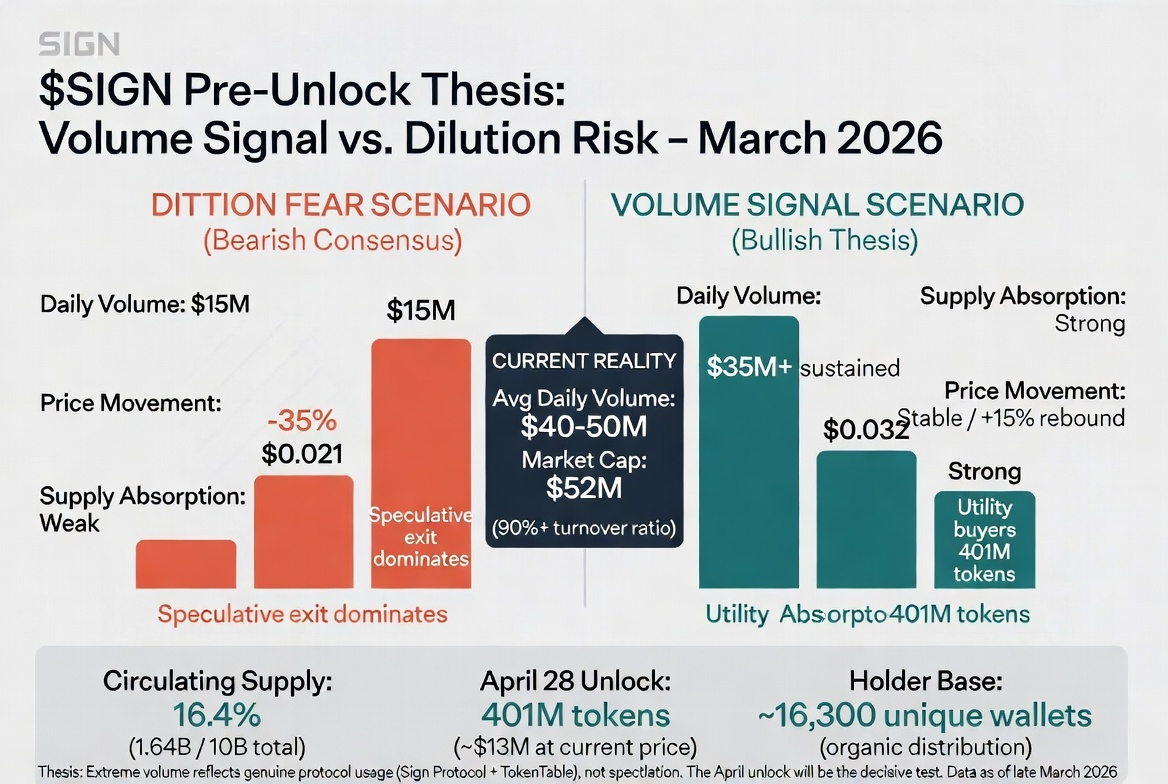
Right now it’s sitting near $0.032, with about $52 million market cap on 1.64 billion circulating out of the full 10 billion. That thin float has been the dominant narrative for months, and the price has taken the hit down over 35 percent in the past week alone, still 75 percent off last year’s highs. On the surface it looks like fear winning. Except the trading data refuses to play along.
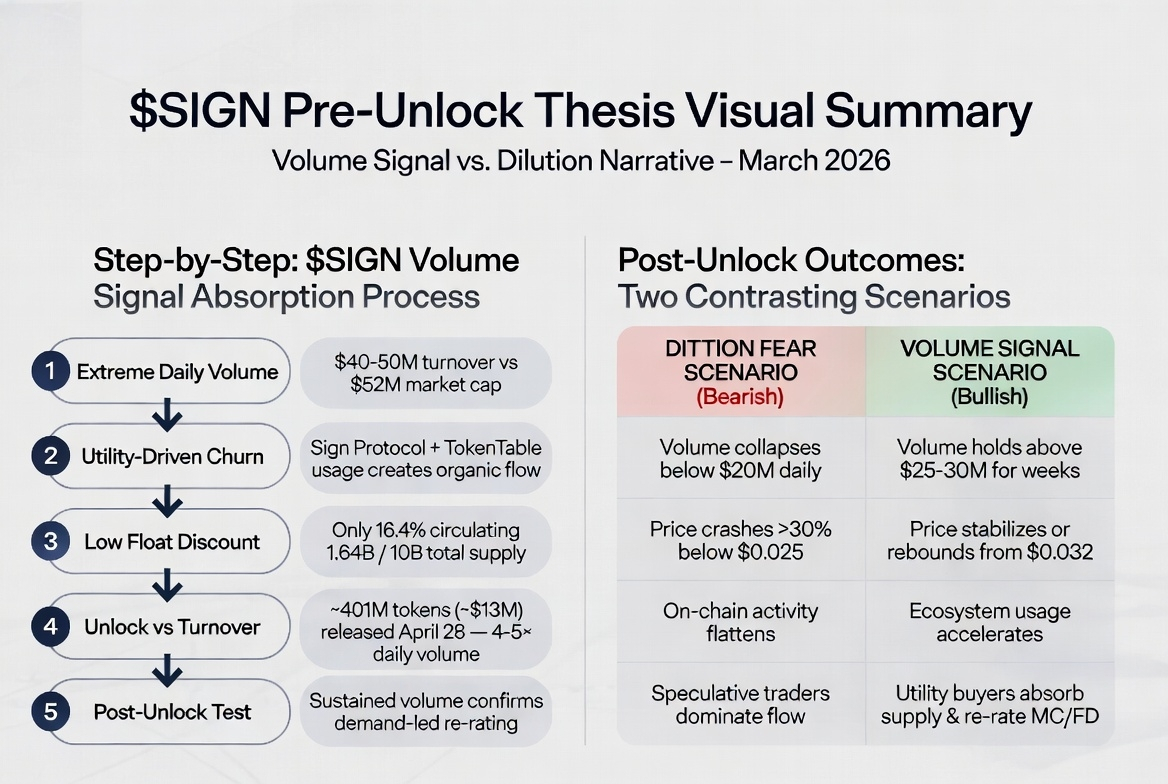
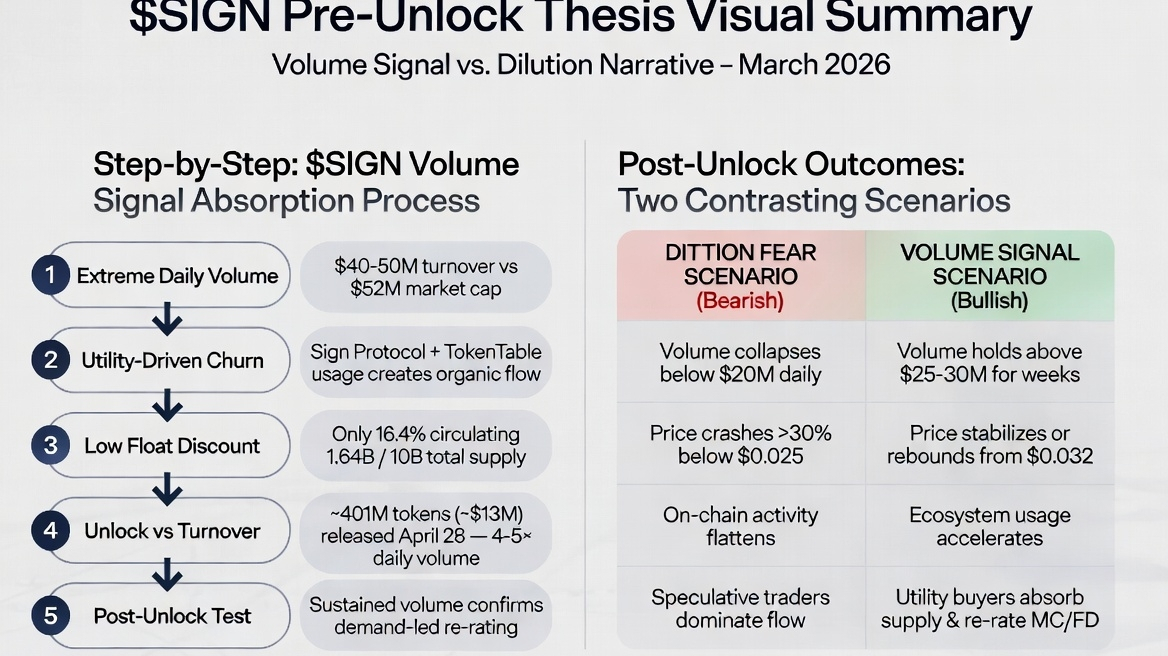
The volume is the part that keeps pulling me back in. We’re talking $40–50 million changing hands on most days lately. For a token this size and this far past launch, that level of turnover isn’t normal noise or wash. It feels like the exact wallets that actually interact with Sign Protocol and TokenTable are moving tokens through the system settling distributions, paying for attestations, whatever the daily flow is. I’ve followed enough infrastructure tokens over the years to recognize when volume starts behaving like usage rather than speculation, and this one has that signature.
What makes it more interesting is how the float discount has held steady even as the price weakened. Only 16.4 percent of supply is out there, yet the market has been willing to keep turning over nearly the entire market cap daily without the bid evaporating. That tells me the marginal buyer stepping in during the recent sell-off isn’t just gambling on a bounce they’re the ones who need the token for actual protocol work. In my experience, when you see price weakness paired with expanding or sticky volume, it’s often the setup where the fear sellers hand off to the usage buyers at better levels.
The holder base reinforces the same picture. Around 16,300 unique wallets own the token. Not super concentrated at the top, not a whale dominated game. It’s spread wide enough that the daily churn feels organic, coming from lots of smaller ecosystem participants rather than a handful of addresses coordinating exits. That kind of distribution is rarer than people admit in these low-float setups, and it makes the whole structure more resilient when the next tranche finally lands.
Even the unlock itself starts to look different once you size it against the volume. The April 28 backer release is roughly 296 million tokens about $9.5 million at current prices. On an average recent day the market turns over four to five times that amount. If the utility driven bid is already this active, the “supply shock” starts reading more like liquidity coming online than a dump catalyst. I’ve seen this mismatch play out a couple times before in other projects where everyone fixated on the schedule and missed the turnover that was already absorbing pressure.
Of course the counter case is real and I keep it front of mind. High volume on a single exchange pair can sometimes just be traders rotating on narrative, not genuine protocol flow. Backers got in cheap and have every incentive to trim. If the turnover melts away the moment the unlock hits, or if on chain metrics flatten while price keeps sliding, then yeah the market was right and the whole liquidity trap idea was wishful thinking.
But here’s what would actually make me double down: after April 28 the volume stays elevated above $25–30 million for a couple of weeks, the price holds or grinds higher instead of cratering, and the ecosystem activity that drives the token keeps ticking up. That would confirm the demand I’m seeing isn’t imaginary.
The opposite volume collapsing, price breaking lower and staying there, usage going quiet would tell me it really was just float math all along.
I’m not out here calling for some parabolic run or pretending the risks don’t exist. I’m just one guy who’s spent enough time watching these charts to notice when the data starts whispering something the crowd isn’t hearing yet. $SIGN is already turning over at a rate that suggests real, recurring need in a market still treating it like a pre-dilution waiting room. The April unlock isn’t going to be the end of the story. It’s going to be the moment the market finally has to reconcile the two. So far, the volume has me convinced the reconciliation is going to surprise a lot of people on the bearish side.
@SignOfficial #SignDigitalSovereignInfra $SIGN
