
Crazy, i just looked at the cross border payment problem and mapped it with Sign, and what i found shocked me about Sign Protocol.
every government building CBDC rails right now is trying to solve the same second-order problem. the first-order problem — creating a digital currency — is largely solved. the technology works. the pilots have run. the settlement has been demonstrated. central banks across the Gulf, Southeast Asia, and Africa have proven that digital money can move between institutions at national scale.
the second-order problem is harder. and nobody budgets for it until the rails are already live.
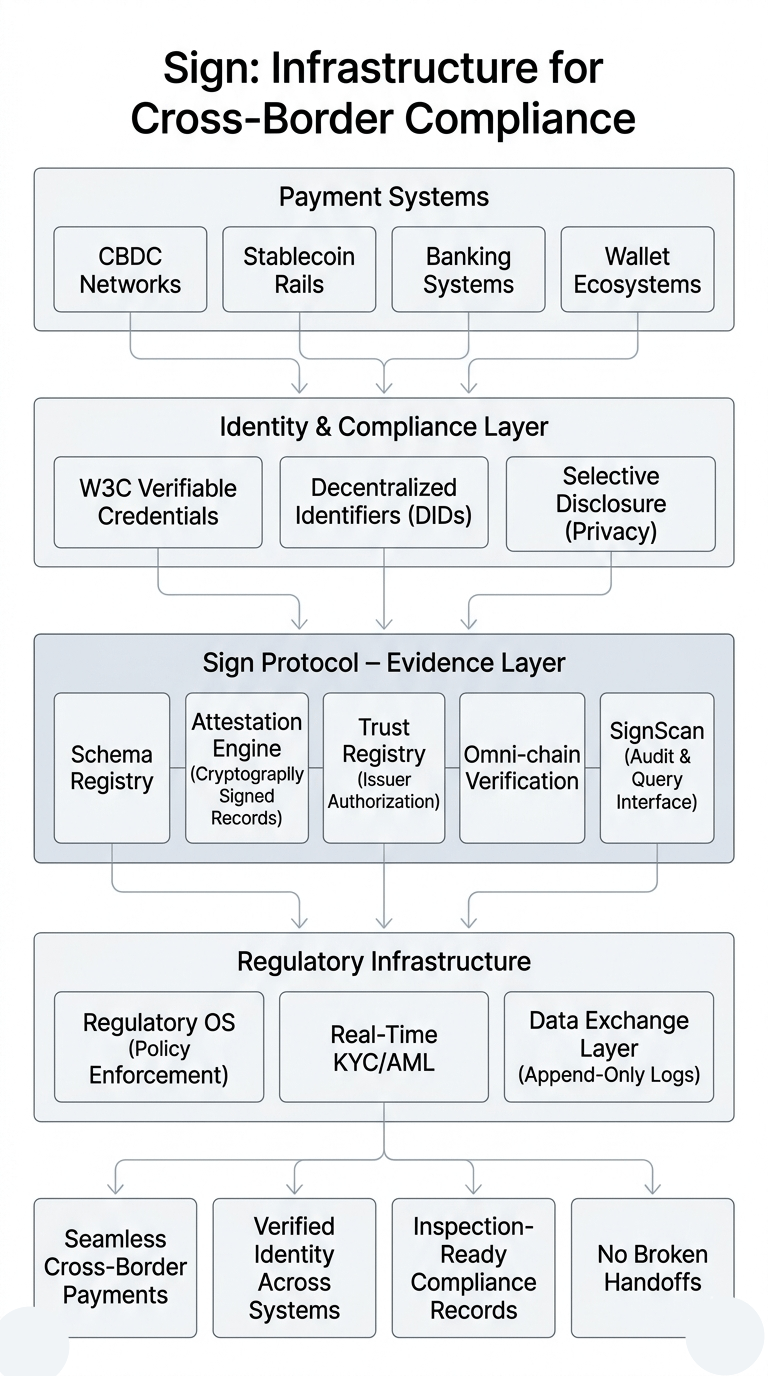
when a government launches CBDC infrastructure and connects it to the international payment system, every cross-border transaction that flows through those rails needs to carry verified identity information with it. originator details. beneficiary records. proof that the sender has been properly verified. proof that the receiver has been checked against the right compliance frameworks. this is not optional. the FATF Travel Rule makes it a global regulatory requirement. and FATF's June 2025 update made enforcement explicit — it is not enough to have a compliance rule in place. governments must prove that originator and beneficiary information stays intact across every hop in the payment chain. end to end. no gaps.
but the infrastructure to actually do this does not exist yet at sovereign scale. every cross-border payment now flows through combinations of CBDC rails, regulated stablecoin corridors, correspondent banking layers, and wallet ecosystems simultaneously. each operates under different jurisdictional rules. each produces compliance records in different formats. and when the payment crosses from one system to another, the identity verification record — the proof that the originator was properly checked — degrades. or disappears. this is the broken handoff. and it is not a technical accident. it is an infrastructure gap. 😐
on the market side, SIGN is currently trading at $0.03188, down 1.02% over the last 24 hours. session high was $0.03696 and the low was $0.03122. volume came in at 270.39 million SIGN tokens, translating to approximately $8.75 million USDT — a meaningful step up from the previous session's 171 million tokens. the 4H candle closed at $0.03188 with a range of 2.30%. the MA(7) at 0.03216 and EMA(7) at 0.03218 remain almost identical — the compression that began two sessions ago is continuing. price is holding just above the $0.03085 support level. the volume increase on a tight-range candle is worth watching. it suggests accumulation is beginning to compete with residual selling pressure. the floor is holding. the compression is tightening. something is building underneath.
but the price is not where Sign's most important work is happening right now.
the work is in the broken handoff problem itself. and Sign's S.I.G.N. framework addresses it at the foundational infrastructure level — where the gap actually lives — not at the application layer where most compliance patches get applied and eventually fail.
it needs a shared evidence layer where cryptographically signed claims about originator and beneficiary identity travel with the payment across every hop in the chain without degrading. it needs a trust registry where every government authority, every regulated operator, and every issuing institution is recorded on-chain so any verifier anywhere in the payment chain can confirm the claim without calling back to the source. it needs attestations structured through schemas, inspection-ready, and queryable through SignScan across chains and storage modes simultaneously — so the compliance record is as portable as the payment itself.
"the Travel Rule is not a data problem. it is a sovereign infrastructure problem. the data exists. the layer that makes it verifiable across every border does not."
this is what Sign Protocol's omni-chain attestation layer builds across the three national systems. the New Money System handles CBDC and regulated stablecoin rails with ISO 20022 aligned payment messaging and policy-grade controls. the New ID System issues W3C Verifiable Credentials and W3C DIDs — with selective disclosure preserving citizen privacy at the point of verification across borders. the Regulatory OS maps real world identities to onchain activity and applies KYC and AML policy enforcement in real time across every system touching the payment. the Data Exchange Layer records every inter-agency interaction as append-only, verifiable logs — no raw data centralised, no broken handoffs, no compliance opacity.
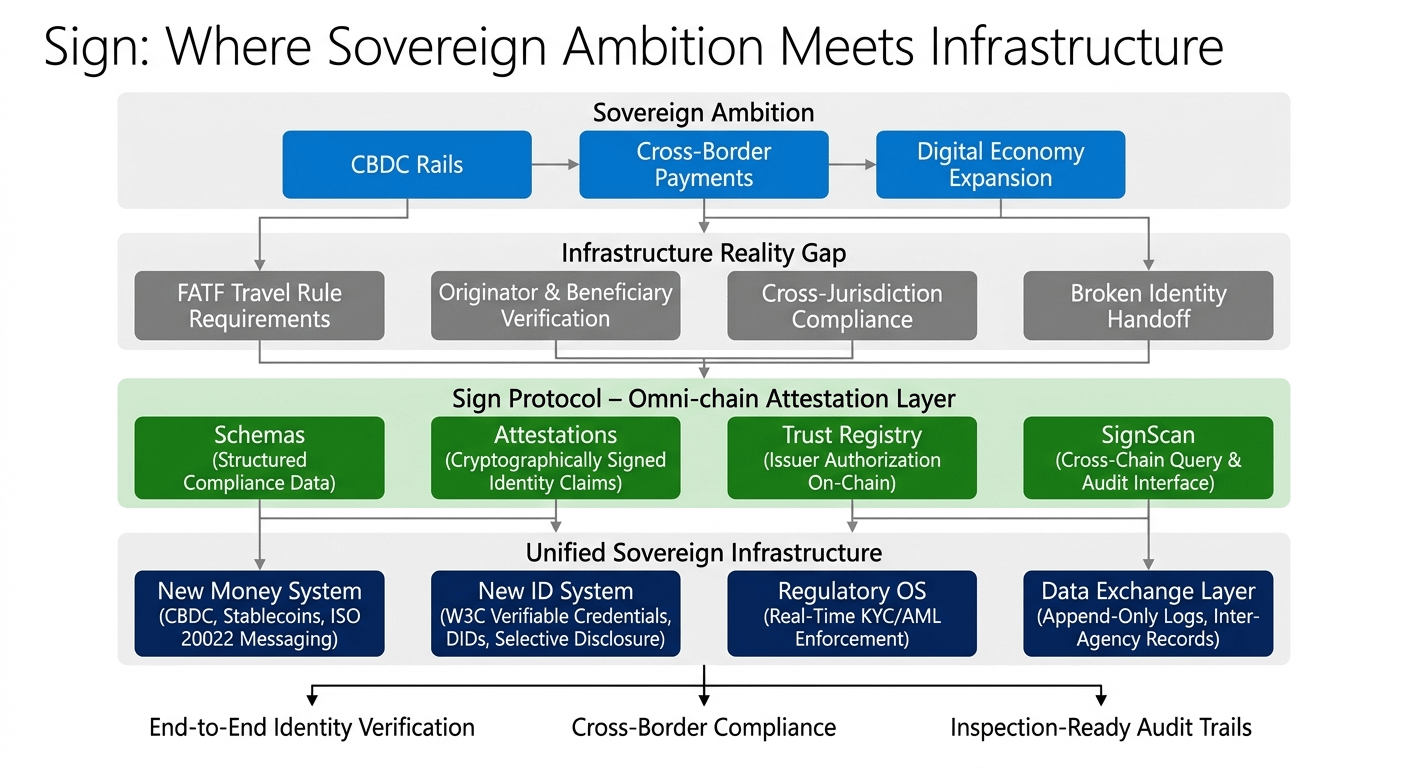
"sovereign infrastructure does not patch the broken handoff. it makes the broken handoff structurally impossible by producing inspection-ready evidence at every hop by default."
the B2G model Sign operates inside is what makes this compounding. long-term contracts. deep integration into live government payment systems. proprietary technology that builds through every iteration cycle inside a real sovereign deployment. each compliance edge case solved inside a live CBDC corridor becomes knowledge that no outside vendor can acquire. the iteration loop is the moat.
and the long horizon is already visible from here. once the foundational systems are stable — once the New Money System, the New ID System, and the New Capital System are operating as one sovereign infrastructure stack — sovereign AI becomes the next layer. governance stops being a paperwork problem. real-time data flows through programmable interfaces. countries become companies. fiat becomes its stock. citizens becomes shareholders. 🤔
the Middle East cross-border payment corridor carries hundreds of billions annually. every transaction crossing a compliance gap where identity cannot be verified end to end is a broken handoff waiting to become an enforcement action.
Sign is building the infrastructure that makes those handoffs whole. one sovereign contract at a time.
@SignOfficial #SignDigitalSovereignInfra $SIGN
