
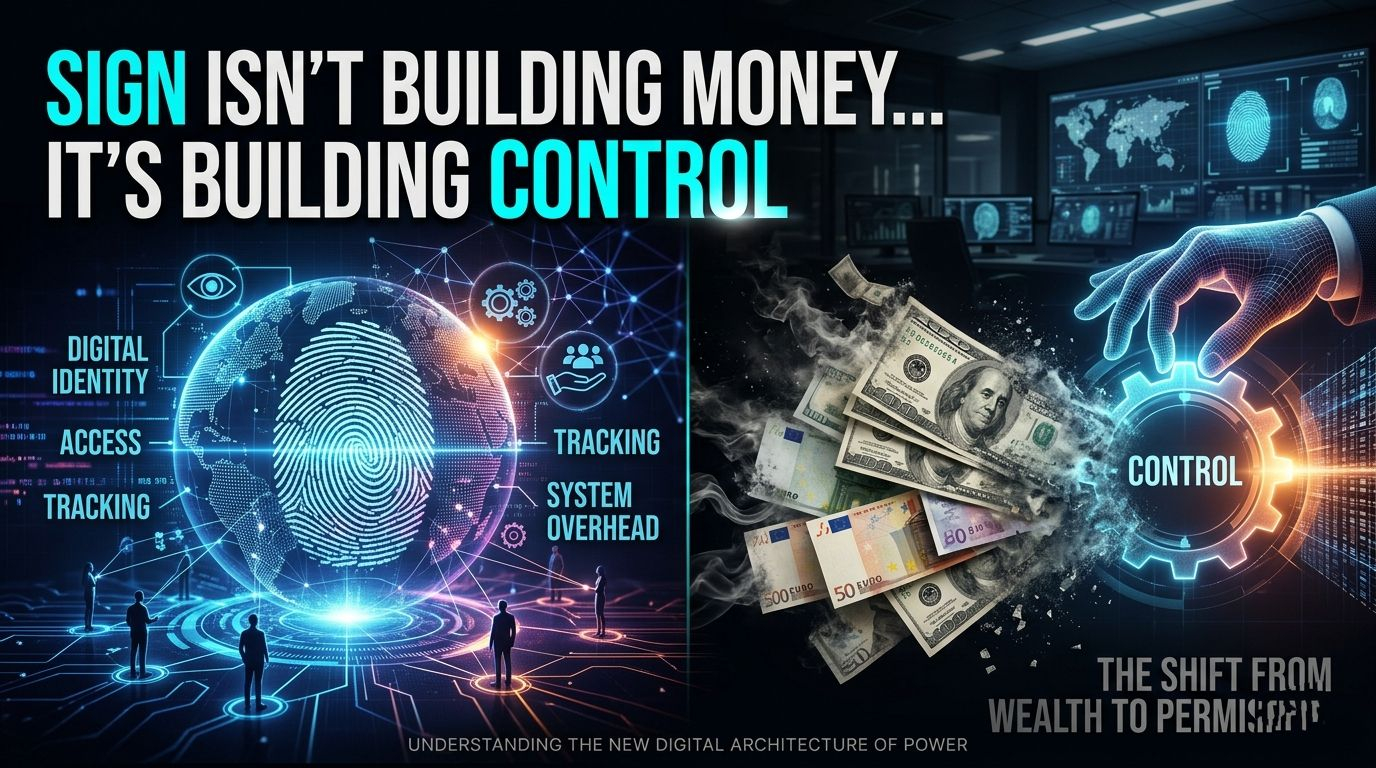
I've been thinking a little seriously about @SignOfficial for a while now. At first, what I thought was honestly simple just another attestation layer. Nothing particularly new in crypto.
But after taking some time to actually read the whitepaper and technical blueprint, I realized they are trying to play in a very different space.
They don’t see Sign the way we usually think about CBDCs as just digital currency, faster payments, or better tracking systems. Their approach is deeper. They’re trying to build what can be called a “smart economic layer.”
This means not just moving money…
…but defining when, where, and under what conditions that money moves using code.
A SHIFT FROM MONEY TO LOGIC
The most interesting part here is their modular architecture.
They’re essentially saying:
Not all countries operate the same way economically so one rigid system simply won’t work.
That’s why they are designing a plug-and-play framework.
At first glance, it looks like flexibility.
But if you think deeper, it’s also about control by design.
One country could monitor retail-level spending
Another could only focus on interbank settlement
Same core system completely different behavior.
This is powerful… but also raises questions.
DEVELOPER-FRIENDLY… BUT DEPENDENT
The SDKs and APIs are a key part of this ecosystem.
A fintech developer doesn’t need to understand the entire CBDC system.
They can simply build on top using Sign’s tools.
On the surface, this is extremely developer-friendly and it genuinely is.
But there’s a tradeoff:
No matter what you build…
you are still operating within the rules of that infrastructure.
That creates invisible dependency.
POLICY BECOMES CODE
The concept of custom modules is where things get really powerful.
Governments can plug in modules like:
Automatic VAT/tax deduction
Policy-based spending rules
Compliance filters
This sounds efficient and it is.
But there’s a deeper shift happening here:
Earlier, policy existed outside the system.
Now, policy becomes embedded in code.
Which means decision-making is no longer interpretive
it becomes programmable and enforceable by default.
That’s both powerful… and potentially dangerous.
Because now the real question becomes:
Who defines the rules?
SHARIAH MODULE: A REAL-WORLD TEST CASE
The Shariah-compliant module is particularly interesting.
Examples include:
Automated riba (interest) filtering
Zakat calculation and distribution
Blocking non compliant financial flows
On paper, this is clean and efficient:
Less human error
Reduced corruption
Transparent enforcement
But again, we hit the same core issue:
Who defines what is halal or haram in code?
Because code is not neutral.
It always reflects someone’s interpretation.
ECOSYSTEM STRATEGY: THE ANDROID MODEL
@SignOfficial clearly states:
They don’t want to build all applications
they want to provide the infrastructure layer, like an operating system.
This is similar to Android:
They build the OS
Developers build the apps
This is a smart move.
Because:
More developers → more use cases
More use cases → stronger network effects
Things like:
BNPL services
Cross border payments
Credit scoring systems
All become possible.
THE REAL QUESTION: WHO DEFINES TRUTH?
Everything eventually comes down to the verification layer.
You attach proof fine.
But:
Who decides whether that proof is valid?
If verification rules or schemas become even partially centralized,
then the system risks shifting into a new form of centralization.
Earlier, data was controlled.
Now, proof can be controlled.
“LESS DATA, MORE PROOF” BUT AT
WHAT COST?
The narrative sounds clean:
Less data → more privacy → more proof-based validation
But in reality:
You’re not eliminating trust
You’re relocating it
Instead of trusting raw data,
you now trust verification systems and rule engines.
That’s a subtle but important shift.
STRENGTH VS RISK
Honestly, I have mixed feelings.
On one hand:
The architecture is strong
Use cases are practical
Government level deployment is realistic
On the other hand:
Without proper governance, this system can easily become biased or over-controlled.
THE REAL POWER IS NOT PROGRAMMABLE MONEY
There’s a lot of hype around programmable money.
But the real power isn’t in programming money…
It’s in:
Who verifies the conditions under which money gets released.
If that layer is:
Transparent
Accountable
Credible
Then this is a real breakthrough.
If not…
it just becomes a smarter version of the existing system.
FINAL THOUGHT
For me, the right way to look at Sign is this:
They are not solving the problem of moving data.
They are trying to build infrastructure to enforce decisions.
That is ambitious.
That is powerful.
And that is risky.
Because:
Automating money is easy.
Automating trust is not.
And honestly…
that’s where their real test begins.
@SignOfficial #SignDigitalSovereignInfra $SIGN
