
@SignOfficial #SignDigitalSovereignInfra
There’s a certain kind of confidence that comes from systems you can inspect.
The first time I really understood what SIGN Protocol is trying to do with benefit distribution, it didn’t feel like hype. It felt… structured. Almost rigid in a reassuring way. Every payment—where it goes, who receives it, under what condition—exists as an attestation. Fixed. Auditable. Immune to the quiet edits that usually happen somewhere between allocation and delivery.
In regions where trust is fragile, that kind of design doesn’t just improve a system. It redefines the expectation of it.
And when I came across TokenTable, the idea moved out of theory. This wasn’t just something written neatly inside a whitepaper. It was already functioning, already scaling, already proving that programmable distribution isn’t some distant concept—it’s here, operational, and increasingly hard to ignore.
But the more convincing the system became, the more uncomfortable my thoughts started to feel.
Because clarity, I’ve noticed, often hides its own assumptions.
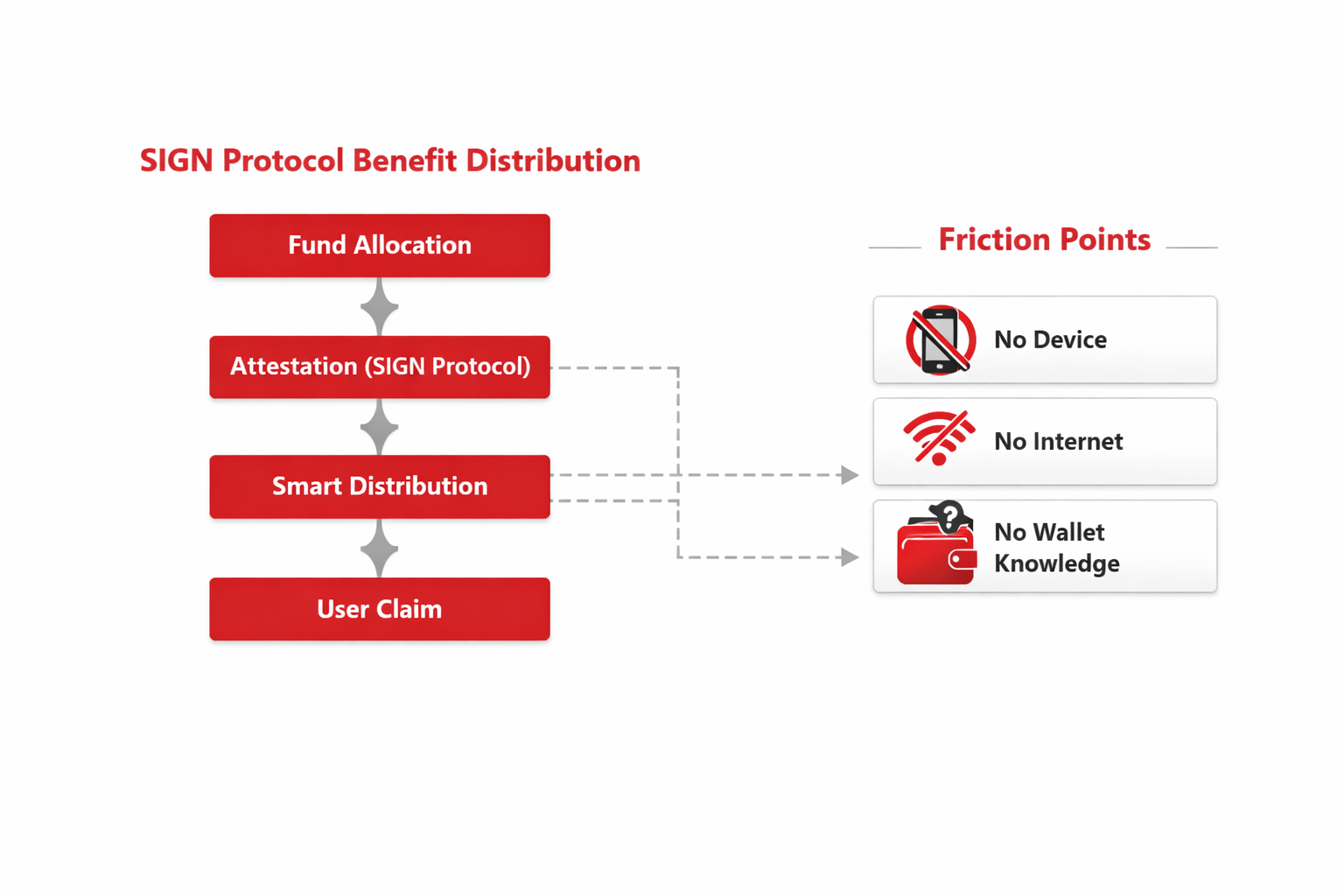
I kept thinking about places like Sierra Leone—not as a headline example, but as a real environment with uneven access to technology. On paper, SIGN’s model works beautifully. In practice, it quietly asks for a lot.
A wallet.
A functioning device.
Stable internet.
And something less visible, but more critical—confidence in using all of it.
Inside crypto, that checklist feels basic. Almost invisible. But outside of it, that list becomes a barrier.
I’ve seen this pattern before. When the World Food Programme introduced tech-driven distribution systems, the intention was the same: reduce leakage, increase transparency, ensure fairness. And in many ways, it worked. But there were always people standing just outside the system—not because they weren’t eligible, but because they couldn’t interface with it.
Not excluded by policy.
Excluded by design.
That’s where the trade-off starts to take shape.
Traditional systems are messy, inefficient, and often opaque. But they have something digital systems struggle to replicate: an offline presence. A physical fallback. A place you can go, a person you can speak to, a process that doesn’t require you to understand interfaces or manage keys.
With SIGN, that path feels less defined.
And maybe that’s intentional. Maybe the assumption is that governments or implementers will build that bridge. But then the responsibility shifts, and the lines blur. If someone is eligible but unable to claim benefits because they lack access or literacy, where does accountability sit?
With the protocol?
Or with the institution deploying it?
I haven’t seen a clean answer to that yet.
There’s also a quieter layer that doesn’t show up in architecture diagrams.
Onboarding.
Not the simplified version we talk about in product terms—but the real one. Teaching someone how to use a wallet. Helping them trust a system they can’t physically see. Providing devices, connectivity, ongoing support. None of this is trivial, and none of it is free.
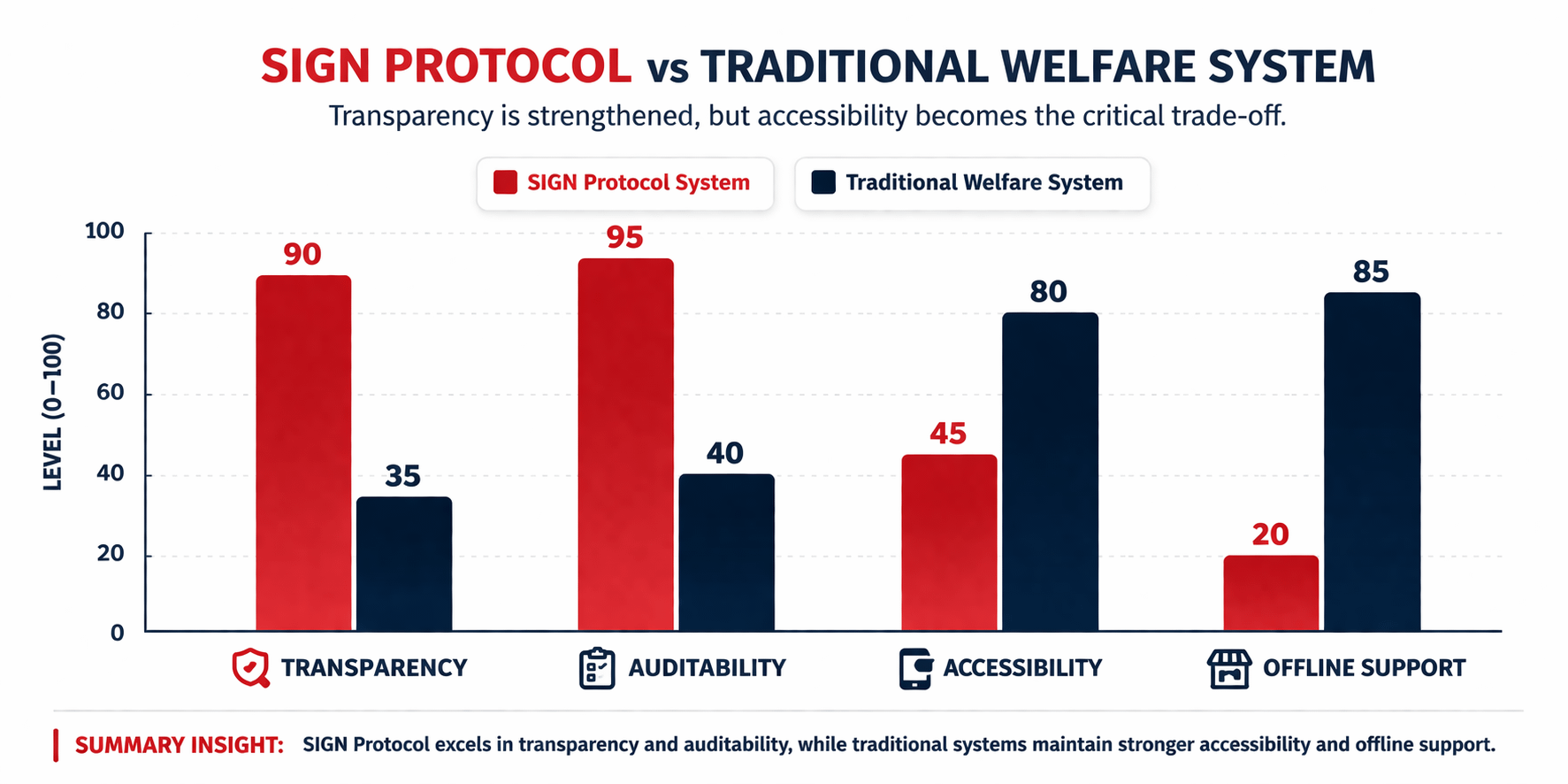
These are not edge cases. In many regions, they are the majority condition.
What I keep coming back to is this:
SIGN Protocol is exceptionally good at making systems verifiable. It reduces ambiguity, removes room for manipulation, and creates a level of auditability that traditional models struggle to match.
But welfare systems aren’t judged only by how well they can be audited.
They’re judged by who actually receives help.
And those two things—transparency and accessibility—don’t always move in the same direction.
If a system works flawlessly for most people but quietly leaves a segment behind, it forces a more difficult question. Not about efficiency, not about innovation—but about purpose.
Because in welfare, the edge cases aren’t really edges.
They’re the reason the system exists in the first place.
I’m still watching how this unfolds. Not the announcements, not the partnerships—but the ground-level implementations. Especially how they deal with the offline reality that doesn’t fit neatly into cryptographic guarantees.
That’s where the real test of SIGN Protocol isn’t technical.
It’s human.
