
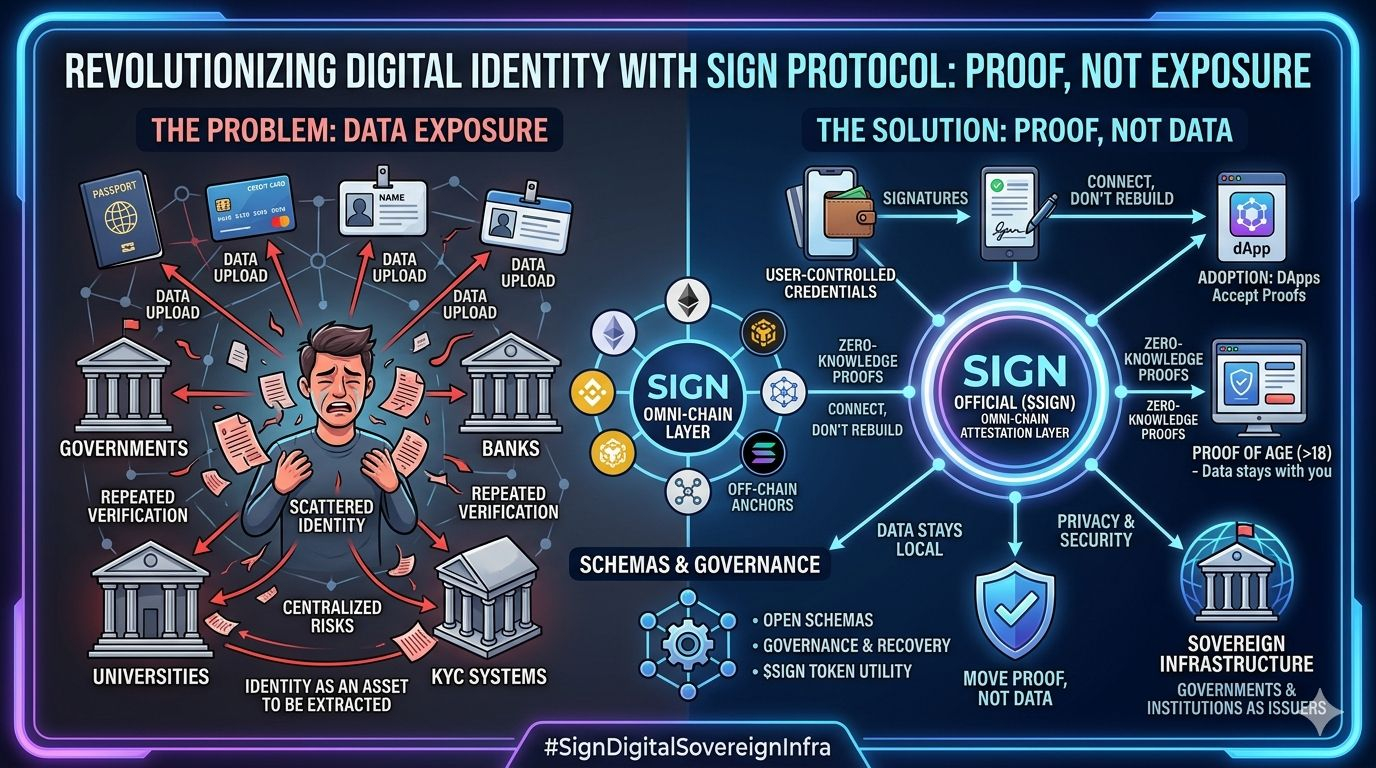
I’ve been sitting with this idea for a while now… and the more I think about identity online the more it feels off Not broken in an obvious way but in a quiet uncomfortable way Every time we verify something we end up giving away more than we should You try to prove one simple thing… and somehow your entire data goes along with it. At some point it stops feeling like verification… and starts feeling like exposure.
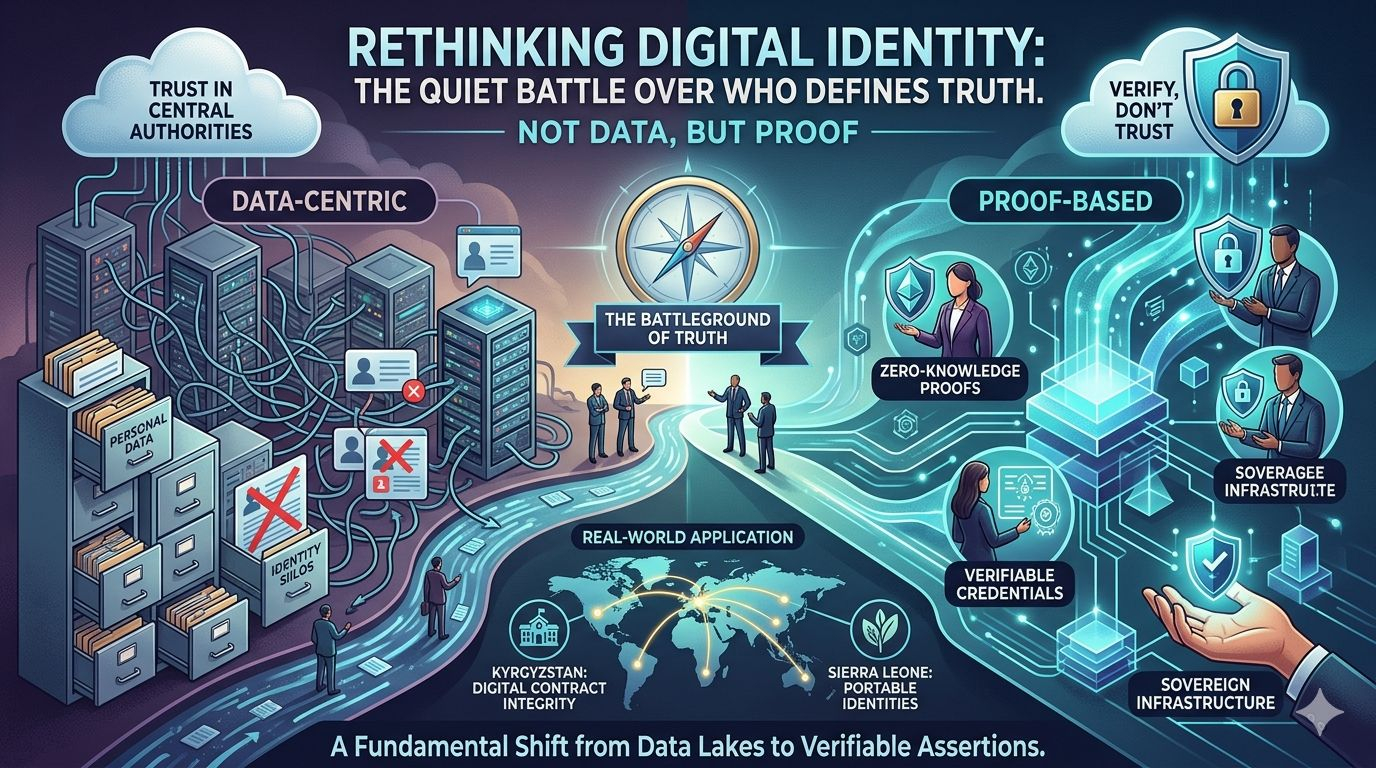
That’s what pulled me into looking at @SignOfficial a bit deeper.
At first, I didn’t take it seriously. Honestly… it looked like just another attestation layer. Crypto has seen plenty of those. But the more I read, the more I realized they’re not really trying to build another system… they’re trying to change the direction of how identity works.
Right now, identity is scattered. Governments have their records. Banks have their own. Universities, passports, KYC… everything exists, but nothing connects properly. Every system is its own island. And every time you move between them, you start from zero again. Upload again. Verify again. Wait again.
Sign isn’t trying to replace all that. They’re saying… don’t rebuild everything. Just connect it. But not by moving data around… by moving proof instead.
That’s where it clicked for me.
Instead of your data flowing everywhere… your data stays where it is. What moves is proof that it’s valid.
Sounds simple… but it changes a lot.
Because if you look at older models, they all had issues. Centralized systems were easy to build… but they became massive targets. Too much data sitting in one place. Federated systems tried to fix that, but added another problem middle layers that could see everything. Quiet observers in the system.
Sign tries to remove that by giving control back to the user. Your credentials sit with you, in your wallet.
Conceptually… that’s powerful.
But I keep thinking about the real world. What if someone loses access? What if they lose their phone? That’s where pure decentralization usually breaks. And to be fair, Sign doesn’t ignore that they introduce governance, recovery mechanisms. It’s not just tech, it’s structure.
Still… that’s where things get messy.
Then there’s the part I keep coming back toselective disclosure.
Because this is where it stops being theory and starts feeling real.
Before this, if you wanted to prove something simple like your age you had to show everything. Your full ID. Your number. Your details. It never made sense, but we accepted it.
Here… you don’t share the data. You prove the condition.
I’m over 18.That’s it. Nothing else.
And that’s where zero-knowledge proofs actually feel useful, not just technical jargon. The system trusts the proof… without ever seeing the raw data.
That’s clean. Almost too clean.
Because then a different question shows up…
Who decides what counts as a valid proof?
And this is where I slow down a bit.
Sign uses schemas to define how credentials are structured and verified. On the surface, it’s just organization. But if you look closely… this layer holds a lot of power. Because whoever controls the schema… shapes what is considered truth in the system.
Even if everything else is decentralized… this part can quietly become a point of control.
And that’s not something you notice immediately.
Another thing that keeps bothering me a bit is adoption. Moving from data to proof sounds right… but systems today are built around collecting data. That’s how they operate. That’s where their value comes from.
So the question is… will they actually accept a model where they don’t hold the data anymore?
And even if they do… there’s a cost side too. ZK proofs aren’t cheap yet. Verification isn’t free. The idea is efficient in theory… but the economics still need to prove themselves.
So I keep coming back to the same place.
@SignOfficial isn’t just building a product. It’s trying to build a layer… something underneath everything else. A trust layer where identity isn’t something you hand over… but something you prove, only when needed.
That idea makes sense to me.
But at the same time… it’s one of those ideas that only matters if it actually works in the real world.
Right now, I’m not fully convinced.
But I’m also not ignoring it.
Because the problem they’re trying to solve… is real. And they’re looking at it from the right angle.
The rest comes down to execution… and that’
s the part I’m watching.