
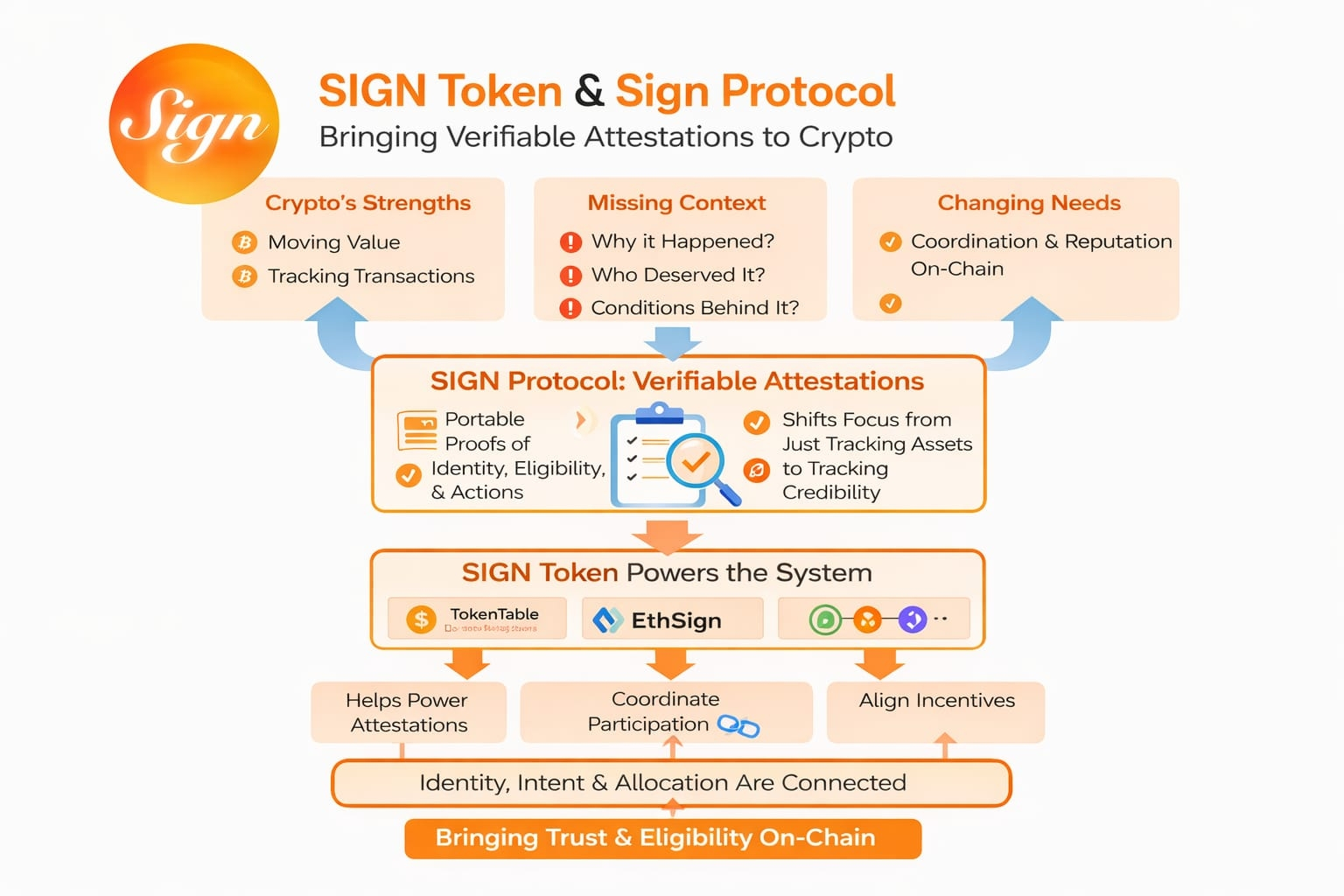
 Crypto has gotten really good at one thing:moving value. Tokens can be sent across wallets instantly,tracked with precision,and verified on chain without much friction. But there’s still something missing. Most of the time,you can see that something happened,but not why it happened, who actually deserved it,or what conditions were behind it. That context tends to disappear the moment the transaction is recorded.
That gap didn’t matter as much in the early days,when speculation was the main focus. But things are changing. Crypto is starting to lean more toward coordination paying contributors,distributing incentives,organizing communities and suddenly that missing layer becomes a real problem.
This is where the Sign ecosystem starts to click.
At its core,Sign Protocol introduces the idea of attestations. Think of them as structured,verifiable claims proofs about identity,eligibility,or actions that can exist on chain or move across different chains. Instead of relying on scattered databases or hidden off chain logic,these attestations give projects a way to anchor information in something portable and reusable. It shifts the focus a bit:from just tracking assets to actually tracking credibility.
The SIGN token fits into this system more as a working component than something meant to stand on its own. Its value seems tied to how the system is used helping power attestations,coordinate participation,and align incentives across different applications. Tools like TokenTable and EthSign give a glimpse of what that looks like in practice. TokenTable is more about distribution how funds reach the right people while EthSign leans into agreements and commitments. Together,they start to form a stack where identity,intent,and allocation are all connected instead of living in separate layers.
What makes this interesting right now is timing. Crypto is entering a phase where reputation on chain actually matters. Whether it’s airdrops,grants,DAOs,or contributor networks,everything comes down to deciding who qualifies for what. Without a shared way to verify that,projects end up repeating the same checks or relying on systems that are easy to manipulate.Sign’s approach hints at something more reusable where trust and eligibility don’t have to be rebuilt every time.
Of course,none of this is guaranteed to work perfectly.
Attestation systems are only as strong as the sources behind them. If the issuers aren’t reliable,the whole structure can weaken pretty quickly. There’s also the challenge of adoption. A system like this only becomes powerful if enough projects actually use it. Otherwise,it risks becoming just another isolated tool instead of a common layer across the ecosystem. And from a token perspective,there’s always the question of whether real usage will translate into consistent demand over time.
Still,the direction makes sense.For builders,it’s about reducing friction when coordinating people and resources.For investors,it’s less about hype and more about whether this kind of infrastructure quietly becomes essential as the ecosystem grows.And more broadly,it reflects a shift toward making crypto systems not just transparent,but also meaningful.The more crypto moves into real world coordination,the harder it becomes to rely on transactions without context.Systems that can capture trust without central control won’t always be loud,but they’ll matter.SIGN is one attempt to build that layer.Whether it succeeds will depend less on the idea itself and more on whether people actually start using it in ways that are hard to ignore.