
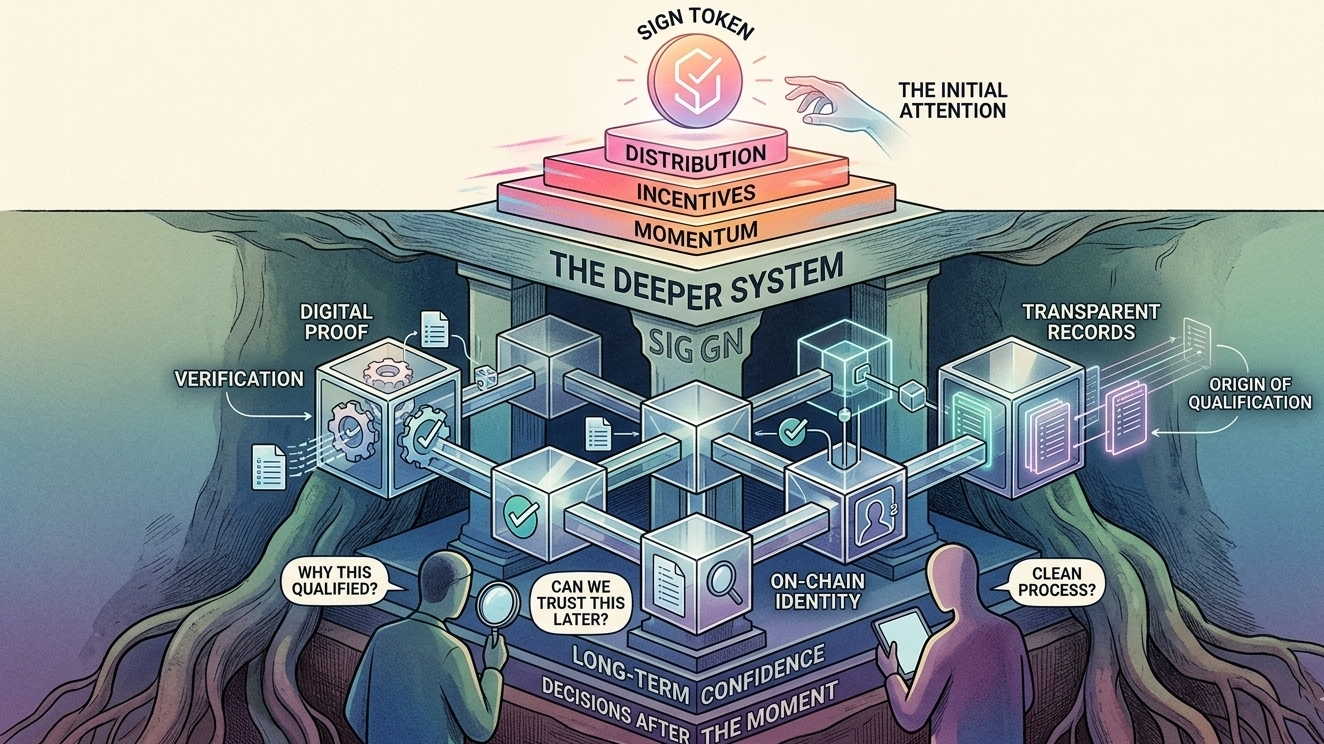

I was out today, and while talking with friends, Sign came up for a bit. At first it was the kind of conversation that starts in a familiar place. Someone mentions the token, someone mentions distribution, and for a minute it feels like the whole story is about rewards. But later, when I thought about it again, the thing that stayed with me was not really the reward side of it. It was the feeling that some projects slowly stop looking like simple crypto campaigns and start feeling like they are trying to solve a much deeper problem underneath.
That is what kept sitting with me today.
What makes Sign interesting to me is that it does not feel like a project you can explain fully by talking only about incentives. The easy version would be to say it helps with distribution, verification, and all the things people usually attach to token systems. But the more I think about it, the more it feels like the bigger story is really about whether digital systems can leave behind something people still trust later.
That is where my mind goes with it.
A lot of systems can give a result. That part is not always hard. The harder part is whether the result still feels clear once the moment has passed and people start looking at it more carefully. Why did this wallet qualify. Why was this rule used. Why does the outcome look neat on the surface, but still leave people with doubts underneath. Those are the questions that make a system feel either stronger or weaker over time.
And I think that is why Sign feels bigger to me than a normal project conversation.
It makes me think less about the reward itself and more about the structure behind the reward. Because once a system starts touching identity, proof, verification, or who qualifies for what, it stops feeling small. It starts feeling like part of a larger shift in how digital decisions might work in the future. That is a much more serious thing than a normal token story.
For me, that difference matters a lot.
Some projects stay easy to talk about because they stay close to market language. Price, momentum, visibility, narrative. Sign does not feel like that to me right now. It feels more like one of those projects where the first layer is simple, but the deeper layer keeps getting heavier the more you sit with it. The token may be what brings people in at first, but the stronger story feels closer to trust, records, proof, and whether systems can still make sense after the result is already out there.
That is the part I keep coming back to.
Because in the end, digital systems are not only judged by what they do in the moment. They are judged by what they leave behind. A clean outcome is useful, but it does not always create confidence on its own. Confidence usually comes later, when people can return to the process and still feel that it holds together. That is the point where a project starts feeling less like a short-term crypto story and more like something that could matter for longer.
I think Sign sits in that space for me.
It feels less like something that only wants attention now and more like something tied to a bigger question about how digital trust will actually work when more decisions move online. Once that becomes the conversation, the token stops feeling like the whole point. It starts feeling like only one visible part of a much larger system.
And honestly, that is why it keeps staying in my head.
A lot of projects can look important for a while. Fewer projects make you feel like the real story is still unfolding underneath the obvious one. With Sign, that is what stands out to me. The reward side may be what people notice first, but the deeper part feels like it is really about making digital systems easier to trust when the easy moment is over.
That is a different kind of weight.
I think people often miss these shifts at first because they are quieter than hype. A token is easy to discuss. A bigger system story takes longer to settle in. But once it does, it usually stays with you longer than the first wave of attention ever could.
That is where my head was today.
Some projects look active. Some start feeling important in a deeper way. For me, Sign starts standing out more when I stop looking at it like a reward story and start looking at it like a system that may matter more after the reward is already done.
Do you think people notice when a project starts becoming something deeper, or only after the simple story stops being enough?