
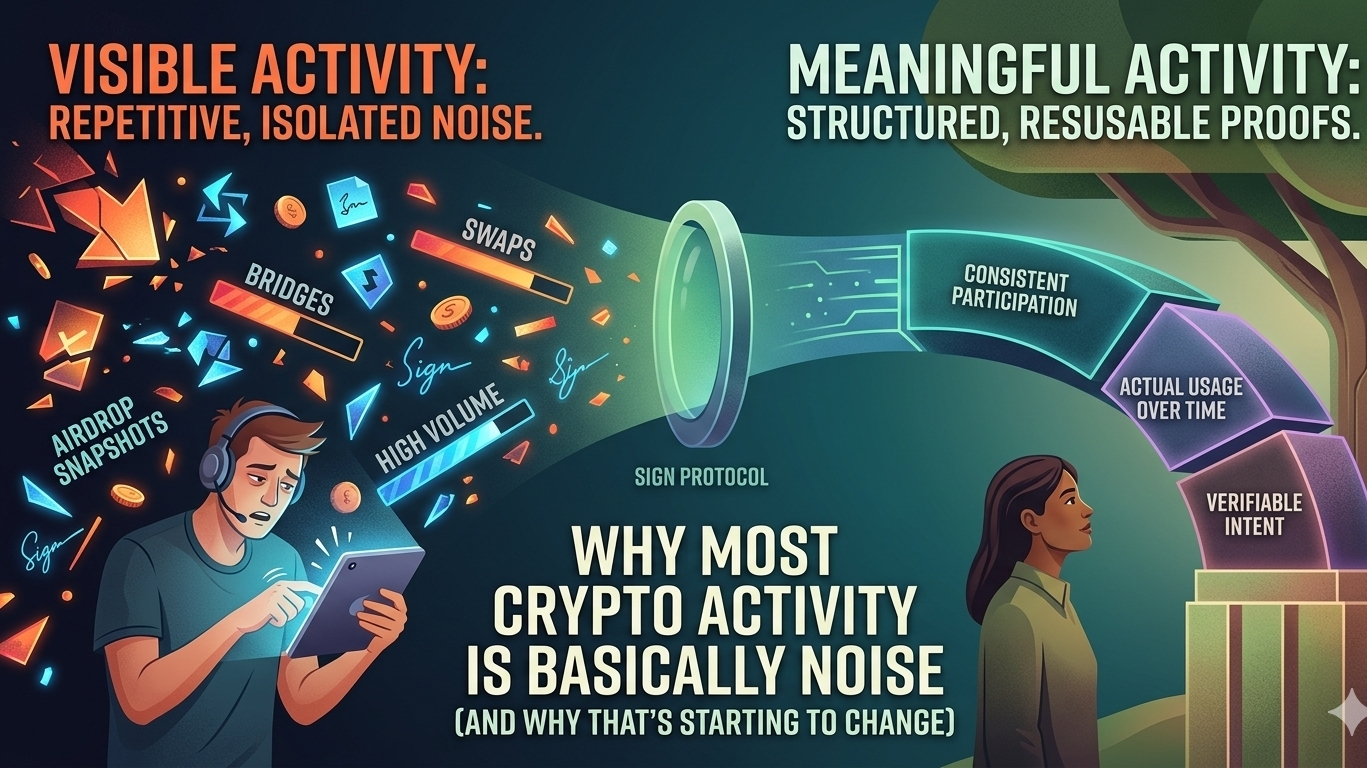
I used to think being “active” in crypto actually meant something.
You know the loop — bridge funds, swap a bit, stake something, maybe try a new app just in case it turns into an airdrop later. Do that across a few chains and suddenly you feel like you’re doing a lot. Like you’re early. Like you’re positioning.
But if you zoom out for a second… what did any of that actually produce?
Not much.
Most of it is just isolated actions. You click around, generate transactions, pay fees, and then move on. Nothing compounds. Nothing carries. It’s like writing notes on water.
And yeah, sometimes you get rewarded. Most times you don’t. Even when you do, it’s usually based on rough snapshots or unclear criteria that nobody fully understands. So people start gaming it — more volume, more transactions, more noise.
That’s when it hit me.
Crypto doesn’t really reward meaningful activity. It rewards visible activity.
Those two are not the same thing.
Because meaningful activity would be:
consistent participation
actual usage over time
doing something that proves intent or contribution
But visible activity? That’s just:
transaction count
volume spikes
random interactions
And the system can’t really tell the difference.
At least… it couldn’t.
This is where something like Sign Protocol starts to shift the logic a bit. Not in a loud way. Not in a “this changes everything overnight” way. More like — it quietly changes what gets tracked.
Instead of just logging that a transaction happened, it turns that action into something structured. Something that can actually be referenced later.
Which sounds small. But it changes incentives.
Because now the question isn’t: “How many times did you interact?”
It becomes: “What did you actually do — and does it still matter later?”
That’s a different filter entirely.
Look—right now, most systems don’t have memory in any usable sense. They can see your history, sure, but they can’t interpret it without rebuilding logic every time. So everything resets. Every app, every campaign, every “eligibility check.”
That’s why people overdo everything. More swaps, more signatures, more “just in case” actions.
Because nothing sticks.
But if actions turn into reusable proofs… that behavior starts to look inefficient.
Why repeat something ten times if doing it once properly is enough?
And this is where things get a bit weird — in a good way.
Because if systems can start reading past actions directly, then:
low-quality spam becomes easier to ignore
consistent behavior becomes more valuable
and random activity loses its edge
Which, honestly, would clean up a lot of the noise we’ve just normalized.
Quick aside — this doesn’t magically fix incentives overnight. People will still try to game things. They always do. But it raises the cost of doing it badly. And that alone shifts behavior over time.
Another thing people don’t really think about: most of crypto’s current “activity” isn’t reusable. You do something, it gets recorded, and then it just… sits there. No one references it again.
That’s wasted signal.
If that same action could be verified and reused across different systems, suddenly it has weight. Not because it happened — but because it can be used again.
That’s the difference between data and infrastructure.
And yeah, we’re not fully there yet. Most apps still operate in isolation. Most users still act like volume equals value.
But you can kind of see where this is going.
Less spam. More intent.
Less “do more.” More “do it once, properly.”
Honestly, that alone would make crypto feel less exhausting.
Because right now? It’s not hard — it’s just repetitive.
And repetition without memory is basically noise.