
There are moments in the market where price action stops being noise and starts becoming a stress test.
Right now, $SIGN is in one of those moments.
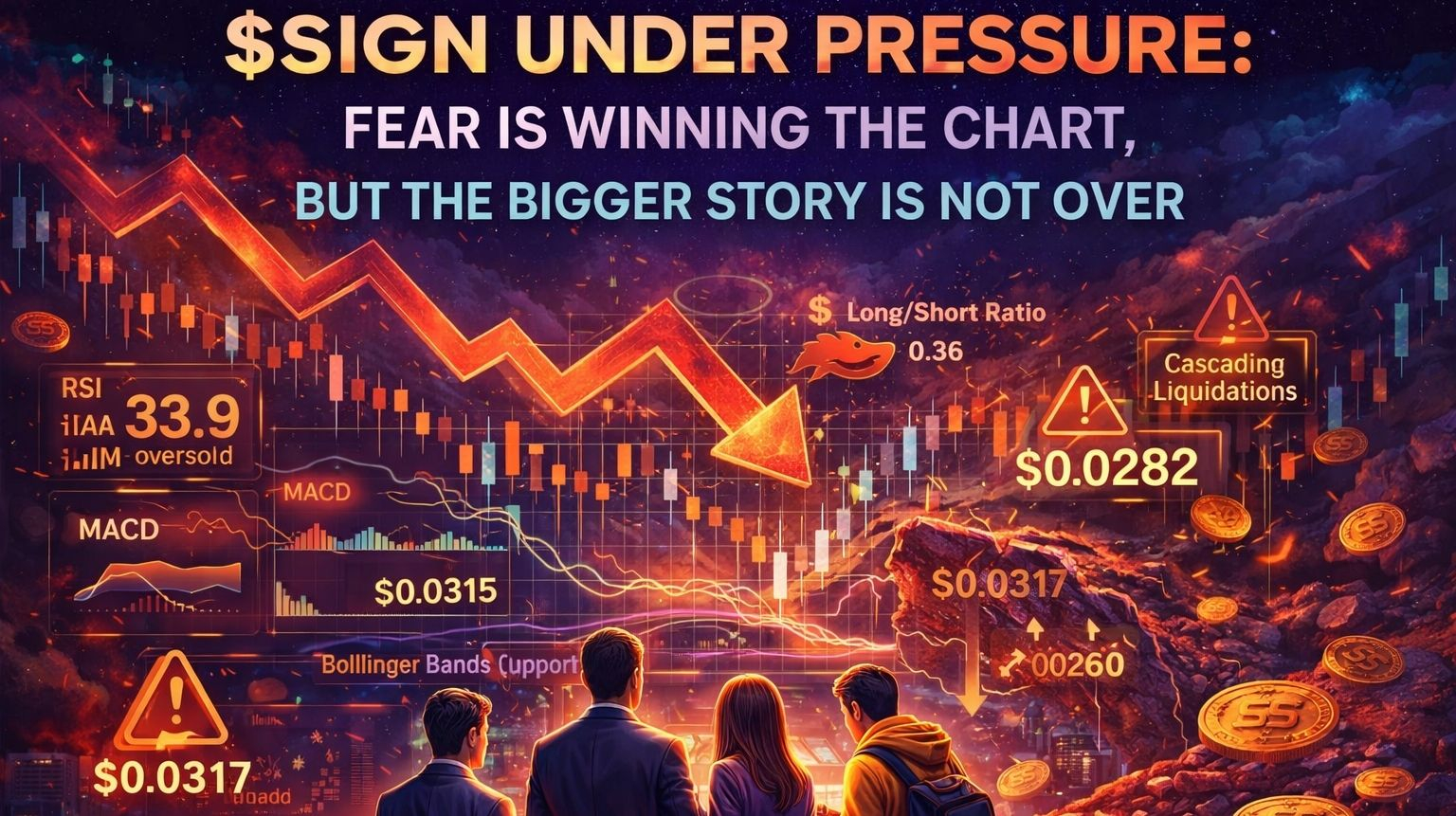
On the surface, the data looks brutal. A 40% weekly decline, RSI collapsing to 33.9, MACD accelerating deeper into bearish territory, and price trading below all major EMAs. This is not just weakness — it is structured downside pressure. The kind that forces participants to make decisions, not assumptions.
But the real story is not just in the indicators.
It is in who is in control of the market right now.
When Smart Money Turns, The Market Listens
The most important shift is happening beneath the chart.
The long/short ratio collapsing to 0.36 is not a minor signal. It reflects a decisive move by larger players — whales are no longer defending positions, they are actively leaning bearish. Top traders executed three consecutive hours of pure sell signals, distributing into weakness instead of absorbing it.
At the same time, 93% of short positions are now profitable, sitting on roughly 12% gains.
This creates a dangerous feedback loop:
Profitable shorts → stronger conviction → continued pressure → weaker longs → forced liquidations
And that is exactly what the market is starting to price in.
The Fragile Line That Could Break Everything
All eyes now sit on one level: $0.0315
This is not just a support.
It is a pressure point.
Price is already testing the lower Bollinger band, and if this level fails, the path toward $0.0282 opens quickly. Below that, the risk increases significantly, with cascading liquidations potentially driving price toward $0.0260.
This is where markets stop moving step by step…
and start falling in sequences.
Because once long positions begin to unwind, the market does not wait.
Flows Tell the Truth — And Right Now They Are Weak
Even the order flow confirms the imbalance.
A -$971K net outflow in a single hour, with sell orders nearly 2x stronger than buys, shows that this is not passive decline. This is active distribution.
There is no aggressive dip-buying yet.
No clear absorption.
No sign that large capital is stepping in to defend structure.
And in markets like this, absence of buyers is just as powerful as presence of sellers.
Silence Makes It Worse
What makes this phase even more fragile is the complete absence of catalysts.
No announcements.
No campaigns.
No ecosystem triggers.
No narrative support.
This leaves $SIGN fully exposed to pure market mechanics.
And in a broader environment dominated by fear, that is not a small detail.
Because when sentiment is weak, even strong projects can bleed simply due to lack of attention and momentum.
But This Is Where The Real Question Begins
Because despite everything happening on the chart, one thing has not changed:
@SignOfficial is still building infrastructure.
Not hype.
Not short-term narratives.
But systems around attestations, verifiable trust, digital agreements, and structured token distribution.
And that creates a powerful contrast:
Short-term → panic, liquidations, bearish flow
Long-term → infrastructure, utility, adoption potential
This is exactly where markets separate speculation from conviction.
The Reality No One Likes To Admit
Infrastructure projects rarely move cleanly.
They bleed.
They get ignored.
They get mispriced.
And only later — if they execute —
they get repriced aggressively.
Right now, the market is clearly saying:
“We do not trust this yet.”
But markets have said that before…
about projects that later became essential.
What Comes Next For $SIGN
The structure is very clear now:
Short-term →
Lose $0.0315 and downside accelerates
Reclaim $0.0322 and stabilization begins
Mid-term →
Pressure remains toward $0.0282 while liquidation risk builds
Long-term →
Only a reclaim above $0.0344 shifts structure meaningfully
Until then, this remains a high-risk, high-volatility environment
Final Thought
This is not a comfortable phase for $SIGN.
But it is a revealing one.
Because when whales are bearish, sentiment is weak, and price is under pressure —
the only thing that holds value is real belief in the underlying thesis.
So the question is no longer:
“Is the price going down?”
The question is:
Is this just another breakdown…
or the kind of pressure that builds the foundation for something bigger?