
There’s a certain kind of project that only starts making sense when the market gets tired. Not at the beginning, when hype is enough, and not at the peak, when everything sounds convincing. It shows up later, when people have already seen too much noise and too many promises that didn’t land. That’s where Sign Protocol sits. It doesn’t try to impress loudly. It tries to feel solid.
At first, it’s easy to like. The idea is simple in a way that actually works: people need to prove things. Not in some abstract, philosophical way, but in very real, everyday ways. Credentials, approvals, relationships, actions, records — all of it. Most of the systems we rely on today already do this, just in messy, disconnected formats. Sign takes that and tries to turn it into something cleaner, something programmable, something that can move across systems without losing meaning.
That part is hard to argue with. It makes sense almost immediately.
Instead of scattered databases and manual checks, you get structured schemas and attestations. Instead of trusting a system because you’re told to, you can verify what it’s saying. That alone puts it ahead of a lot of projects that struggle just to explain why they exist.
But the more time you spend with it, the more the feeling changes.
Because Sign isn’t just a neutral layer quietly sitting in the background. It’s built to work in different environments — open ones, controlled ones, and everything in between. And that flexibility, while useful, tells you something important about what it really is.
In an open setting, it behaves the way people expect from crypto: transparent, verifiable, public. But in more controlled environments, the rules shift. Access can be restricted. Decisions can be governed. Systems can be adjusted depending on who is using them and why.
That’s not a flaw. It’s intentional.
And that’s where things start to feel a little less clean.
For a long time, crypto pushed this idea that trust could be removed completely. That code would replace people, and systems would run exactly as written without anyone stepping in. It sounded powerful, and for a while, people really believed in it.
But reality didn’t cooperate.
Things break. Edge cases show up. Incentives get weird. And eventually, someone has to decide what happens next. Not the protocol. A person.
Sign seems to accept that instead of fighting it. It doesn’t try to erase control — it reshapes it. It builds a system where verification is cryptographic, but decisions can still be made when they need to be. Where records are structured and provable, but the system itself isn’t frozen forever.
That makes it more usable. It also makes it more complicated.
Because once you accept that a system can evolve, you also have to accept that someone, somewhere, has the ability to shape that evolution.
And that’s the part people don’t always sit with long enough.
When something is described as infrastructure, it feels neutral. When it’s called a protocol, it feels fixed. When it promises verification, it feels trustworthy. But those words don’t automatically remove human influence. They just make it easier to overlook where that influence still exists.
Sign lives right in that space.
It gives you proof, but it also keeps room for adjustment. It gives you structure, but not rigidity. It gives you something that feels stable, while still allowing it to change over time.
That balance is probably the reason it has a real chance.
Because if we’re being honest, most people don’t actually want a system that can never be touched. They want something that works, something that can handle problems, something that doesn’t collapse the moment something unexpected happens. Builders want flexibility. Organizations want control. Even users, after enough bad experiences, start to value systems that can adapt instead of just break.
Sign fits that mindset almost perfectly.
It doesn’t sell purity. It sells reliability.
But that tradeoff doesn’t disappear just because it’s packaged well.
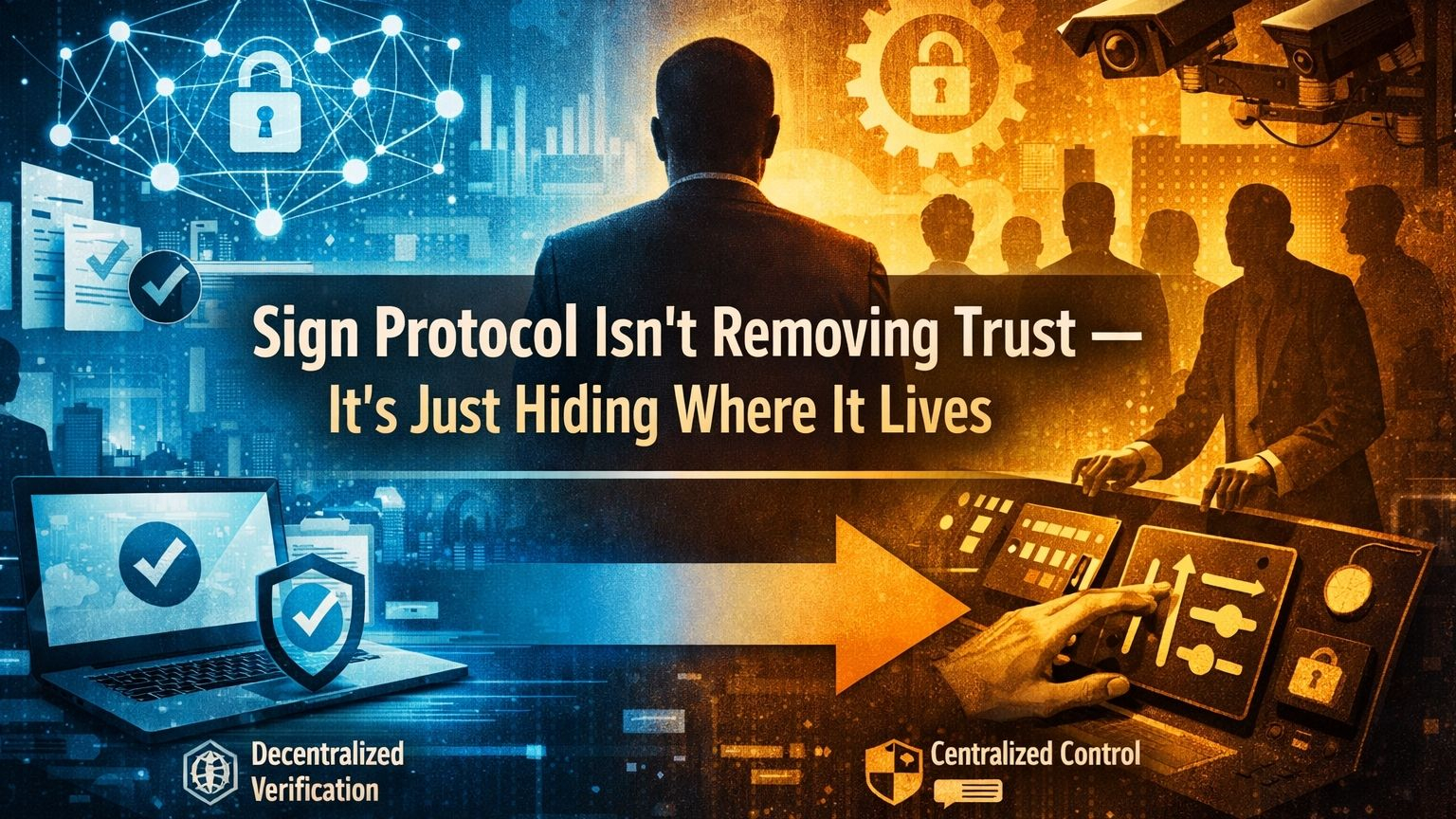
When a system keeps the ability to change, trust doesn’t go away. It just moves somewhere else. Instead of trusting a visible middleman, you’re trusting the structure behind the system — the governance, the permissions, the people who can still make decisions when it matters.
That kind of trust is quieter. It feels more technical. But it’s still there.
And in something built entirely around proof, that matters more than anywhere else.
Because proof only works if people believe the system itself won’t shift in ways they can’t see or influence. If the rules can change, then the meaning of what’s being proven can shift too. Sometimes that’s necessary. Sometimes it’s risky. Most of the time, it’s both at once.
That’s the tension sitting underneath everything.
And it’s not unique to Sign. You can see it across the entire space. Some systems lean fully open, letting anyone participate without much structure. Others lean more controlled, making sure things work in real-world conditions, even if that means giving up some idealism.
Sign clearly leans toward the second path.
It’s trying to build something that doesn’t just exist in theory, but actually gets used — by teams, by organizations, maybe even by governments at some point. And to do that, it has to meet those users where they are, not where crypto once hoped they would be.
That’s why it feels different.
Not because it’s perfect, but because it’s more honest about the compromises.
And maybe that’s what makes it worth paying attention to.
It’s not promising a world where trust disappears. It’s building a system where trust is organized, structured, and made easier to live with. Where control is still present, but less obvious. Less intrusive. More disciplined.
You can look at that and see progress.
Or you can look at it and see the same old tradeoff, just refined.
Either way, it’s not something you can ignore.
Because if Sign Protocol does succeed, it probably won’t be because it achieved some pure version of decentralization. It will be because it found a place in that middle ground — open enough to feel credible, controlled enough to be useful.
And that middle ground is exactly where the market seems to be heading, whether people like to admit it or not.
