
@SignOfficial #SignDigitalSovereignInfra $SIGN
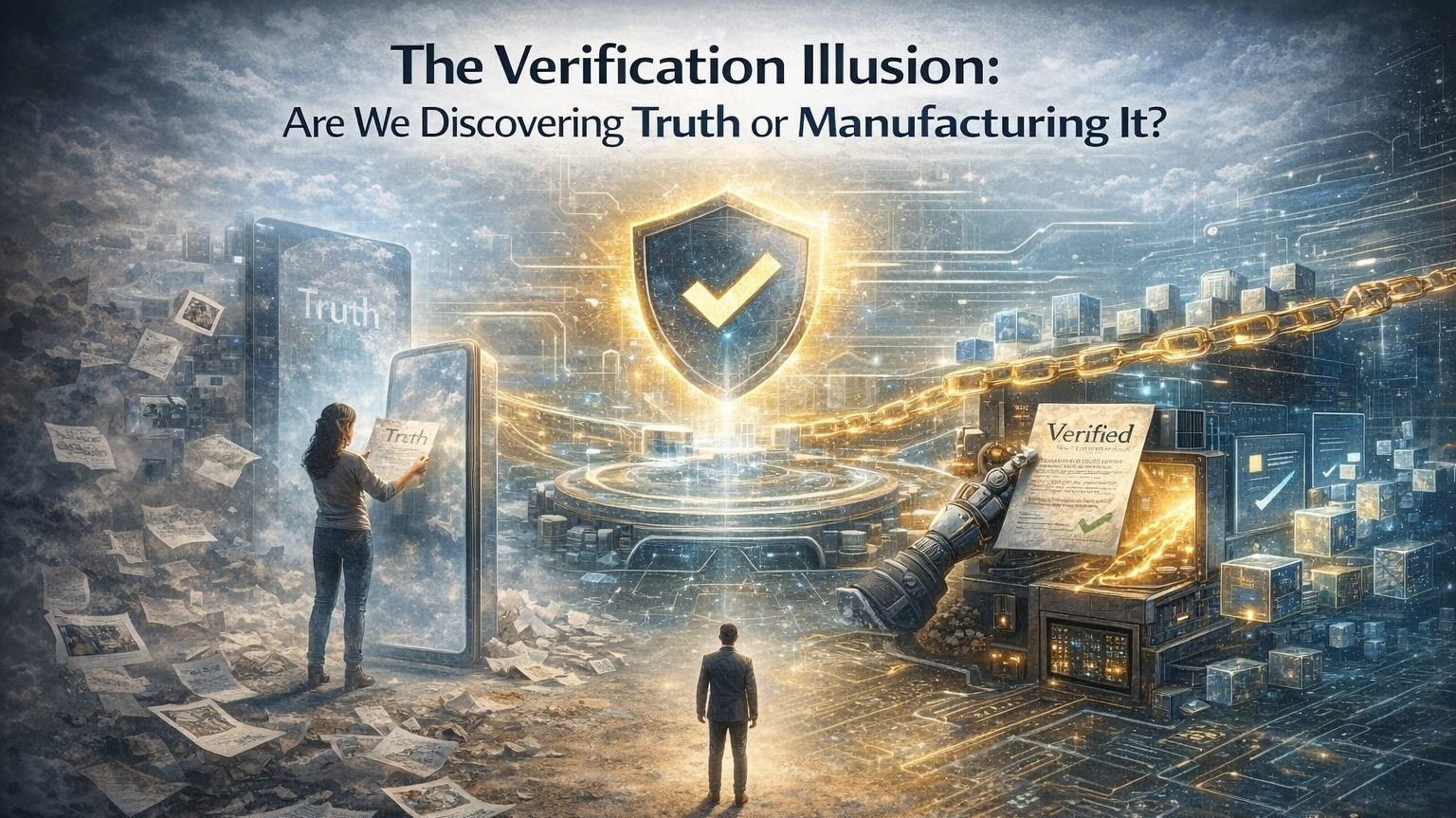
Lately, I haven't been able to shake this weird thought: what if systems like $SIGN aren’t actually uncovering the truth, but slowly dictating what we’re allowed to call truth?
The more I chew on it, the more "verification" feels less like a mirror and more like a mold. A mirror just reflects what's already there. A mold decides the shape before anything is even formed. And with all its schemas, attestations, and programmable rules, SIGN leans heavily toward the latter.
Think about it—before anything can be verified, it has to be formatted. It has to fit into a neat little schema. That tiny, almost invisible requirement changes the whole game. It means reality has to agree to become "data" before the system even acknowledges it. If something is too messy or resists being structured? It just quietly drops off the map.
It makes me wonder: are we discovering the truth here, or just formatting it?
Even "attestations" start to feel a bit unsettling when you really unpack them. On the surface, they look like hard proof. But honestly? They aren’t the truth itself. They’re just someone’s signed agreement about the truth—a claim backed by authority and wrapped up in cryptography. Once that claim gets recorded, reused, and shared enough times, it magically becomes "fact," even if it started as an assumption.
It feels like we aren't building a system to prove reality; we're building an engine to stabilize agreements.
And the scale of this is wild. Millions of attestations. Billions in token distributions. Tens of millions of wallets. At that size, it stops being just a tech tool and becomes an environment. And humans do what humans do best: we adapt to our environment.
If your access, rewards, and opportunities depend entirely on what can be cryptographically verified, your behavior is going to shift. You start optimizing for what is provable within the system's boundaries, rather than what is genuinely true. Looked at from this angle, token distribution isn't just economics; it’s quiet, subtle conditioning. It teaches people what kind of actions—and what kind of existence—actually count.
Then there's the privacy angle. "Selective disclosure" sounds incredibly empowering, but you’re still only choosing from a menu the system designed for you. It's a very polite, structural kind of control.
And immutability... man, that used to sound like the ultimate protection, but it's starting to feel heavy. Humans are messy. We grow, we change our minds, we evolve. A system that literally never forgets can't evolve with us. It just traps us in older versions of ourselves. What happens when a living, breathing human is tethered to a non-living, permanent record?
Even cross-chain trust feels less like actual certainty and more like passing the buck. We say trust is portable, but risk is just as portable. Once a claim moves across systems, it drags all its original, unquestioned assumptions right along with it.
Somewhere in all of this, verification stops being about reducing the unknown and starts being about redefining it.
So where does that leave the stuff that can't be proven? The intuition, the context, the beautiful, messy parts of human life that refuse to be compressed into a data field?
I really think the biggest shift here isn't technological—it’s philosophical.
We’re transitioning from a world where truth existed first (and systems just tried to capture it) to a world where systems dictate the strict conditions under which truth is allowed to exist at all.
And if that’s the case, the real question isn’t whether platforms like SIGN are working. The question is a lot deeper, and way more uncomfortable:
Are we still looking for the truth, or are we just learning to live inside the only version of it our tech can process?
#SignDigitalSovereignInfra $SIGN
