
I used to think the biggest problem in crypto was speed. Fees. Congestion. “Better TPS.” All that stuff. But the longer I stay in this space, the more I realize the real pain is smaller and more repetitive: proving the same thing again and again.
I join a campaign… then I have to prove I joined. I contribute… then I have to prove I contributed. I pass a check once… then a different app makes me do it again like the first proof never existed. And the worst part? Half of the time, the “proof” is a messy mix of screenshots, forms, spreadsheets, Discord roles, and some backend script nobody can audit. It works… until it doesn’t. Then you’re stuck refreshing, opening tickets, and hoping the team didn’t miss your wallet.
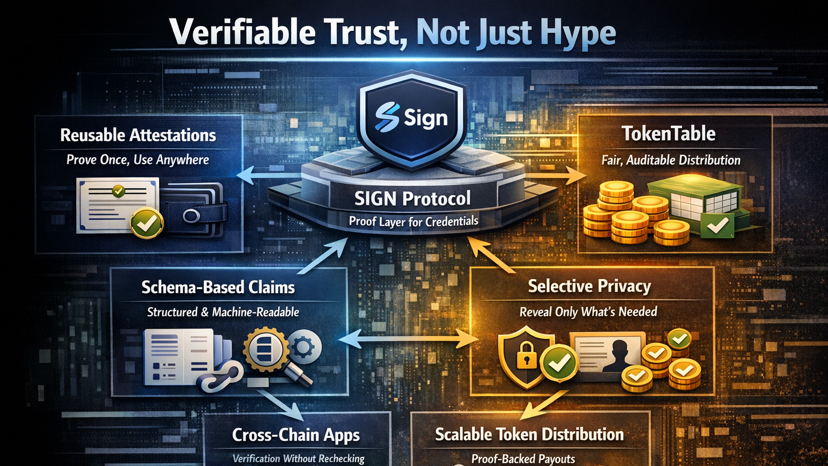
That’s why $SIGN caught my attention. Not because it has the loudest marketing, but because the idea is annoyingly practical: make verification reusable. Not “verify once for this one app.” More like: verify it once, turn it into a clean record, and let other systems read it later without making you restart the whole process.
The Shift: From “Trust Me” to “Show Me”
This is the mental flip I keep coming back to. Most projects still run on a “trust me” layer, even when they pretend they don’t. Trust the team’s spreadsheet. Trust the airdrop script. Trust the backend. Trust the admin.
Sign is pushing a different pattern: a claim becomes an attestation — a structured, signed statement linked to a wallet and an issuer. That way, it’s not just “Annie says she did the task.” It’s “This issuer attested that this wallet did the task,” and that proof can be checked later.
And I like that because it’s not philosophical. It’s operational. It makes the boring stuff clean:
• who is eligible
• who is verified
• who completed what
• who should receive what
That’s the stuff that breaks the fastest when your system grows.
Schemas Are the Part People Sleep On
The deeper I go, the more I think schemas are where the “quiet power” sits.
A schema is basically the format that says: this is what truth looks like in this system. If the schema says “KYC approved,” it defines what fields matter, what counts as valid, and what an app can rely on. Then attestations are the real records that follow those rules.
So it’s not just storing data. It’s storing meaning in a way machines can read.
That’s why I keep saying Sign 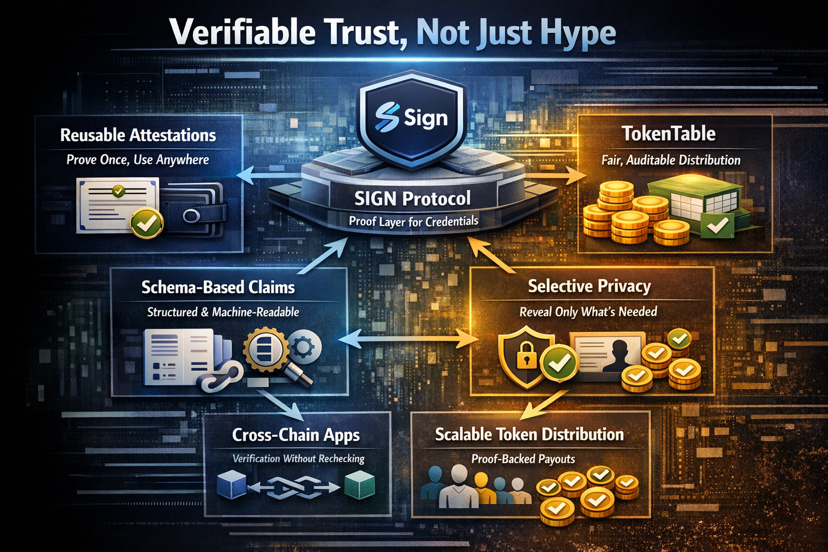 doesn’t feel like a single product to me. It feels like the kind of infrastructure where, once enough apps accept the same “shape of truth,” verification stops being a constant headache.
TokenTable Is Where This Gets Real
A lot of people only notice Sign when TokenTable comes up, because distribution is where everyone feels pain instantly.
Token distribution at scale is chaos. I’ve watched teams mess up allocations, miss wallets, struggle with vesting schedules, and end up in damage-control mode because one spreadsheet cell was wrong. And even when it “works,” it still feels like a fragile process held together by admin effort.
What I like about Sign’s approach is that distribution can be tied to proof, not vibes.
Instead of “here’s a list, trust us,” it becomes “this wallet qualifies because it has this attestation.” That’s a big upgrade in my head. It makes fairness programmable. It makes eligibility verifiable. And it makes the process easier to audit later when people ask questions (because they always do).
Privacy Isn’t Optional, It’s the Whole Point
One thing I don’t want is a world where identity becomes fully public by default. That’s not progress. That’s just surveillance with nicer UX.
What makes this interesting is the direction toward selective disclosure — proving what’s necessary without exposing everything behind it. In real systems (especially anything compliance-heavy), most of the time the goal is not “show all your data.” The goal is “prove the minimum required.”
That’s the difference between:
• “here’s my whole identity”
and
• “here’s proof I meet the condition”
If Sign can keep pushing this balance — proof without oversharing — then it becomes useful far beyond airdrops. It becomes usable in the real world where privacy, compliance, and auditability all have to sit in the same room.
What I’m Watching Next (Because This Is the Real Test)
I’m not blindly bullish on anything. I’ve seen too many smart ideas die because nobody adopted the standard.
That’s the real risk here too: infrastructure only matters when other people actually use it. The product can be perfect, but if builders keep doing their own custom verification flows out of habit, the whole “shared trust layer” stays smaller than it should be.
So I’m watching for something simple:
• Are more apps issuing attestations as default behavior?
• Are more systems reading them instead of re-verifying users?
• Does the proof start traveling across ecosystems like it’s normal?
Because if that happens, @SignOfficial stops being “a project I post about.”
It becomes a layer people depend on without thinking.
And honestly… that’s usually how the most important infrastructure wins.
Quietly. Repeatedly. Until it’s hard to replace.