
There’s something I used to believe was pretty straightforward:
whoever stakes more → has more influence.
And most of the time… that doesn’t end well.
Back in early 2025, we saw governance cases getting manipulated by just a handful of large wallets. It didn’t take a crowd — a small group with enough tokens could shape the outcome. When capital is big enough, “truth” sometimes takes a back seat.
So when I first came across SIGN using staking to validate models, my initial reaction was:
“Here we go again — another playground for whales.”
But the deeper I looked, the more I realized the core mechanism here is actually different.
SIGN doesn’t use staking to vote on what’s right or wrong.
It uses staking as a financial commitment to belief.
You don’t just “support” a model — you put money behind it.
If the model is wrong? You pay for it. Not with reputation, but with real assets.
The key lies in one mechanism: slashing.
Without slashing, staking is just a formality.
With strong enough slashing, staking becomes accountability.
Think of it like co-signing a loan.
You’re not just saying “I trust this person” — you’re putting your own money at risk. If they fail, you take the hit.
⚖️ SIGN sits between two extremes that have already failed
No staking → open participation → spam & Sybil attacks
Heavy staking → whale dominance → centralization
SIGN tries to balance both:
👉 Stake to create responsibility
👉 Keep the system open for multiple models to compete
Sounds great in theory. But reality is messier.
⚠️ Problems start to appear in practice
Two likely scenarios:
1. Whales shape “truth”
A model gets heavily staked — not necessarily because it’s right, but because it has strong capital backing. Over time, it becomes the default standard.
2. Fragmentation
Smaller participants spread their stake across many models → too many options, but none strong enough to build consensus.
Neither outcome is ideal.
One leads to soft centralization, the other to chaos.
🧠 The most important insight
In this system:
It’s not that those who stake more are more correct.
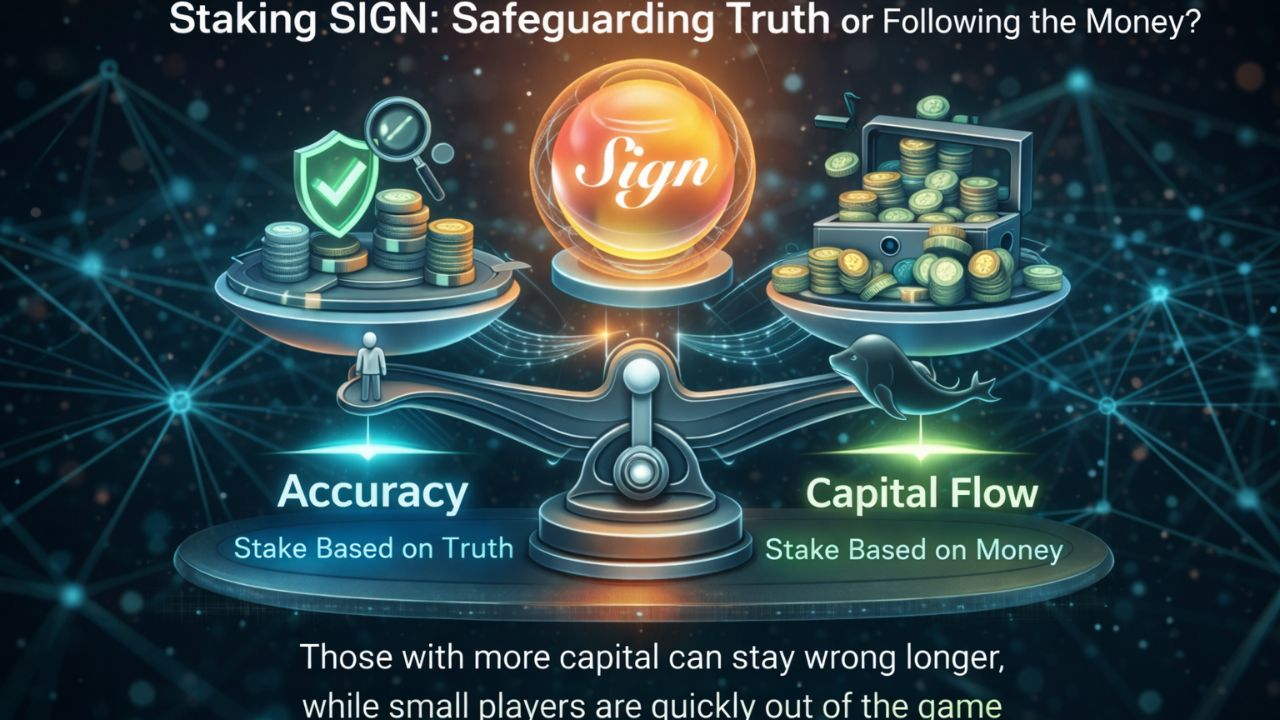
It’s that they can afford to be wrong longer.
Large holders can keep backing a flawed model for extended periods.
Smaller players? One mistake and they’re out.
And from here, a subtle but dangerous shift happens:
👉 People start staking based on capital flow
👉 Not based on accuracy
At that point, the system no longer reflects truth
—it reflects where the money is going
🚧 What SIGN needs to address
For this model to truly work, a few things are critical:
Limit the influence of large stakes per model
Increase the speed and severity of slashing
Introduce weighting based on historical accuracy
Reduce the ability for capital to “sustain being wrong”
🎯 Conclusion
At first, I thought staking was about power.
But looking closer, it feels more like high-risk insurance.
You take a side with your capital.
If you’re right → you earn
If you’re wrong → you pay
But here’s the catch:
those with more money can always afford more “insurance.”
👉 SIGN succeeds if:
The cost of being wrong is high — and happens fast
👉 SIGN fails if:
Large capital can afford to stay wrong for too long
And once you see it this way,
it’s hard to look at staking as just “belief” ever again.
@SignOfficial #SignDigitalSovereignInfra $SIGN
