
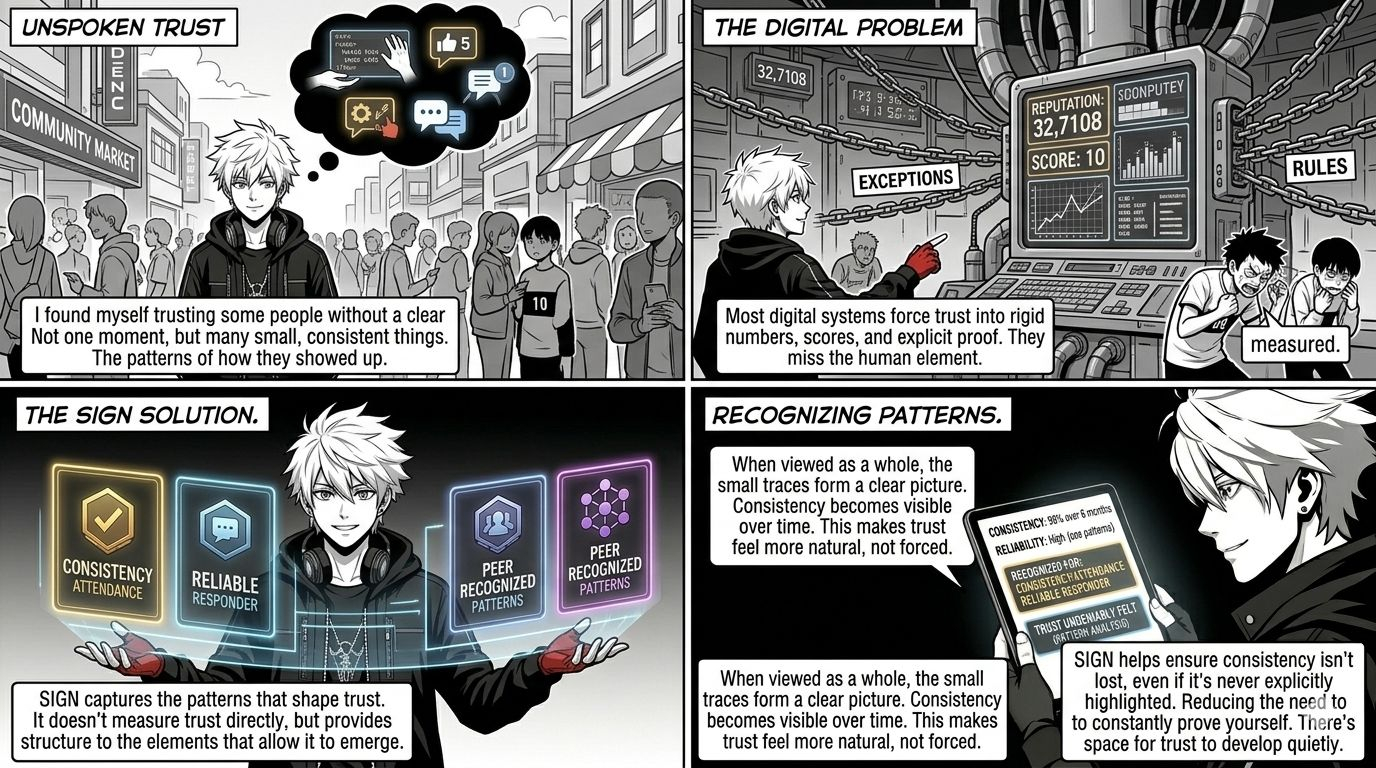
I’ve been in situations where you trust someone, but if asked why, you can’t really give a clear answer. Not because of one defining moment, but because of many small, consistent things. The way they respond, the way they show up, the way they don’t disappear when needed. It all adds up, without ever being explicitly stated.
The problem is, in many digital systems, this kind of trust is almost never accounted for. Systems usually require something explicit, numbers, scores, or proof that can be directly pointed to. Meanwhile, real trust is often formed from things that are never formally expressed.
This is where I started to see SIGN moving in a different direction. Instead of trying to “measure trust” directly, it focuses on capturing the patterns that shape it. SIGN doesn’t declare who is trustworthy, but provides structure to the elements that allow trust to emerge.
What’s interesting is that this makes trust feel more natural. It isn’t forced into numbers or rigid labels. SIGN simply ties together small traces that, when viewed as a whole, begin to form a clearer picture.
This approach also changes how people build relationships in digital spaces. It’s no longer about a single moment of proof, but about consistency that becomes visible over time. SIGN helps ensure that this consistency isn’t lost, even if it’s never explicitly highlighted.
At the same time, it reduces the need to constantly “prove yourself.” As systems become better at recognizing patterns, people don’t always have to perform or explain. There’s space for trust to develop quietly.
What stands out is how SIGN begins to touch something deeply human, trust that isn’t always easy to explain, but is undeniably felt.
@SignOfficial #SignDigitalSovereignInfra $SIGN
