
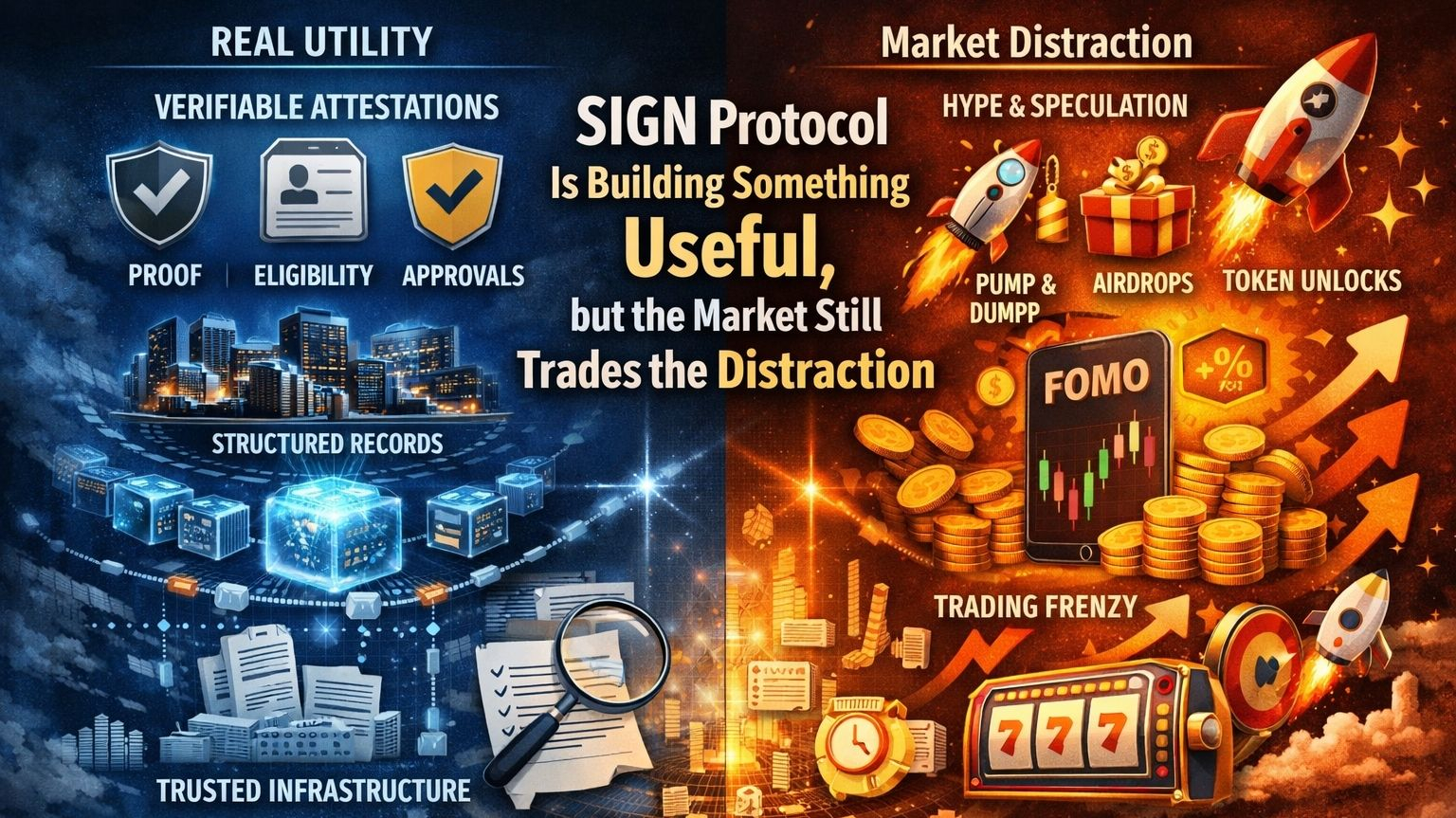
What keeps pulling me back to SIGN Protocol is that it doesn’t feel like one of those empty crypto projects that survives on recycled vocabulary and borrowed excitement. I’ve seen too many of those already. Too many glossy systems with no real center, no actual friction point they’re solving, just the same noise wrapped in a new color palette. SIGN at least starts from a real problem, and that alone puts it ahead of a depressing amount of the market.
Most blockchains are fine at recording movement. Tokens move. Balances update. Wallets sign. Great. But the second you ask a more serious question — why this address qualifies, who approved this action, what evidence supports this distribution, whether a claim can be verified six months later without digging through scattered dashboards and half-dead links — things get messy fast. That part of crypto still feels primitive. Not early. Primitive.
That’s the gap SIGN is trying to deal with.
And I’ll be honest, I think that matters more than a lot of the louder narratives people keep chasing. Everyone wants speed, scale, attention. Very few want to talk about proof, because proof is boring until the moment you desperately need it. Then it becomes the only thing that matters. That’s where SIGN makes sense to me. It is built around attestations, which is a dry word for something pretty simple: a verifiable claim. A record that says something is true, or was true, and can still be checked later without depending on somebody’s memory, somebody’s private spreadsheet, or somebody’s convenient version of events.
That sounds basic. It isn’t.
The whole space keeps pretending that trust disappears once a transaction lands onchain. It doesn’t. The transaction is often the cleanest part. The mess sits behind it. Somebody still decides who gets access, who passes a check, who can claim funds, who signed off on a release, whether a condition was met, whether a record is valid. Crypto likes to act as if these are minor operational details. They’re not. They’re the part that breaks first when systems start handling real money, real coordination, real scrutiny.
This is where SIGN gets more interesting the longer I sit with it. It isn’t trying to solve everything, which already makes it more believable than half the market. It is focused on turning claims into structured records that can actually travel across systems and still mean something when they get there. That is a narrower ambition than the usual “we’re rebuilding the future” nonsense. Narrower is good. Narrower means there might be an actual product underneath the pitch.
I also think there’s something quietly serious about the way the project is positioned. Not sexy. Serious. That distinction matters. A lot of crypto teams want to be seen as infrastructure because it sounds mature, but when you press on what they’re actually building, it falls apart into branding language. SIGN feels different to me because the evidence layer is concrete. Claims, approvals, eligibility, records, signatures, proof. You can imagine where that lives in a real workflow. You can imagine why someone would not want to build it from scratch every single time.
That’s usually my test now. Not whether a project sounds smart. Plenty of bad projects sound smart. I ask whether I can see the grind. Whether I can see the problem it’s rubbing against every day. Whether there’s enough friction in the category to justify the existence of a dedicated protocol. With SIGN, I can see it. That doesn’t make it a winner. It just means it isn’t obviously fake.
Still, I don’t trust easy compliments anymore.
The real test, though, is whether useful infrastructure becomes necessary infrastructure. That’s where a lot of otherwise respectable projects stall out. They solve a real problem, people nod along, maybe a few teams integrate them, and then nothing breaks open. They remain helpful. They never become essential. That middle state kills a lot of projects slowly, and the market is full of dead things that were once described as “promising.”
I can imagine that risk with SIGN pretty clearly.
Because here’s the ugly part about infrastructure in crypto: the more functional it is, the easier it is for the market to ignore it. If it works, it fades into the background. If it fades into the background, people stop assigning narrative premium to it. And if the token doesn’t have a brutally clear connection to the value being created, then you end up with the familiar problem — a serious protocol, maybe even a good one, attached to an asset the market mostly treats as another speculative chip.
That’s not me being cynical for sport. I’ve just seen this movie too many times.
SIGN’s focus on attestations and structured proof gives it real shape. I believe that. I also know belief is cheap. The harder question is whether enough builders, enough organizations, enough systems with real operational pain start depending on it in a way that creates depth instead of temporary usage. I’m not looking for surface-level traction anymore. I’m looking for the moment this actually becomes annoying to replace. That’s when I start paying attention in a different way.
Because usefulness alone won’t carry it. Crypto graveyards are full of useful things.
Another reason I keep some skepticism in the frame is that projects like this are always at risk of getting swallowed by broader market behavior. It doesn’t matter how thoughtful the core design is if the surrounding attention stays trapped in the usual cycle of token chatter, emissions, rotation, unlocks, incentives, noise. The market has a talent for flattening everything into the same trade. Good systems, bad systems, half-built systems — all shoved into the same machine, all priced through the same exhausted reflexes.
That grind changes how projects are perceived. It changes what people notice. A protocol can be doing careful, necessary work in the background while most of the market watches the loudest metric on the screen and calls that analysis. I’ve seen solid projects get buried under that. I’ve also seen weak projects survive way longer than they should because the timing lined up and the noise machine picked them.
So when I look at SIGN, I try to separate the project from the market around it. Those are not the same thing. The project itself has more coherence than most. It is trying to make claims portable, records verifiable, and trust less dependent on closed systems and scattered evidence. That’s real. It’s not fluff. It addresses a layer that has been underbuilt for years.
But I’m still watching for whether it actually locks into recurring workflows where the pain is obvious and the replacement cost starts to rise. That’s what matters. Not whether people can write a good thread about it. Not whether it sounds like “future infrastructure.” I’m past caring about polished labels. I want to see whether this becomes part of the plumbing people stop noticing because they no longer want to live without it.
And maybe that’s the quiet strength here. SIGN doesn’t need to dominate public attention. Honestly, that might be a bad sign if it did. It just needs to become embedded where proof, approval, and structured records are a constant headache. If it can do that, then it might end up mattering more than the louder projects that spend all day performing importance.
I don’t know if it gets there. I just know it’s asking a better question than most of the market is asking right now.
Maybe that’s enough to keep watching. Or maybe it’s just another smart system entering the same old grind, hoping utility survives long enough for someone to notice.