

The recent price action of SIGN may look uncertain on the surface, but a closer look at the chart reveals something more structured -- and potentially promising. After a period of volatility, the token is now stabilizing around a critical support zone, and that’s where the story begins.
At the moment, SIGN is holding above the $0.030–$0.033 range, a level that has already proven to be important. Price has tested this zone multiple times, and each time, buyers have stepped in to defend it. This kind of repeated reaction is not random -- it signals that the market recognizes this area as value.
What makes the current setup more interesting is the context. Before this pullback, $SIGN showed a strong upward move from the lows near $0.023, rallying toward the $0.053 to $0.061 resistance zone. That move confirmed that demand still exists. The current dip, therefore, appears less like weakness and more like a retest of support after a bullish attempt.
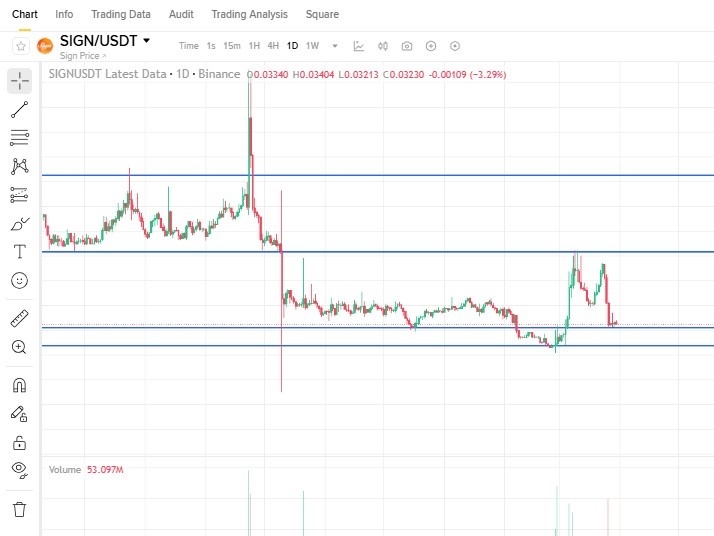
In many cases, this kind of price behavior -- an upward push followed by a controlled pullback and stabilization--- marks the early stages of a trend shift. As long as the price continues to hold above this support zone, the structure remains constructive.
Looking ahead, the key level to watch is again the $0.053–$0.061 range. A move back toward this area would signal renewed strength, and a successful breakout above it could open the path toward the next major level near $0.092. These levels define the roadmap: support below, confirmation in the middle, and expansion above.
What stands out in this chart is how clearly the levels are being respected. The market is reacting cleanly to both support and resistance, which often indicates that accumulation is taking place. Instead of chaotic movement, the structure appears controlled -- something traders typically look for when identifying potential reversals. However, the technical setup is only part of the picture.
@SignOfficial is positioning itself as more than just another crypto project. It is designed as sovereign-grade infrastructure, where governance and operational reliability are central to its architecture. This is reflected in its layered governance model, which separates responsibilities into policy, operational, and technical domains.
Policy governance defines the rules -- what programs exist, how they function, and who is authorized. Operational governance ensures systems run smoothly on a daily basis, with clear processes for monitoring and incident handling. Technical governance, meanwhile, controls upgrades, security measures, and system integrity. Together, these layers create a framework that is not only functional but also auditable and adaptable to real-world conditions.
This level of structure is essential for systems that aim to operate at national or institutional scale. It moves the conversation beyond simple applications and into the realm of infrastructure that can support complex, high-stakes environments. In this context, the current price zone becomes more meaningful. It represents a point where technical support aligns with a broader narrative of long-term development. While short-term volatility is always a factor, the foundation being built suggests that SIGN is not solely dependent on market cycles.
For now, the focus remains on how price behaves around the current support. Holding this level keeps the bullish structure intact, while a move back toward resistance would provide further confirmation of strength. In markets, clarity often comes from structure. And right now, SIGN is beginning to show one.
#SignDigitalSovereignInfra
