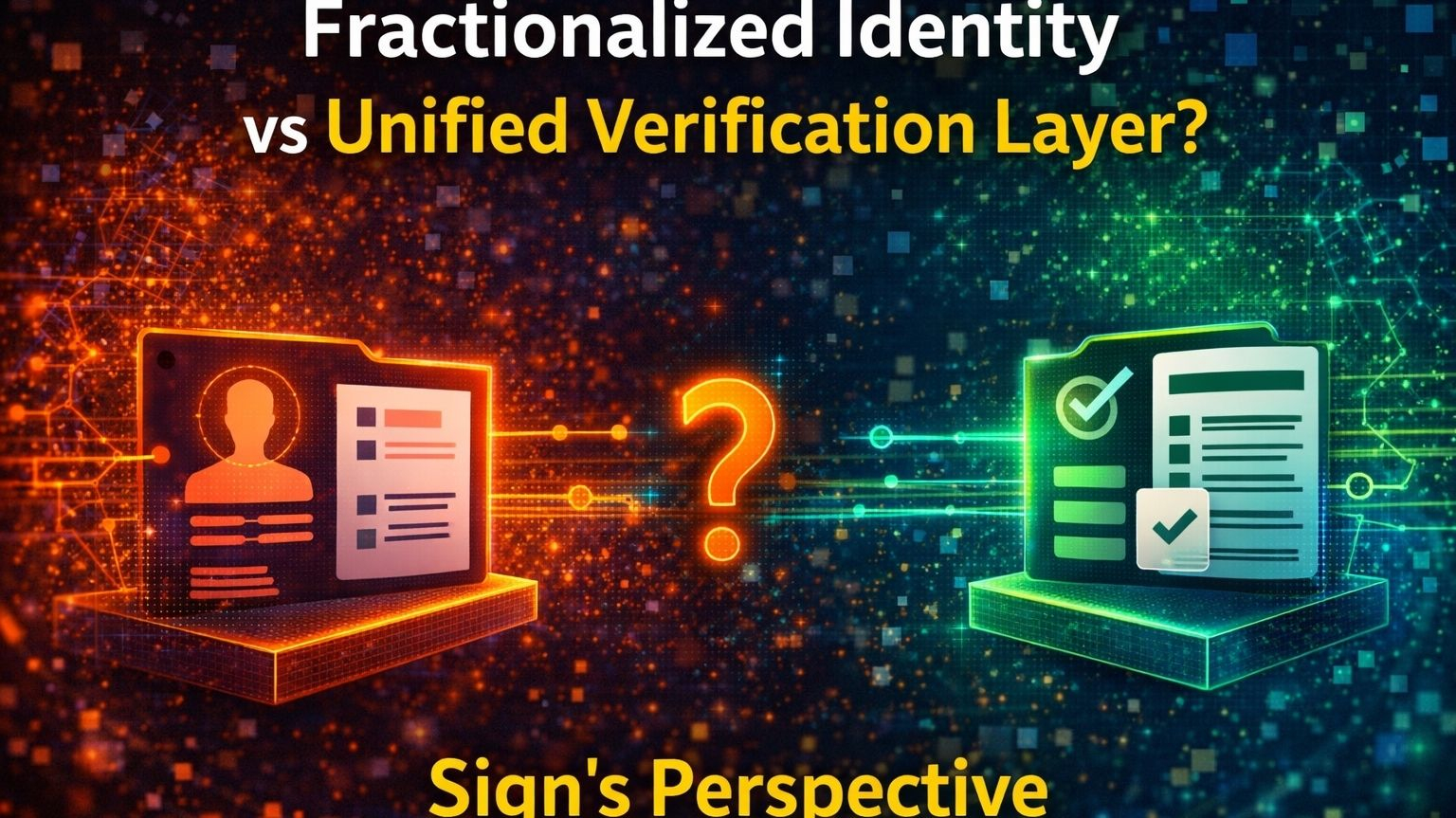
When people talk about identity in digital systems, they usually assume the goal is to create one unified identity that works everywhere. But if you look closely, that approach has never really worked well. In Web2, every platform creates its own identity system. In Web3, wallets were supposed to simplify things, but even there, identity is still fragmented. Different apps rely on different signals, and nothing truly carries over in a consistent way.
This is where Sign takes a slightly different path. Instead of trying to unify identity itself, it focuses on unifying verification. That might sound like a small shift, but in practice, it changes how systems interact. Sign is not asking every platform to agree on who you are. It is creating a way for platforms to agree on what can be verified about you.
That difference becomes clearer with examples. Imagine a user who has already proven eligibility for a program on one platform. Normally, if they move to another platform, they have to go through the same checks again. The identity is not trusted outside its original context. With a shared verification layer, the second platform does not need to rebuild the process. It only needs to recognize the attestation and verify that it meets the required conditions.
Another example is reputation. A user might complete tasks, contribute to communities, or meet certain criteria across different environments. Today, that information is scattered and often locked inside individual systems. With a unified verification layer, those actions can be structured as attestations and recognized elsewhere without starting from zero each time.
From my point of view, this approach feels more realistic than trying to force a single identity system across everything. Systems do not need to fully trust each other at the identity level. They only need a reliable way to verify specific claims. That lowers the barrier for interaction while still maintaining flexibility.
At the same time, this model depends heavily on whether platforms are willing to recognize and rely on shared attestations. The technology can define the structure, but adoption is what gives it meaning. Without enough participants, even a well-designed verification layer remains limited in practice.
Still, I think this is one of the more grounded ideas behind Sign. It does not try to solve identity as a whole. It focuses on making verification portable and consistent, which is a more achievable step with immediate value.
The real question is simple: if systems can agree on what to verify, do they still need to agree on identity at all?@SignOfficial $SIGN