
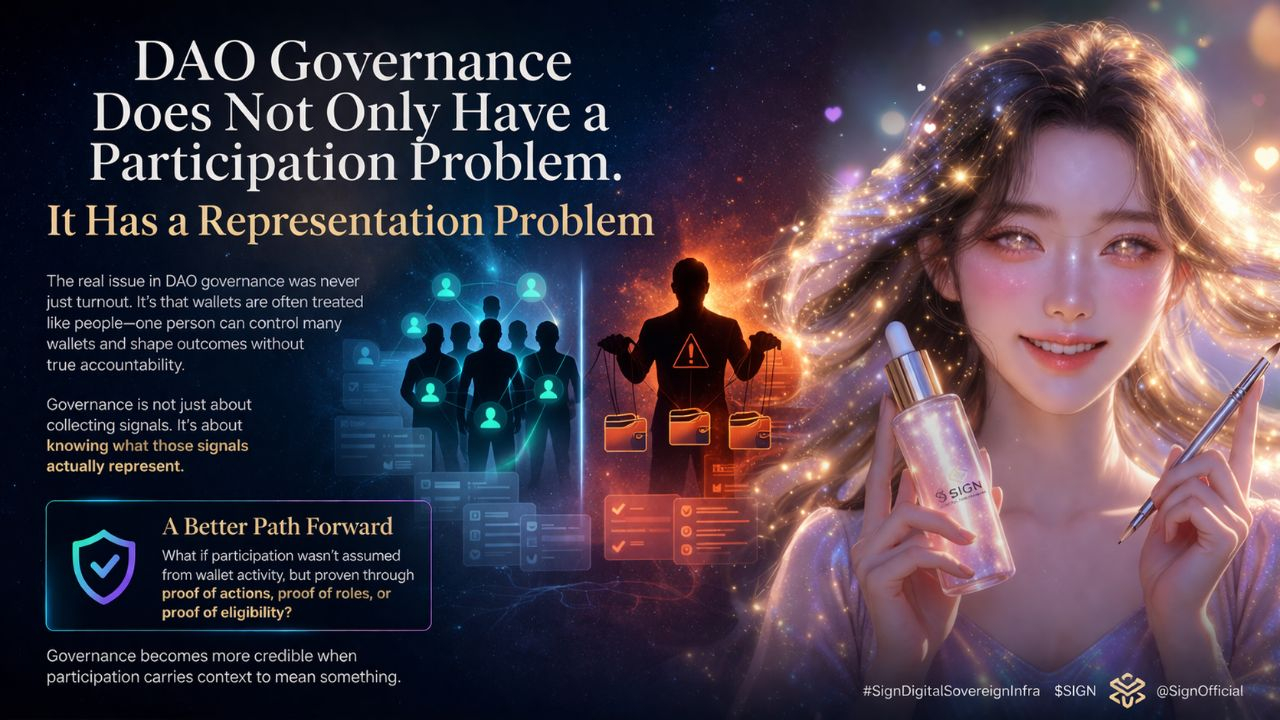
The more I watch crypto governance, the more I feel the conversation often starts in the wrong place.
People usually talk about turnout.
How many wallets voted.
How active the discussion looked.
How many signals appeared around a proposal.
But I am not sure that is where the real issue begins.
Sometimes a system can look active on the surface and still feel strangely hollow underneath. The article that stayed with me put this feeling into words very clearly: DAOs can appear busy and alive, yet still leave the impression that something is off. Its core argument is that the deeper problem may not be governance design or tokenomics first, but the fact that wallets are often treated like people even though one person can control many wallets and quietly shape outcomes through that structure.
That distinction matters more than it seems.
Because governance is not just about collecting signals.
It is about knowing what those signals actually represent.
A wallet can hold tokens.
A wallet can vote.
A wallet can stay active across proposals.
But none of those things automatically tell us whether there is real understanding, real commitment, or real accountability behind the action. The article makes this point directly when it questions assumptions like “more votes = better decisions” and argues that holding, voting, and visible activity do not necessarily mean meaningful contribution.
To me, that is where the problem shifts.
It stops being a participation problem.
It becomes a representation problem.
What exactly is being represented when a vote appears?
A distinct individual?
A real contributor?
A coordinated actor with multiple wallets?
A passive holder clicking through?
A voice with context, or just a signal that happened to be counted?
These are uncomfortable questions, but they are important ones.
And this is why the SIGN angle feels interesting to me.
The article does not present SIGN as a magical solution. In fact, one of its strengths is that it stays measured. What caught the writer’s attention was not a promise to “fix governance,” but a better question: what if participation were not simply assumed from wallet activity, but had to be proven through things like proof of actions, proof of roles, or proof of eligibility. The same piece also points to signs of real usage, mentioning millions of attestations, tens of millions of wallets touched, billions in value, and activity across multiple chains.
That idea stayed with me too.
Because once participation starts carrying context, governance begins to change shape.
Not everyone has to vote on everything.
Not every signal has to carry the same weight.
And not every wallet should automatically be treated as an equally credible representation of a person’s stake in a decision.
That does not necessarily make a system less decentralized.
In some cases, it may make it more honest.
At the same time, I do not think this removes the hard questions. The article is careful about that as well. It explicitly asks who decides what counts as valid proof, who issues the credentials, and whether this can become another layer of control rather than a cleaner foundation for trust. Those questions are important because proof systems do not eliminate power; they often reorganize it.
And maybe that is the deeper lesson here.
The real issue in DAO governance was never just that too few people were participating.
It was that systems became comfortable treating weak signals as if they were strong representations of real involvement.
Once that happens, governance starts to drift.
Not because nobody is voting,
but because the system does not really know what kind of presence it is counting.
That is why I keep coming back to this thought:
governance becomes more credible not when more wallets appear,
but when participation starts carrying enough context to mean something.
If crypto has already learned how to move value across systems, then maybe the next harder step is learning how trust, responsibility, and representation move with enough clarity that decisions begin to feel grounded again. The article ends in a similar place, arguing that the real issue was not lack of participation, but lack of real, meaningful participation, and that the unresolved challenge is not moving value across chains, but figuring out how trust moves. (Binance)
That feels like a quieter idea than most governance narratives.
But it may also be the more important one.
#SignDigitalSovereignInfra $SIGN
