
I used to think most of crypto’s inefficiency was just the price of decentralization, until I started looking closely at how much gas we quietly burn on things that don’t really need to live on-chain.
Attestations are a perfect example. On paper, they’re simple. Someone makes a claim, signs it, and others can verify it. But in practice, we’ve been stuffing these claims directly into smart contracts, paying full storage costs on networks where a single kilobyte can run anywhere from $0.50 to over $5 depending on congestion. Multiply that by thousands of attestations, and suddenly you’re looking at millions in cumulative gas spent just to store statements that rarely need to be executed.
That’s where something like @SignOfficial Protocol starts to feel less like an optimization and more like a correction. When I first looked at it, what struck me wasn’t complexity, but restraint. Instead of assuming attestations belong fully on-chain, it treats the blockchain as a verification layer, not a storage layer.
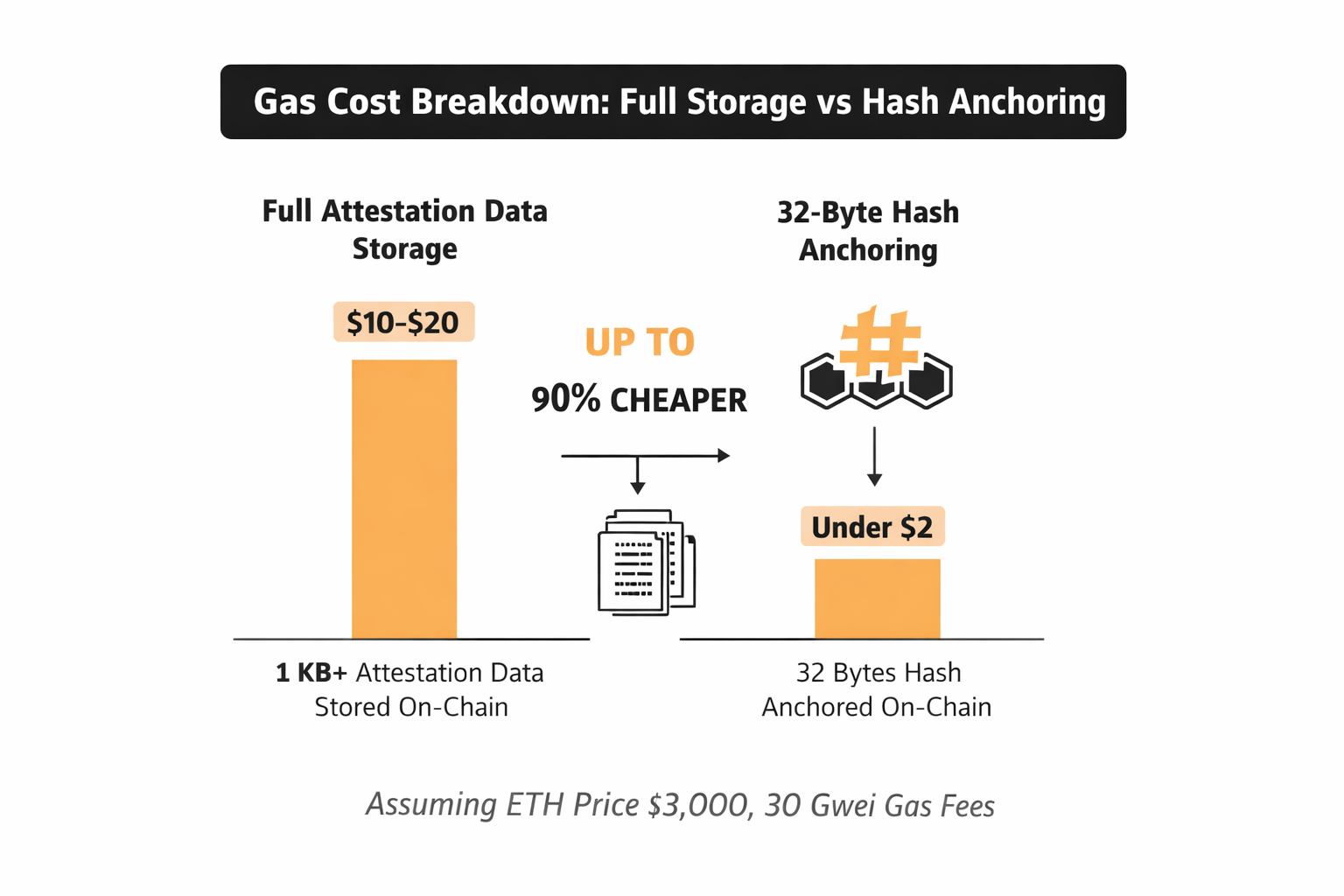
On the surface, the flow is straightforward. A user creates an attestation, signs it, and optionally anchors a hash of that data on-chain. That hash is tiny, often 32 bytes, which means storing it costs a fraction of a full data payload. If Ethereum gas is sitting around 30 gwei and ETH at $3,000, anchoring that hash might cost under $1, while storing full structured data could easily be 10 to 20 times more.
Underneath, the design choice matters more. The actual attestation data lives off-chain, often in decentralized storage like IPFS or Arweave. What’s on-chain is just enough to prove integrity. If someone tampers with the data, the hash won’t match. That gives you trust without forcing the network to carry unnecessary weight.
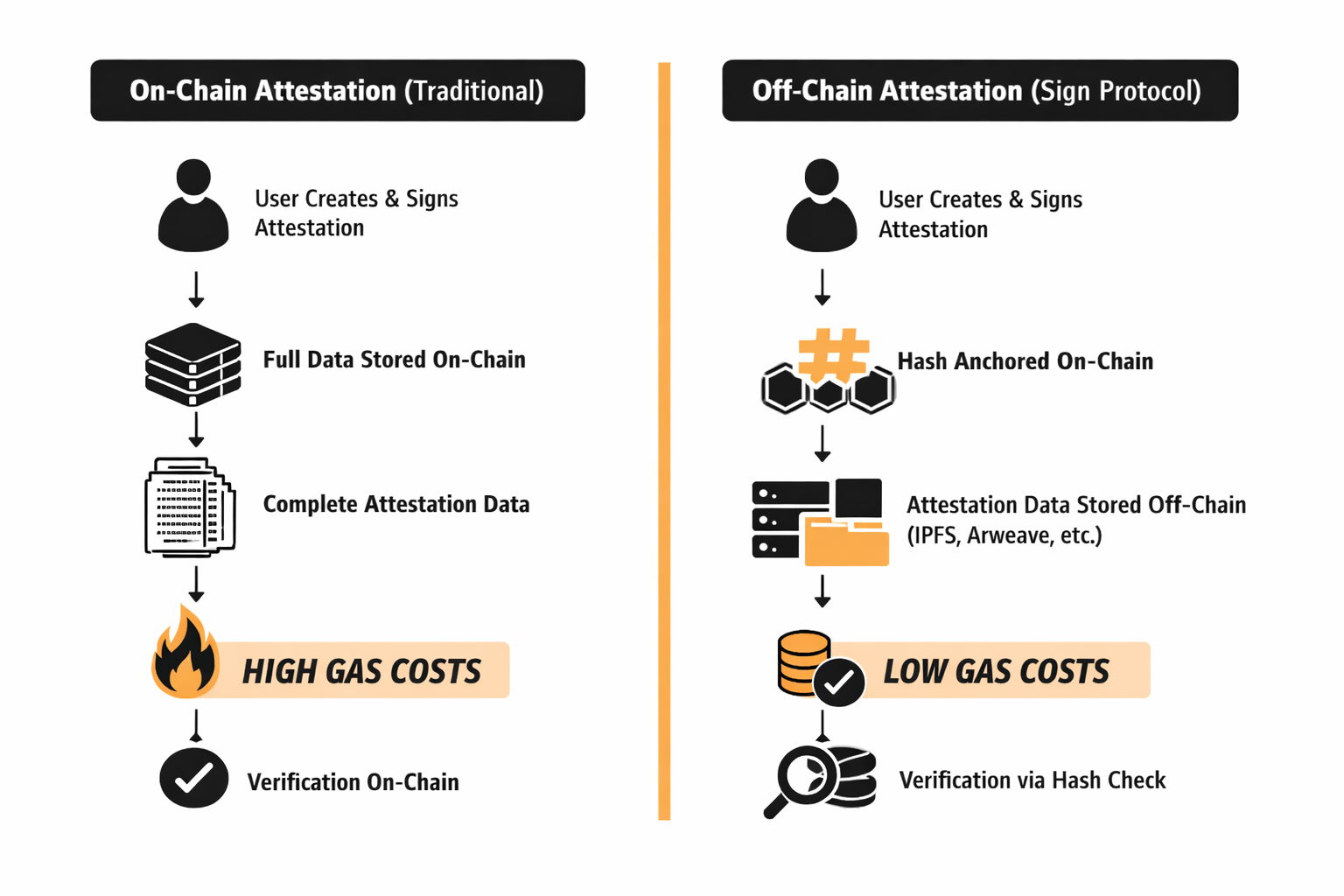
Understanding that helps explain why costs drop so sharply. You’re not paying for storage, you’re paying for proof. And proof is cheaper.
That shift creates another effect. It opens the door for scale. If a protocol needs to issue 100,000 attestations, the difference between $1 and $10 per entry is the difference between $100,000 and $1 million. That’s not a marginal improvement. That’s the difference between feasible and unrealistic for most teams.
Meanwhile, there’s a clarity benefit that’s easy to overlook. When data is modular, you can update schemas, expand fields, or attach new metadata without redeploying contracts. On-chain systems tend to fossilize quickly because changes are expensive. Off-chain layers stay flexible, which means systems can evolve without dragging users through migrations.
Of course, this isn’t free of trade-offs. Moving data off-chain introduces availability risk. If the storage layer goes down or data isn’t properly pinned, verification becomes harder. There’s also a subtle trust shift. You’re trusting that the data referenced by the hash is accessible somewhere, not just that the hash exists. Early signs suggest redundancy solutions are improving, but it remains to be seen how resilient this becomes under stress.
Still, the broader pattern is hard to ignore. Across the market right now, from rollups compressing transaction data to modular chains separating execution from settlement, everything is moving toward minimizing what lives on the base layer. Gas isn’t just a fee anymore. It’s a constraint shaping architecture.
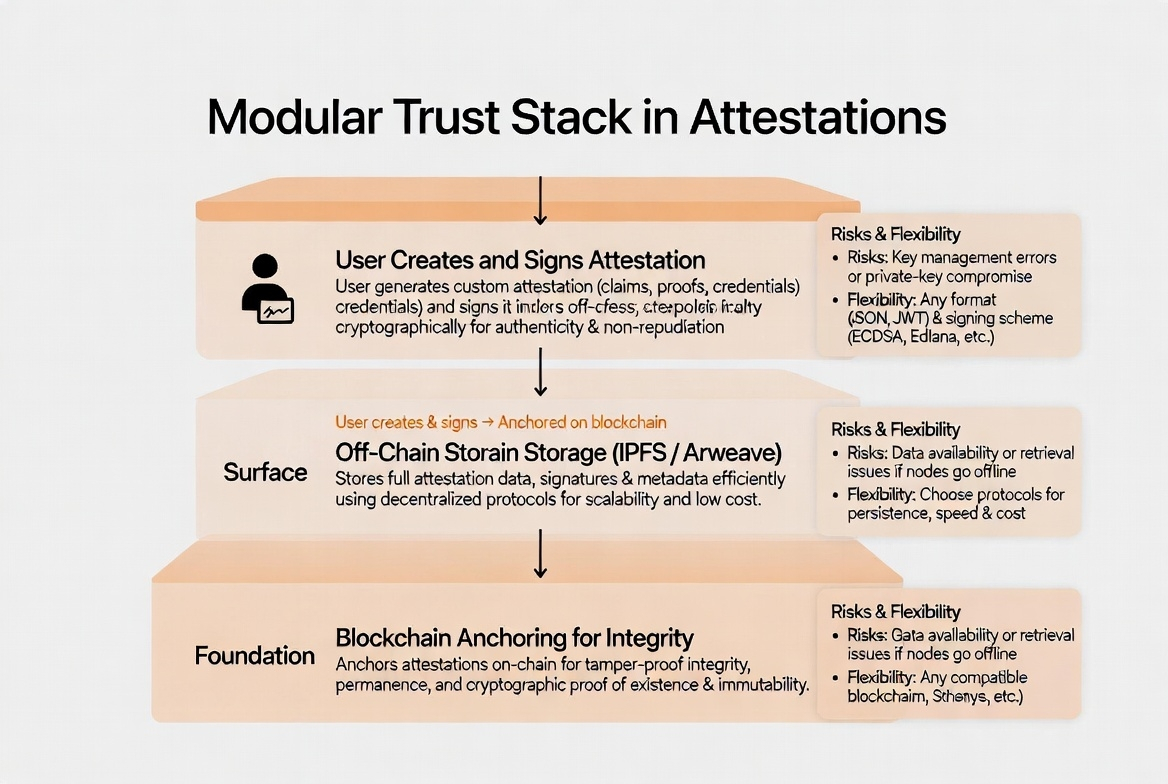
Sign Protocol fits neatly into that direction. It doesn’t try to do more on-chain. It tries to do less, but with precision. And that restraint feels earned.
What this reveals is simple but important. The future of crypto infrastructure isn’t about putting everything on-chain. It’s about knowing exactly what deserves to be there, and being disciplined enough to leave the rest off.

