
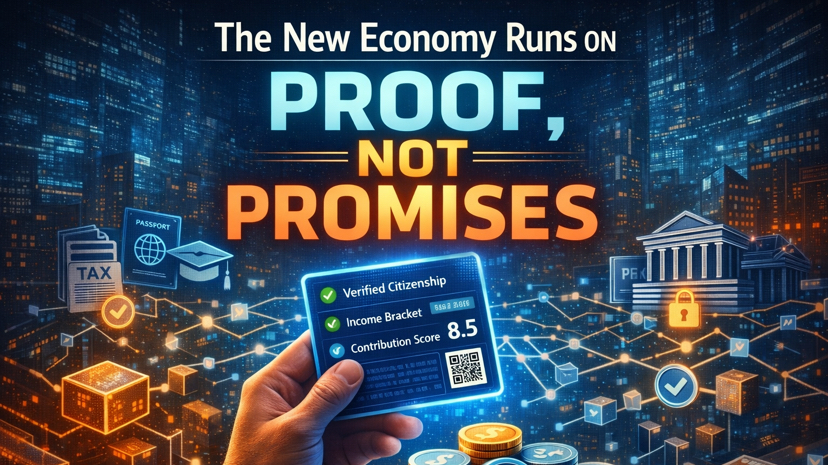

Most governments today are still running critical parts of their digital economies on outdated foundations — centralized databases, paper-heavy systems, and fragile infrastructure that struggles under real pressure. These systems decide everything: identity, eligibility, payments, access. Yet they’re slow, vulnerable to leaks, and heavily dependent on intermediaries who ultimately control the flow.
We hear a lot about sovereignty, but the reality is different. When access to systems depends on centralized logins or third-party platforms, control quietly shifts away from nations themselves. The backbone of modern economies ends up being owned by whoever controls the infrastructure — not the state.
That dynamic begins to change when verifiable claims evolve beyond being just a crypto concept and start functioning as a true layer of economic trust.
Imagine a system where citizenship status, income brackets, contribution history, or public service records can be instantly verified — without exposing unnecessary personal data. In that world, these claims stop being passive records. They become active assets.
They unlock services automatically.
They trigger distributions without friction.
They enforce agreements without delay.
In short, they become a new unit of trust — something closer to a programmable form of value rather than just proof.
Governments aren’t looking for another database. What they need is infrastructure — something that allows them to issue, verify, and distribute value at a national scale while still maintaining control over rules and protecting citizen data. The countries that understand this shift won’t just digitize their existing systems — they’ll redefine what participation in an economy actually means.
This is where $SIGN fits in.
It’s not trying to be a consumer-facing app or a hype-driven DeFi product. Instead, it’s positioning itself as foundational infrastructure for digital nations.
At its core, it introduces zero-knowledge verification, allowing individuals to prove eligibility without revealing their full data. It standardizes how claims are structured, so different institutions and departments can interpret information consistently. It also uses a hybrid storage model — keeping sensitive data off-chain while anchoring its validity on-chain for integrity.
Then there’s the distribution layer.
Through systems like TokenTable, verified claims can directly power large-scale distributions — reaching millions without collapsing under fraud or sybil attacks. Agreements themselves are secured through EthSign, ensuring that once rules are set, they can’t be quietly altered behind the scenes.
And importantly, the entire system operates across multiple chains. That means no single blockchain dictates the rules or costs — giving nations flexibility instead of locking them into one ecosystem.
What matters most isn’t the noise around it — it’s the quiet integrations.
When a country adopts infrastructure like this within its identity or public systems, it’s not experimenting. It’s rebuilding the rails of its economy — how value is distributed, how trust is verified, and how participation is defined in a digital-first world.
The attestation layer becomes a shared language of trust.
The infrastructure becomes invisible but essential — reliable under real-world pressure.
And because the system is designed to be neutral, governments retain control over policies and schemas instead of handing power to external entities.
That said, there’s a real tension here.
The same system that enables trust at scale can also concentrate power if controlled improperly. If schemas or verification rules are dominated by a small group, the system risks becoming just another centralized gatekeeper — only more sophisticated.
That’s why neutrality matters.
The long-term bet behind SIGN isn’t about dominating the narrative — it’s about becoming a layer that governments can adopt without compromising sovereignty. A system where states define the rules, while citizens retain the ability to prove what matters without exposing everything.
While most of the market is still focused on short-term price action, a deeper transformation is already underway.
Verifiable claims are evolving into a new kind of currency — one that governs access, distribution, and participation. And the infrastructure supporting it is being built quietly, designed for scale, privacy, and permanence.
The nations that move early won’t just adapt to this shift — they’ll define it.
$SIGN isn’t selling a vision of the future.
It’s building the rails that future systems are already starting to run on.