

The Sign ecosystem is made up of multiple parts that serve different purposes. Each piece has its own purpose. For example, EthSign is responsible for creating agreements; TokenTable helps to distribute tokens according to logic; and Sign Protocol supports all of these activities through an underlayer of schemas, attestations, and verifications. Together, these three pieces create a complete ecosystem that can support signing documents, distributing assets, and providing proof thereof.
As you examine how $SIGN fits into the Sign ecosystem, you will find a clearly defined role for the token. The main way the token is used is in the evidence component of the ecosystem. This includes providing attestations, verifying attestations, and working with off-chain storage services like IPFS or Arweave. These are the most tangible and easily recognized uses of the token.
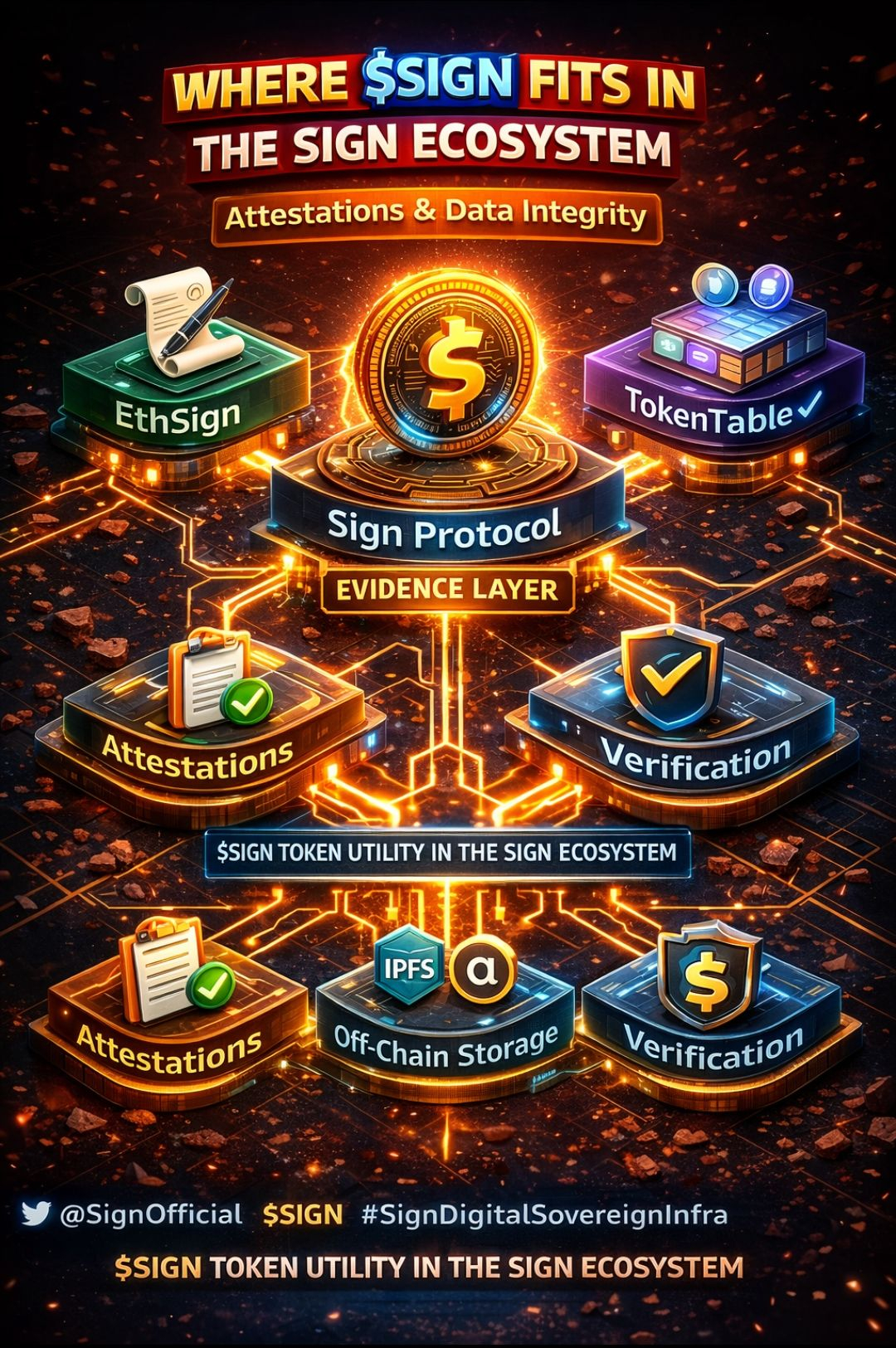
The $SIGN token will not diminish the value of the broader Sign ecosystem. What the token does is provide clarity in the structure and interdependence of different workflows within Sign - not all workflows require equal usage of $SIGN; in fact, developer APIs rely on other mechanisms (e.g., USDC credits). The Sign system is very broad, but $SIGN has the strongest relationship to the key parts of proof, verification, and data integrity. It is here that the $SIGN token will be used most prominently.
@SignOfficial $SIGN #SignDigitalSovereignInfra
