
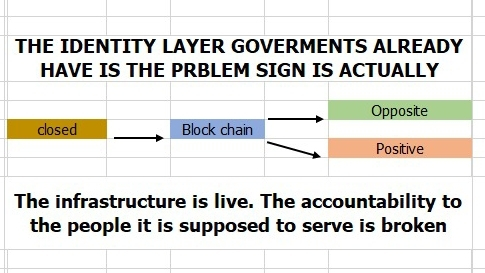
Closed the laptop after watching markets move for an hour and went back to the Sign documentation with completely fresh eyes.
Been sitting with the core framing of what Sign actually is since this morning and honestly?
most people are describing this project the wrong way and that misframing is causing them to miss the most important insight in the entire stack 😂
Most blockchain infrastructure projects present technology and ask governments to find a use case.
Sign does the opposite. It starts with a governance failure that is measurable, documented, and destroying lives right now and builds backward from there.
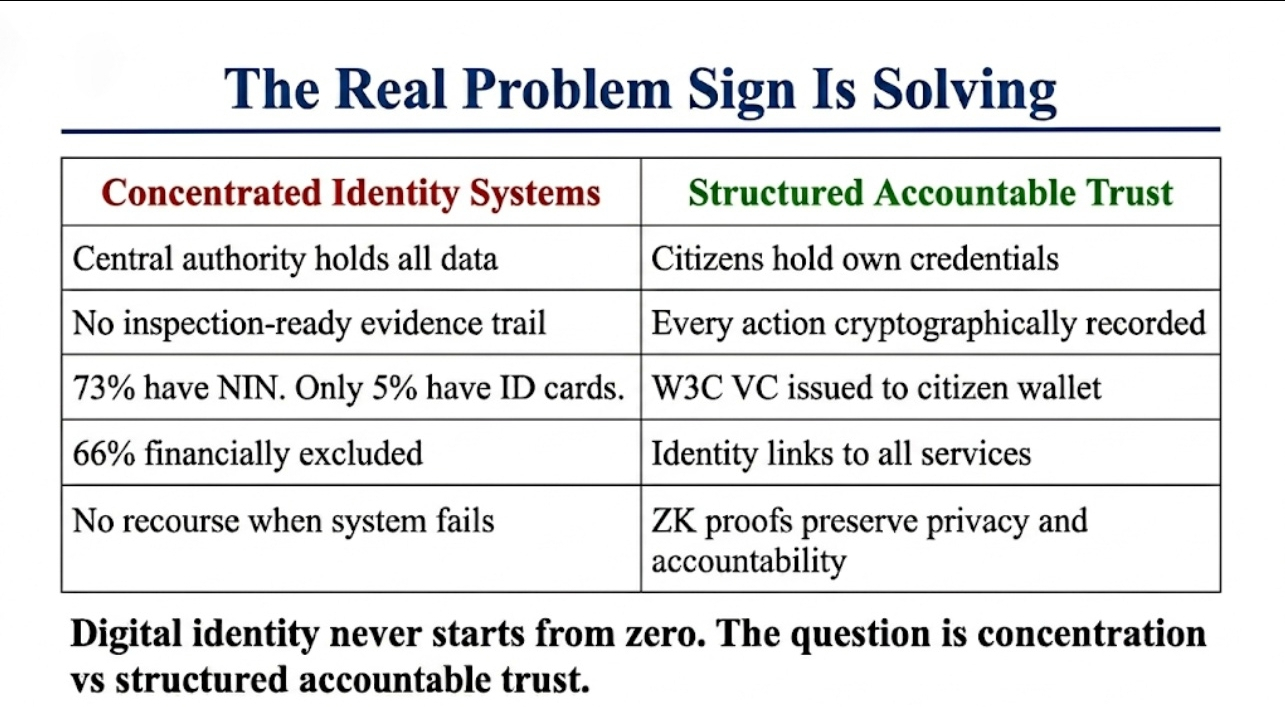
Digital identity will never start from zero. The question is whether it evolves toward concentration or toward structured, accountable trust.
SIgn builds for the latter. That sentence from Sign Foundation is not marketing language. It is the most precise description of what the entire stack is actually solving.
The framing that Sign is building identity infrastructure from scratch is completely wrong. and that wrong framing leads people to underestimate both the problem and the solution simultaneously.
Identity infrastructure already exists everywhere.
Facebook knows who you are. Your bank knows who you are.
Your government database holds your citizenship records. Your hospital holds your medical identity. Every nation on earth already has some form of identity infrastructure. The problem is not absence. The problem is concentration without accountability.
Sierra Leone does not have a zero identity problem. It has a concentrated identity problem. 73% of citizens hold identity numbers. Only 5% hold actual ID cards.
That gap exists because a central authority controls the infrastructure and failed to distribute access to it properly.
The infrastructure is live. The accountability to the people it is supposed to serve is broken.
Done. except Sign Protocol builds the accountability layer the concentrated systems never had.
The tokenomics angle noboDy discusses:
Here is what most Sign analysis is missing entirely. Sign is not one product.
It is three interconnected systems sharing a single evidence layer and that shared evidence layer is what makes the whole architecture genuinely different from anything governments have deployed before.
New Money System handles CBDC and regulated stablecoins operating across public and private rails. Public L2 chain delivering under 1 second blocktime and 4000 transactions per second for transparent government services. Private Hyperledger Fabric X CBDC network achieving 200,000 plus transactions per second through Arma BFT sharded consensus.
Namespace isolation separates wholesale interbank settlements at RTGS transparency from retail citizen transactions protected by Zero-Knowledge Proofs ensuring only sender, recipient, and designated regulators see transaction details. A CBDC to stablecoin atomic swap bridge connects both systems with the central bank controlling exchange rates, conversion limits, and emergency suspension capability.
ISO-20022 compliant throughout for cross-border interoperability with SWIFT, FedNow, and TARGET2.
New ID System delivers W3C Verifiable Credentials 2.0 and Decentralized Identifiers. Citizens store credentials in non-custodial wallets secured by device-level biometric authentication using iOS Secure Enclave and Android Trusty hardware. Selective disclosure through ZK proof systems including Groth16, Plonk, Honk, and BBS+ lets citizens prove age without revealing birthdate, citizenship without exposing address, compliance without disclosing customer data.
Sign Protocol handles onchain attestation with ICAO 9303 ePassport compatible border control, smart contract e-visa automation, ZK ballot privacy voting, and immutable land title registration.
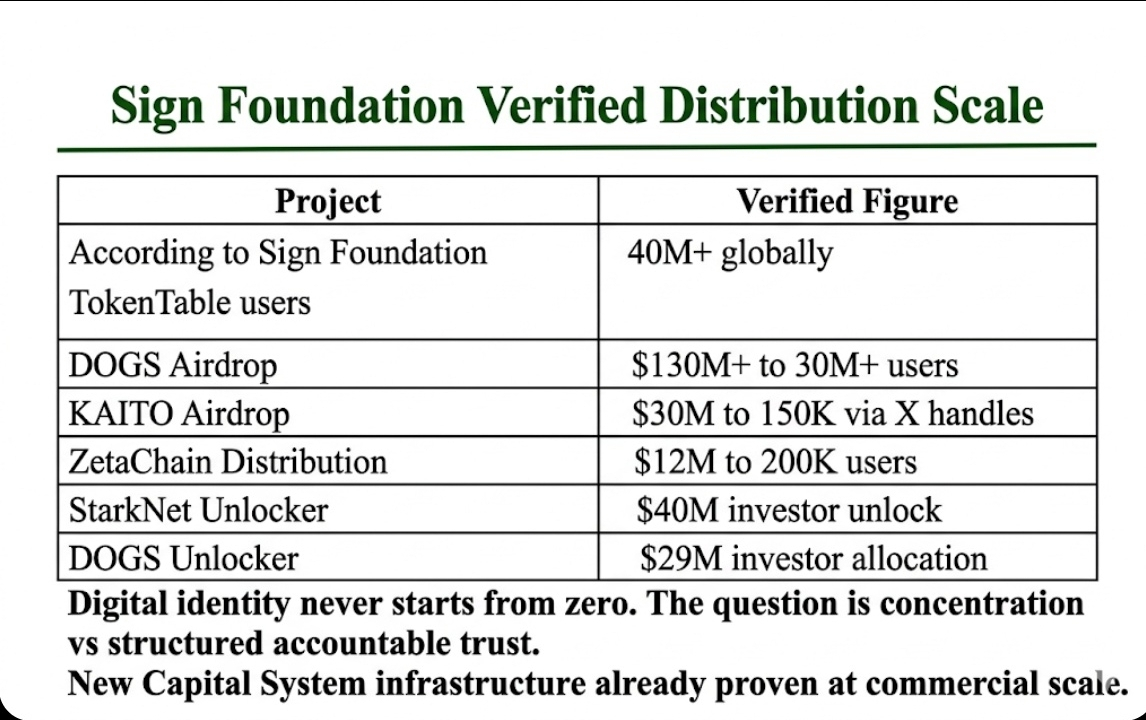
New Capital System runs through TokenTable. According to Sign Foundation, TokenTable serves 40 million plus users globally. DOGS distributed 130 million dollars plus to 30 million plus users.
KAITO distributed 30 million dollars to 150,000 users verified through X handles. ZetaChain distributed 12 million dollars to 200,000 users. StarkNet unlocked 40 million dollars through TokenTable Unlocker with unruggable smart contract enforcement. DOGS unlocked 29 million dollars in investor allocations. TokenTable Lite handles permissionless community distributions for memecoins, AI agents, and social tokens with no onboarding barriers.
Underneath all three systems sits Sign Protocol as the shared evidence layer answering one question that repeats across every deployment. Who approved what, under which authority, when it occurred, and which ruleset version applied. Two primitives only. Schemas defining how structured data is represented. Attestations being signed verifiable records conforming to those schemas. Four placement models. Fully onchain for maximum transparency. Fully offchain with verifiable anchors for sensitive data. Hybrid combining both. ZK privacy-enhanced modes for confidential payloads. SignScan provides REST and GraphQL querying across all supported chains.
EthSign completes the agreement layer. EIP-712 signatures written directly into documents. Keyless AES-256-GCM and ECIES encryption. Zero-cost public verification. Cross-chain signing across Bitcoin, EVM, TON, and Solana. Completed contracts stored permanently on Arweave free. No user data ever sold. Every signed agreement produces an attestation. Every attestation is inspection-ready evidence.
t
Two outcomes. both real.
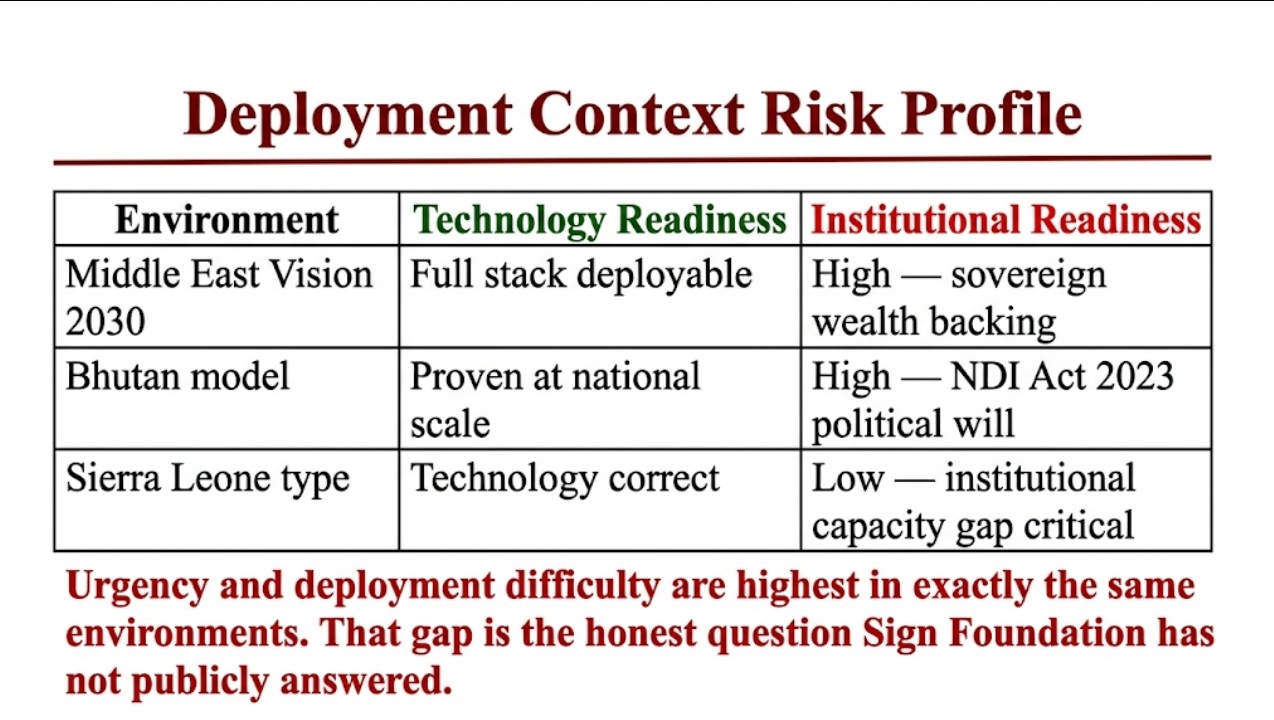
if Sign Foundation deploys in environments with strong institutional capacity like Middle East economies with Vision 2030 backing and sovereign wealth fund infrastructure the technology works and the accountability argument lands.
governments that already have functional institutions get better institutions. the improvement is real but the urgency is moderate.
if Sign Foundation deploys in environments where accountability failure is most severe like Sierra Leone where 66% financial exclusion exists because concentrated identity infrastructure failed the populations it was supposed to serve the technology is correct but institutional capacity to operate it without creating new failure modes is exactly what is missing. the urgency is maximum. the deployment difficulty is also maximum.
2 outcomes same architecture completely different risk profiles. Sign Foundation has not publicly resolved which deployment context it is optimising for first.
What they get right:
Sign's four tenets are not values statements. They are architectural constraints that determined what got built.
Keep it simple means sovereign systems are already complex. Infrastructure that adds complexity does not get deployed regardless of how correct it is technically. Sign's explicit design goal of making verifiable systems intuitive to integrate and difficult to misuse is an architectural commitment not a marketing claim.
Improvise adapt excel means Sign acknowledges explicitly that real sovereign deployments never follow the planned path. Policy changes. Threats evolve. Interoperability constraints shift. A system that cannot adapt while remaining governable and auditable breaks the moment real conditions diverge from whitepaper assumptions. Most blockchain infrastructure breaks exactly here.
An open stack means open standards and interoperable primitives so systems evolve without locking policy into one vendor or one network. W3C Verifiable Credentials 2.0. W3C DIDs. OIDC4VCI. OIDC4VP.
ISO-20022. Every standard Sign uses is an international open standard that any government can verify independently and any alternative system can interoperate with.
Evidence maketh governance is the tenet governments actually need to hear directly. Attestations are not a feature. They are the bedrock of accountability. The concentrated identity systems that produced Sierra Leone's 66% financial exclusion failed not because the technology was wrong but because there was no inspection-ready evidence trail answering who approved what, under which authority, when it happened.
Bhutan proved national scale SSI deployment works. NDI Act 2023 gave digital identity constitutional recognition. According to Sign Foundation, 750,000 citizens enrolled.
The system migrated from Hyperledger Indy to Polygon in 2024 with Ethereum targeted for Q1 2026. Thirteen plus developer teams built NDI-integrated applications. The deployment worked because political will, legal foundation, and institutional capacity aligned simultaneously.
That combination is genuinely rare. Sierra Leone exists at the other end of that spectrum. 73% hold identity numbers.
Only 5% hold actual ID cards. 66% financially excluded. 60% of farmers locked out of digital agricultural services. The infrastructure to serve them exists. The accountability layer connecting them to it does not.
SIgn Foundation is building that accountability layer. Whether the institutions in the environments that need it most can operate it without creating new concentrated failure modes is the question the whitepaper does not answer and no deployment beyond Bhutan has yet tested at scale.
Honestly dont kNow if Sign Foundation's structured accountable trust infrastructure reaches the governments where concentrated unaccountable identity systems are causing the most harm before those governments build their own inferior alternatives out of frustration with the implementation gap or whether Bhutan remains the reference implementation that proves the concept without proving the scale.
What's your take the right infrastructure arriving exactly when governments need it most or a technically correct solution waiting for institutions to become ready to operate it??
🤔