
Let me be honest. I don't know how to feel about SIGN. Part of me thinks they're building the most important infrastructure in crypto. Part of me worries about what happens if they actually succeed. And part of me is just annoyed at how hard they make it to understand what they're doing.
So I'm gonna break it down. The stuff they nailed. The stuff that drives me crazy. And the stuff that keeps me up at night.
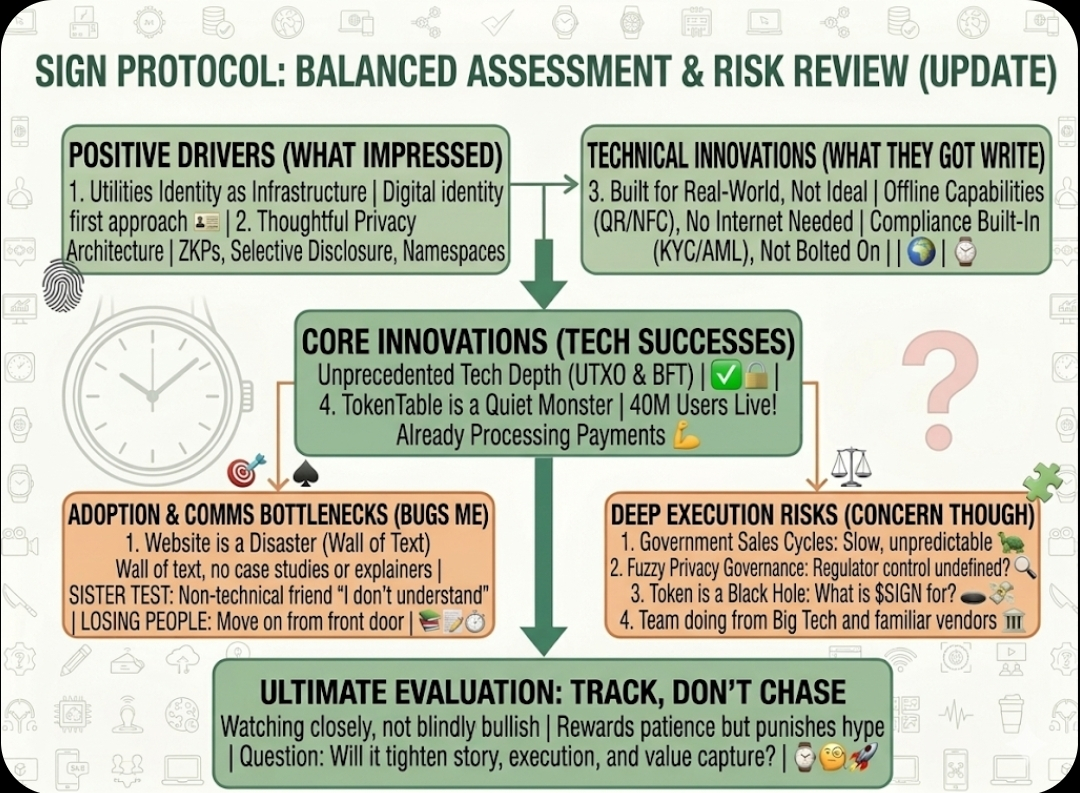
What They Got Write (And I Mean Actually Write)
1. They solved the identity problem nobody else is solving.
Most crypto projects treat identity like an app. Something you download. Something you use when you need to. SIGN treats identity like a utility. Like water. Like electricity. Like something that should just be there, always, without you thinking about it.
I didn't get this at first. I thought identity was just having a username and password. But after reading about how broken the current systems are, I get it now. You can't have digital payments without digital identity. You can't have digital services without digital identity. You can't have digital anything without digital identity. SIGN put identity first. Everyone else put it last.
2. The privacy architecture is actually thoughtful.
I expected the usual crypto privacy stuff. "We care about privacy" with no details. But SIGN actually built something. Zero-knowledge proofs. Selective disclosure. Namespace isolation. Unlinkability.
Translation: you can prove you're over 21 without showing your birthdate. You can prove you have a degree without showing your grades. You can prove you're a citizen without showing your passport number. The person verifying gets exactly what they need. Nothing more.
This is how privacy should work. Not hiding. Just... only sharing whats necessary.
3. They built for the real world, not the ideal world.
Most crypto projects assume perfect conditions. Fast internet. Reliable power. Users who understand private keys. SIGN didn't.
They built offline capability. QR codes. NFC. No signal needed. You can prove who you are when the cell towers are down. When the power is out. When your in a rural area with no coverage.
They built compliance into the architecture. KYC. AML. Transfer limits. Regulatory reporting. Not because they love regulation. Because governments won't adopt infrastructure that ignores their rules. SIGN understood this. Most crypto projects don't. 🌍
4. TokenTable is a quiet monster.
40 million users. Already live. Already processing benefits, subsidies, payments. I keep coming back to this number because it changes how I think about SIGN.
This isn't a project waiting for adoption. Adoption is already happening. Right now. 40 million people using infrastructure I'd never heard of until I read a 35 page whitepaper.
Thats not hype. Thats real. 💪
What Bugs Me (And I Mean Really Bugs Me)
1. The website is a disaster.
I'm not exaggerating. I went to their site after reading the whitepaper. I couldn't find anything I was looking for. Case studies? No. Explainer videos? No. Stories about how people actually use this? No. Just architecture diagrams and technical specs.
I showed the site to a friend who works in local government. She looked at it for 30 seconds and said "I don't know what any of this means." Thats a problem. If government people cant understand your site, how are you going to sell to governments?
2. The token is a black hole.
I've read the whitepaper twice. I've searched the docs. I still don't fully understand what $SIGN is for.
Is it gas for the public chain? Is it governance for the protocol? Is it both? Is it something else entirely? The answer should be on the homepage. Its not. 🕳️
This matters because most people in crypto look at the token first. If they don't understand it, they move on. SIGN is losing people at the front door.
3. Too many use cases.
The whitepaper lists like 20 different things SIGN can do. CBDCs. Stablecoins. Identity. Credentials. Land registries. Voting. Border control. Visas. Property rights. Art provenance. Regulatory records. Healthcare. Education. Supply chains. I'm exhausted just typing that.
I get that the infrastructure is flexible. But listing everything makes it feel unfocused. What's the priority? What should a government do first? What's the use case with the shortest path to value? I don't know. And I bet most readers don't either. 🎯
4. No customer voices.
40 million users on TokenTable. Thats a story. Where are the interviews? Where are the case studies? Where are the videos of people actually using this?
I want to hear from a government official who implemented it. I want to hear from a citizen who receives benefits through it. I want to hear from a business that uses it for verification.
Those stories would make SIGN real to people who don't read whitepapers. But I can't find them anywhere. 📢
My Concerns Though (The Stuff That Keeps Me Up)
1. Government adoption is slow and unpredictable.
SIGN could have the best technology in the world. It could still take years to close deals. Years. Governments move at a glacial pace. They have procurement processes. They have legacy contracts. They have risk aversion. They have elections.
What happens if SIGN runs out of funding before the next big deal closes? What happens if a new administration kills a project that was almost done? What happens if a pilot goes well but the government still chooses a different vendor for political reasons?
These are real risks. And nobody talks about them.
2. Privacy governance is fuzzy.
SIGN says privacy by default. Zero-knowledge proofs. Only sender, recipient, regulator can see transactions.
But who is the regulator? What can they see? Who decides what they can see? What happens when a government decides they need more access? What happens when "regulator" expands to include more agencies? What happens when "need to know" gets redefined after a security incident?
The technology is strong. The governance is unclear. And governance matters more than technology when it comes to privacy. 🔍
3. The token might not capture value.
This is a crypto-specific concern. Governments can deploy SIGN's infrastructure without using the token. They can run their own nodes. Issue their own assets. The token could be completely decoupled from adoption.
So even if SIGN succeeds — even if every country on earth uses their infrastructure — $SIGN might not go anywhere. Thats a problem for anyone holding it expecting appreciation.
I need a clear explanation of how value flows to the token. I haven't seen it yet. 💸
4. Competition is coming from unexpected places.
SIGN isn't the only project in this space. There are other identity protocols. Other CBDC platforms. Other asset tokenization engines. Some have more funding. Some have better marketing. Some have deeper relationships with governments.
But heres what I'm really worried about. Big tech. Google. Microsoft. IBM. Accenture. These companies already sell identity systems to governments. They already have procurement contracts. They already have relationships. They already have trust.
If they decide to build something like SIGN, they could move fast. And governments might choose the familiar vendor over the better technology. 🏛️
5. The team is doing too much.
The whitepaper covers like 5 different product areas. Identity. Payments. Asset distribution. Cross-chain bridges. Private blockchain infrastructure. Public blockchain infrastructure.
Thats a huge surface area. Each piece needs to work perfectly. Governments won't tolerate downtime. They won't tolerate security breaches. They won't tolerate bugs.
I worry the team is spread thin. That they're trying to do everything instead of focusing on the one thing that matters most. Identity is the foundation. Maybe focus there first. Get it perfect. Then layer everything else on top.
Where I Land
I think SIGN is building something important. The technology is solid. TokenTable's 40 million users prove they can execute. The privacy architecture is thoughtful. The offline capability is rare.
But the communication is a mess. The token economics are unclear. Government adoption is slow and uncertain. Privacy governance needs more attention. Competition is real. The team might be doing too much.
I'm watching. I'm interested. But I'm not all in. Not yet.
I want to see clearer tokenomics. I want to see customer stories. I want to see a simpler website. I want to see a clear priority list of use cases. I want to see privacy governance that addresses my concerns.
When I see those things, maybe I'll feel different.
For now? I'm paying attention. But I'm keeping my eyes open. 👀
#SignDigitalSovereignInfra #signdigitalsovereigninfra $SIGN @SignOfficial