
If you’ve been watching the DePIN and Decentralized Compute space lately, you’ve probably noticed that we’re moving away from "all-in-one" blockchains toward a modular stack where every resource (bandwidth, connectivity, information, and compute) is its own marketplace.
Comparing Orchid ($OXT), Roam ($ROAM), Augur ($REP), and Fluence ($FLT) reveals a fascinating arc of Web3 infrastructure.
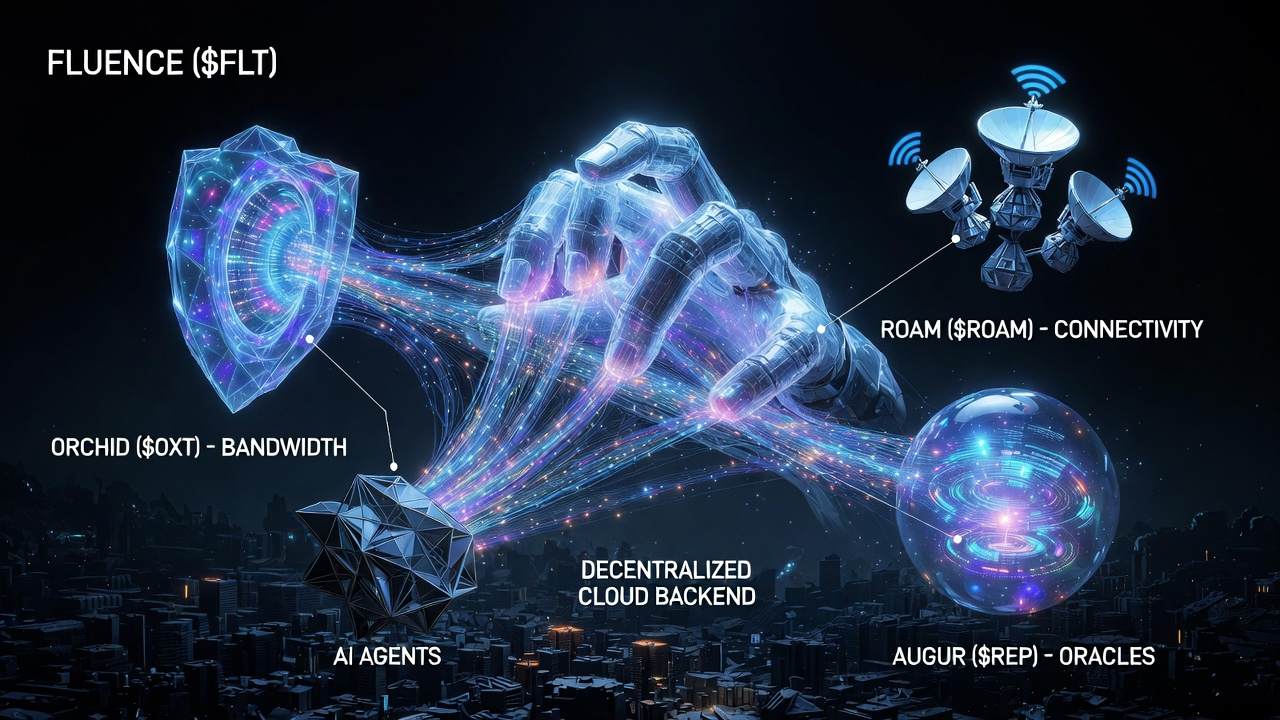
Here is what stands out from the digital trenches:
🧱 Four Pillars, Four Resources
While all these projects fall under "infrastructure," they are solving fundamentally different bottlenecks:
Bandwidth & Privacy ($OXT): Orchid pioneered the market for VPN bandwidth, trying to turn privacy into a stakable resource.
Connectivity & Wireless ($ROAM): A newer DePIN player focused on "crypto telco" services, specifically bringing wireless access to the Solana and BNB ecosystems.
Information & Intelligence ($REP): An OG prediction market protocol that functions as a decentralized oracle network for collective forecasting.
The Execution Engine ($FLT): Fluence sits at the top of this stack as a serverless compute protocol.
🧠 Why Fluence is the Glue for AI Infrastructure
While the older projects like Orchid and Augur laid the groundwork for resource marketplaces, Fluence feels like the missing piece for the current AI and Agentic narrative.
In 2026, Fluence has realized that owning the hardware (GPUs) isn’t enough. We need a way to orchestrate logic across a peer network without a central cloud provider acting as a chokepoint.
How Fluence fits the bigger picture:
The Runtime over the Metal: Unlike projects that just rent you a virtual machine, Fluence is a programmable compute fabric. It’s where developers actually deploy the code that runs the AI agents.
Modular Synergy: Imagine an AI agent that pulls prediction data from Augur, routes its communication through Orchid for privacy, and executes its logic on Fluence. That is a truly resilient, unbundled application.
The Cloudless Mission: Fluence’s goal isn’t just to be another compute coin. It’s to provide a verifiable alternative to the Big Tech cloud monopoly, ensuring that the logic of our future apps isn't owned by a single company.
🎯 The Bottom Line
Many of these legacy infrastructure tokens have seen 90–99% drawdowns, serving as a grounded reminder that narrative fit is not the same as adoption. While Fluence is the youngest and smallest in market cap, it is positioning itself as the glue layer. It doesn't just provide a resource; it provides the execution that turns raw bandwidth, data, and connectivity into functional, decentralized applications.
Summary: We are moving from buying a machine to calling a service. If the future of Web3 is truly cloudless, the coordination layer where $FLT sits will be the most critical piece of the puzzle.