
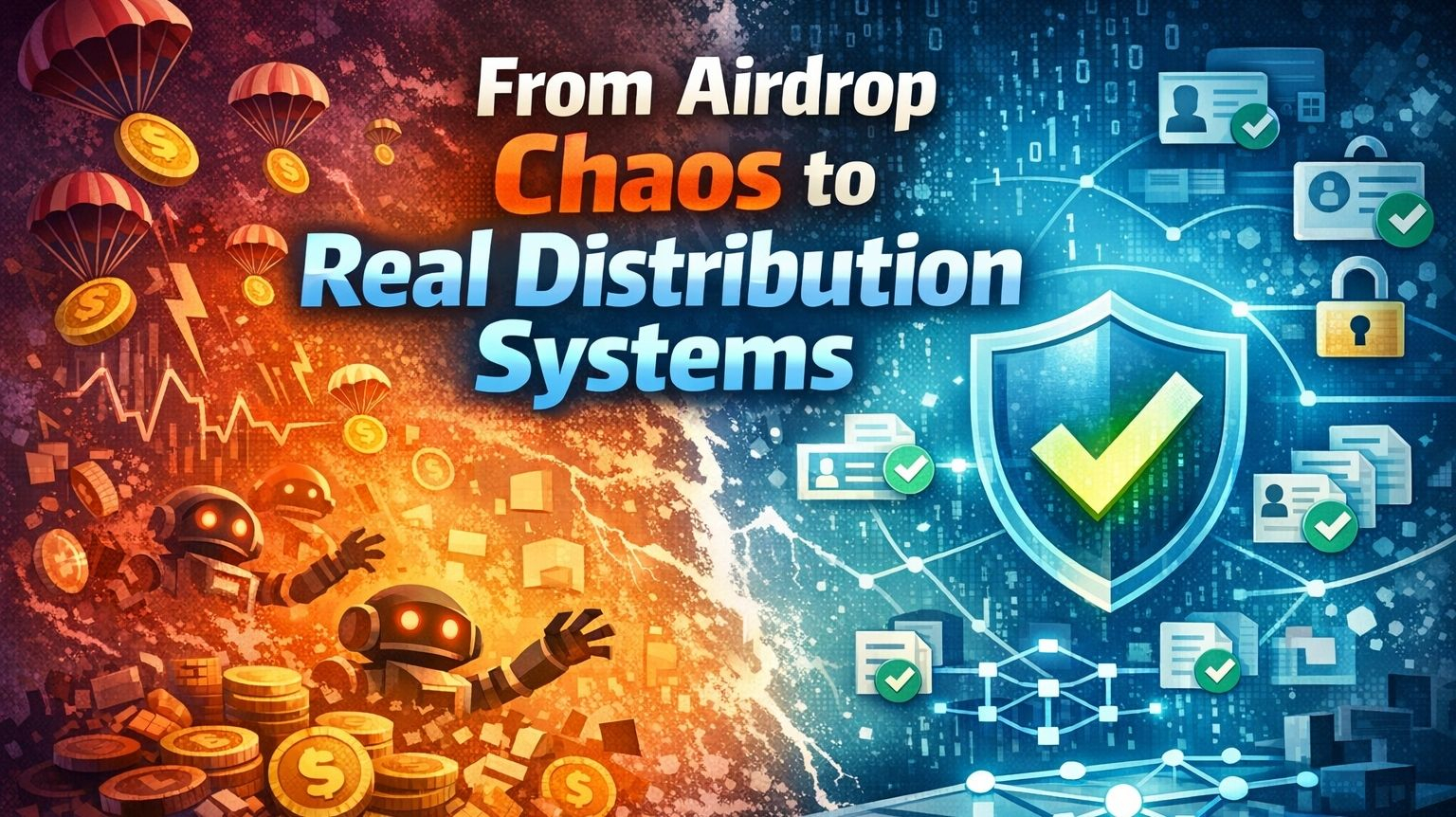

People think putting an airdrop on-chain makes it fair. It doesn’t. Transparency shows the outcome, not the logic behind it. You can watch the chaos happen in real time.
We’ve seen this story before. NFTs, DAOs, and privacy coins all promised to redesign digital economies. Each ran into the same wall. Total transparency exposed too much. Total privacy hid too much. Systems became either impractical or untrustworthy.
Airdrops followed the same path. Open participation sounds fair, but without structure it becomes noise. Bots farm rewards. Metrics get gamed. Real users get diluted. The problem isn’t how tokens are distributed. It’s how participation is verified.
That’s where things actually break. In the real world, you often need to prove something without revealing everything. Not full identity, but proof of eligibility, behavior, or contribution. That balance, proof without exposure, is what most systems fail to handle.
Credential-based distribution tries to fix this. Instead of rewarding activity blindly, it introduces selective proof. You show what matters, and keep the rest private. Projects like Sign Protocol are pushing in this direction, using structured credentials and controlled disclosure to make participation both measurable and meaningful.
The concept is simple. The execution isn’t. Privacy layers, zero-knowledge proofs, and programmable disclosure let applications control what becomes public and what stays hidden. In this model, blockchain stops acting like a loudspeaker and starts acting like a verifier.
If this works, the benefits are clear. Rewards go to the right users. Verification becomes cheaper. Accountability improves. And for the first time, institutions can actually use these systems instead of just observing them.
But there’s no guarantee. Integration is hard. Standards are still evolving. Regulation is unclear. And developers have to choose tools that are more complex, even if they’re more accurate.
So moving from airdrop chaos to targeted distribution isn’t automatic. It depends on whether systems like Sign Protocol can make verification both usable and reliable.
If they succeed, Web3 distribution starts to feel like real infrastructure. If they don’t, it becomes another smart idea that never fully works outside theory.
@SignOfficial #SignDigitalSovereignInfra $SIGN
