If you only look at technology from the surface, it feels like nothing has really changed.
Same apps. Same dashboards. Same flows.
But the real story isn’t being written on the surface.
The real shift is happening at the layer where systems decide what is valid, what is allowed, and what should change.
And this shift isn’t just an upgrade
it’s a complete rewrite of what a system actually is.
What Systems Used to Be
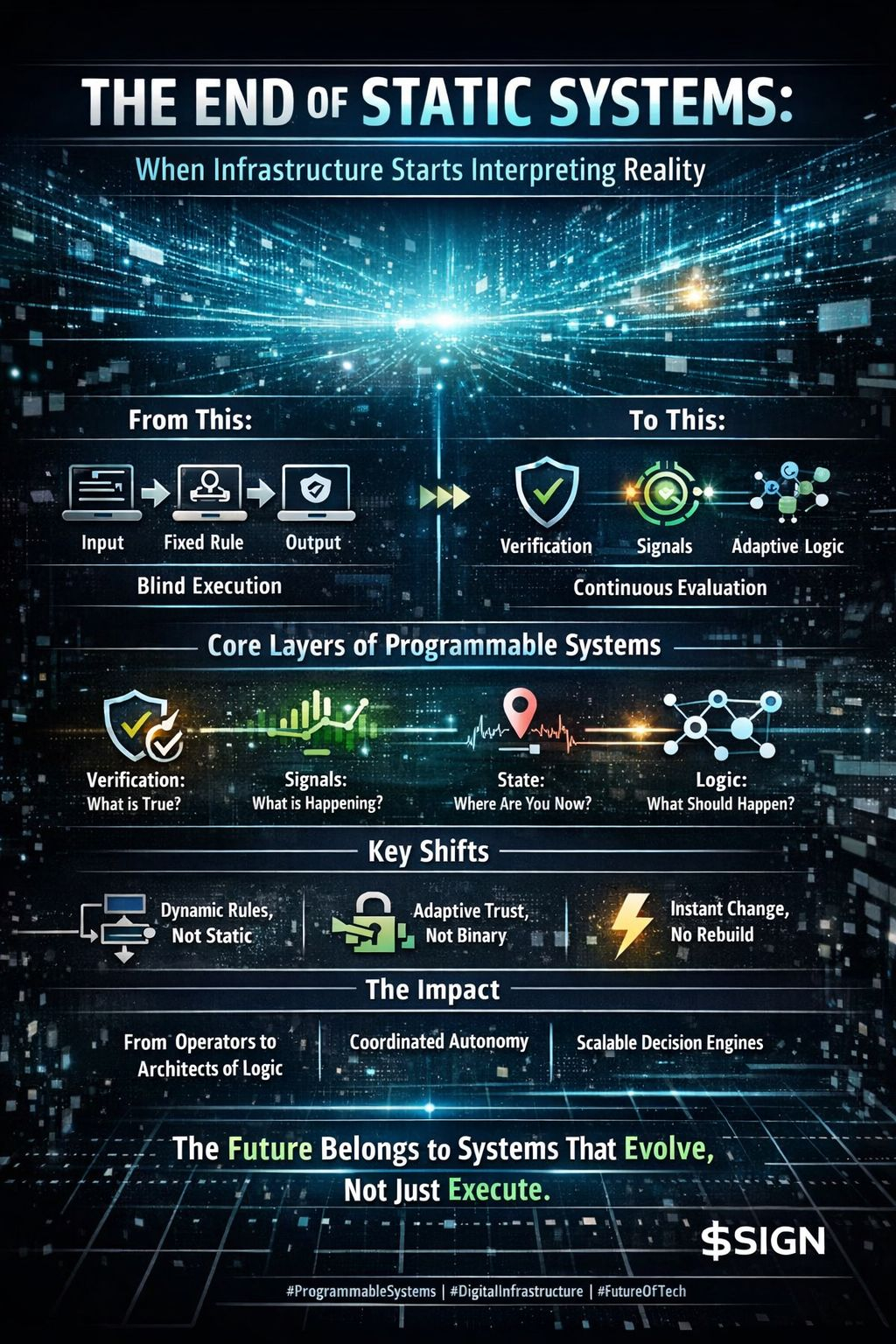
Traditional systems were essentially digital machines:
Take an input
Apply a predefined rule
Produce an output
Their job was execution not evaluation.
They didn’t care if context changed.
They didn’t question whether the condition was still valid.
A rule was written once… and it stayed that way.
That made systems:
Predictable
But fundamentally blind
Where Things Started Breaking
As the world became more digital, systems didn’t just face more traffic
they faced more complexity.
Users don’t stay in one state
Identity isn’t static
Trust isn’t a one-time decision
Conditions constantly evolve
And that’s where static systems started to fail.
Because they follow instructions
they don’t understand reality.
A New Model: Systems That Interpret
Now, a different kind of system is emerging.
Not one that simply asks:
“What should I do?”
But one that continuously asks:
“Under what conditions should I act?”
“Is this condition still valid?”
“If something changes, should my decision change too?”
This is the birth of:
Programmable Reality Layers
These systems don’t rely on fixed rules.
They operate on live, evolving conditions.
They are no longer scripts.
They are interpreters of state and truth.
The Critical Shift: Logic Becomes Fluid
In the past, logic was rigid.
Now, logic is:
Defined
Versioned
Updated
Executed dynamically
We’ve seen a version of this before with
Infrastructure as Code
where infrastructure stopped being manual and became programmable.
But now, that same idea is moving beyond deployment…
into decision-making itself.
How Systems “Think” Now
Old logic:
“If user signs up → grant access”
New logic:
Is the user verified?
Is their credential still valid?
Has any external signal changed their status?
Should access now be restricted or revoked?
The system doesn’t decide once.
It continuously evaluates.
The Architecture of Programmable Systems
Modern systems are built on four core layers:
1. Verification — What is true?
Proof becomes the foundation of trust.
2. Signals — What is happening?
Events provide real-time awareness.
3. State — Where does this entity stand now?
Everything exists in a dynamic state.
4. Logic — What should happen next?
Rules connect everything together.
When these layers combine, systems stop being tools…
They become adaptive intelligence frameworks.
The Breakthrough: Change Without Rebuild
In traditional systems:
Change meant rewriting code
Redeploying
Introducing risk
In programmable systems:
Change means updating logic
Adjusting conditions
Immediate execution
No downtime.
No rebuild.
No friction.
The system evolves quietly
like a living organism adapting to its environment.
The Human Role Is Changing
Before:
Humans made decisions
Systems executed them
Now:
Humans define the rules
Systems enforce and evaluate them
We’re shifting from operators to
architects of logic.
Trust Is Becoming Programmable
This is one of the most important shifts.
Before, trust was:
Binary
Static
One-time
Now, trust is:
Conditional
Time-sensitive
Revocable
Programmable
This will define the next generation of digital systems.
The Bigger Impact: Coordination at Scale
When systems can:
Verify truth
Interpret signals
Track dynamic state
Execute evolving logic
They unlock something powerful:
Scalable coordination without constant human control.
This isn’t just efficiency
it’s a new model of governance.
Final Realization
Systems are no longer:
Passive tools
Static environments
They are becoming:
→ Decision engines
→ Logic layers
→ Programmable coordination systems
And when a system can:
Evaluate continuously
Adapt dynamically
Decide contextually
It doesn’t just run…
It participates in shaping reality.
Final Line
The future doesn’t belong to the fastest systems.
It belongs to the systems that can
change how they operate without needing to be rebuilt.
@SignOfficial #SignDigitalSovereignInfra $SIGN