
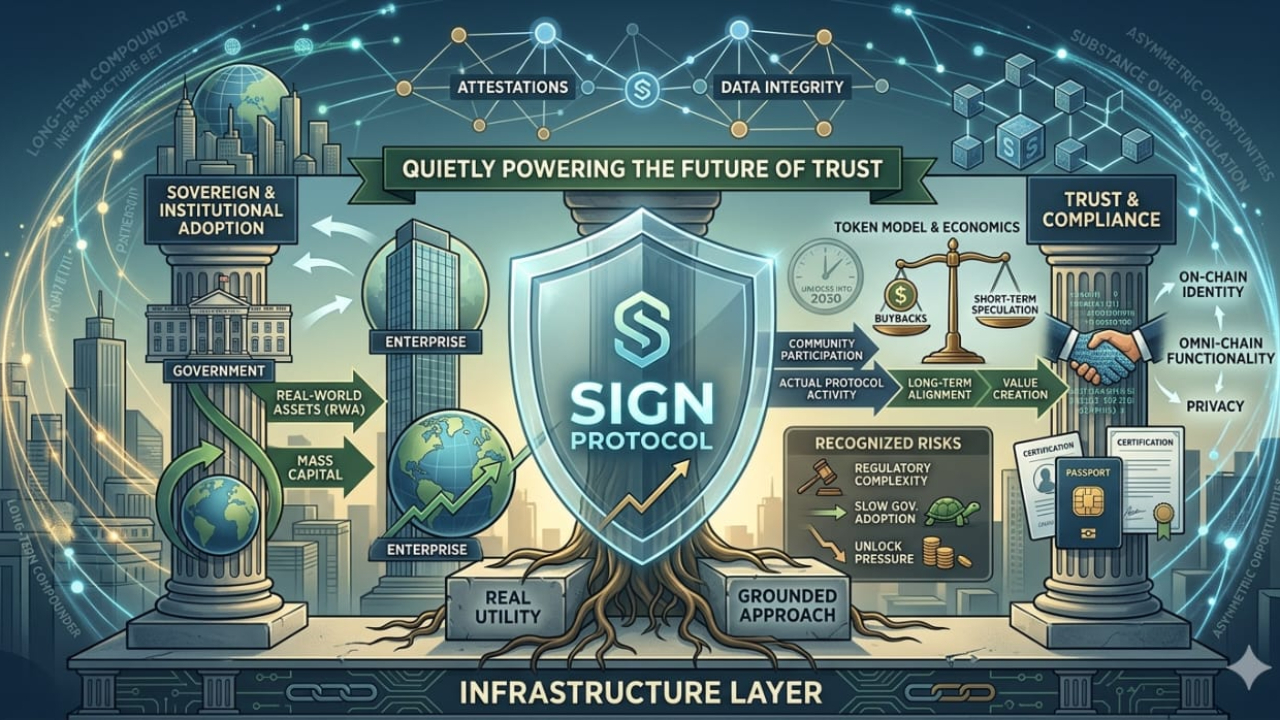
I’m genuinely drawn to projects that quietly solve the “trust” problem in what is otherwise a trustless ecosystem, and @SignOfficial stands out as one of the more thoughtful and mature attempts I’ve seen in the attestation and RWA space. What makes it interesting isn’t the hype or short-term narratives it’s the focus on practical execution. The team is building tools that can realistically be adopted by governments and enterprises, combining privacy, compliance, and omni-chain functionality in a way that feels aligned with real-world requirements.
From my perspective, what stands out the most is how grounded the approach feels. A lot of crypto projects lean heavily into speculation, but this one seems more focused on solving real infrastructure problems. That gives me more confidence, because in my experience, the projects that last are the ones that actually solve something meaningful rather than just ride market cycles.
Another aspect that stands out is the design of the token model. Instead of relying purely on speculative demand or short-term incentives, the economics appear to be structured around long-term community participation and real usage. That kind of alignment is often missing in many projects, where value tends to flow more toward early investors or short-term cycles. Here, there’s at least a visible attempt to tie value creation back to the community and actual protocol activity.
The sovereign and institutional angle is particularly compelling. Most crypto projects talk about mass adoption, but many remain confined to DeFi circles or speculative trading environments. Sign, on the other hand, seems to be targeting the environments where the largest pools of capital and users exist governments, enterprises, and national systems. If they can successfully bridge that gap, it would represent a meaningful step forward in how blockchain technology integrates with the real world.
That said, the risks are just as real as the potential. Working with sovereign entities is complex and often slow. Regulatory frameworks, compliance requirements, and political considerations can significantly impact timelines. It’s not the kind of environment where quick wins are common, and progress may take years rather than months. On top of that, the token unlock schedule extending into 2030 introduces an additional layer of supply-side pressure that the market will be watching closely.
Still, the inclusion of mechanisms like buybacks, along with strong community allocation, suggests that the team is at least aware of the importance of long-term alignment. These are the kinds of signals that can help build confidence over time, especially if the project continues to deliver on its roadmap.
Overall, I see Sign Protocol as one of those quieter, infrastructure-focused plays that could perform very well over a longer time horizon if the broader market shifts toward real utility. It’s not the type of asset that will deliver explosive gains overnight, but it does have the characteristics of a potential multi-year compounder if the execution holds up and adoption follows. In a market often driven by hype, projects like this stand out by focusing on substance over speculation.
For me personally, I’m more interested in this kind of long-term, utility-driven narrative than chasing short-term volatility. It aligns better with how I approach the market focusing on conviction, patience, and asymmetric opportunities rather than noise. Curious to hear your perspective are you approaching $SIGN mainly as an infrastructure bet, or are you looking at it from a different angle?