
I almost didn’t find it.
It was one of those nights where sleep wasn’t really happening and my phone had become the thing filling the space between being awake and actually resting. Brightness turned all the way down. Everyone else in the house long gone. And I was doing the thing I always tell myself I won’t do — scrolling through crypto discussions at some embarrassing hour.
New token launches bring out a specific kind of person. You know the type. They weren’t talking about the project last month. But the moment something goes live on a major exchange, they appear with entry prices posted like trophies and three bullet points lifted directly from the project’s own community channels, delivered with the confidence of someone who has been in since the beginning.
So I kept scrolling.
Then one line stopped me.
Not a price chart.
Not a headline.
A number.
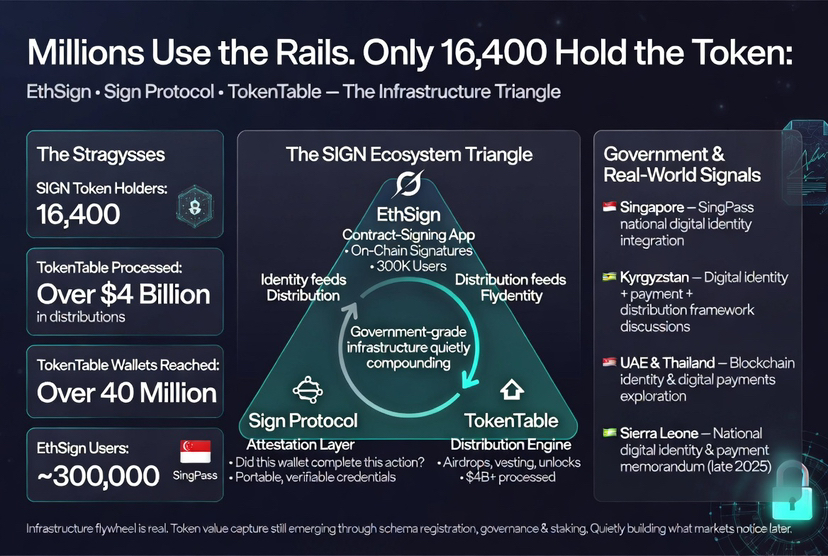
TokenTable had processed over four billion dollars in token distributions. More than forty million wallets. And the token at the center of the ecosystem had around sixteen thousand four hundred holders.
I read that twice. Put the phone face down on the mattress. Picked it back up. Read it again.
That ratio doesn’t make sense on the surface. Tens of millions of people touching a system, and barely anyone holding the token underneath it.
In most situations that would signal a problem — that the token is disconnected from the product or that demand is purely narrative.
But sometimes a strange number is strange for a good reason.
So I started reading.
Not price predictions.
Not sentiment threads.
The documentation.
The GitHub.
The whitepaper.
My wife walked through at some point and asked what I was looking at. I tried to explain attestation protocols to someone who spends her days thinking about landscape architecture. She was patient with me.
Here is what I found.
The project originally started as EthSign, a contract-signing application that spent four years building quietly. No massive marketing budgets. No influencer campaigns. Just a product that let people sign documents on-chain, where every signature became a permanent, verifiable attestation that something happened between two parties at a specific point in time.
By the time they rebranded, they were already the leading contract-signing application in Web3. Around three hundred thousand users.
And one integration that stopped me cold.
SingPass.
Singapore’s national digital identity system with millions of active users. The kind of government infrastructure protected by strict compliance and security reviews.
If something connects to a system like that, it means the team behind it passed extremely serious verification and regulatory processes.
EthSign had done that quietly, long before there was any financial incentive for people to pay attention.
Over time I’ve learned that the loudest projects in crypto are rarely the ones doing the most meaningful work. And the teams doing the most meaningful work are rarely the loudest.
The ratio of energy spent building versus energy spent being seen building is one of the more reliable signals I’ve found.
EthSign had hundreds of thousands of users and a government integration, yet I had never heard of them until that night.
The infrastructure they built underneath that product is called Sign Protocol.
At its core it answers a simple question:
Did this wallet complete this action?
Did this person pass identity verification?
Is this address holding a legitimate credential?
Is this citizen eligible for a specific payment?
The answer becomes an attestation a record written on-chain, cryptographically signed, portable across chains, and verifiable by anyone without relying on a centralized intermediary.
That concept becomes powerful when real systems start using it.
Sitting on top of that layer is TokenTable, the distribution engine.
More than $4 billion processed.
Over 40 million wallets.
Dozens of projects using it for airdrops, vesting schedules, and staggered unlocks.
When certain projects ran KYC-gated distributions through the system, the eligibility check wasn’t a spreadsheet maintained manually.
It was an on-chain attestation.
Permanent.
Auditable.
Verifiable.
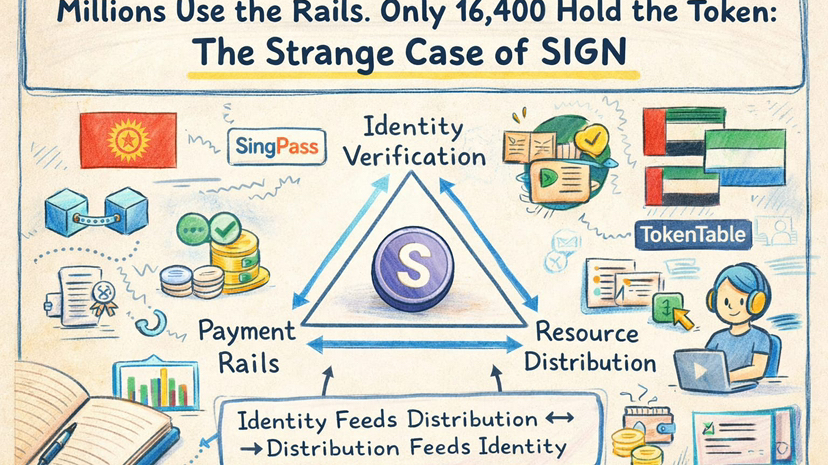
The three products EthSign, Sign Protocol, and TokenTable are not really separate systems. They reinforce each other.
Once a government verifies citizens on-chain, the next question becomes obvious:
How do you distribute resources to them?
Welfare payments.
Grants.
CBDC distributions.
Benefits.
That is exactly what TokenTable is designed to do.
Every distribution generates new attestation data. That data strengthens the identity layer underneath it, making the system more useful for the next participant.
Identity feeds distribution.
Distribution feeds identity.
A compounding loop.
At some point around two in the morning I found myself sketching this on paper at the kitchen table. My wife walked by, looked at the diagram, said it looked like a triangle, and went back to her book.
She wasn’t wrong.
It is a triangle.
And triangles are structurally one of the most stable shapes in existence.
Government deployments are what made the architecture feel real rather than theoretical.
In Kyrgyzstan, discussions around digital infrastructure included the possibility of combining national digital identity, payment systems, and distribution mechanisms for public resources within a single framework. Systems like EthSign, Sign Protocol, and TokenTable are designed around exactly those three layers.
Signals have also appeared in other regions. The UAE and Thailand have both explored blockchain-based identity and digital payment infrastructure, while Sierra Leone signed a memorandum in late 2025 focused on national digital identity and digital payment systems.
These developments suggest a broader pattern.
Rather than experimenting with isolated blockchain tools, some governments are beginning to explore integrated digital infrastructure where identity verification, payment rails, and distribution mechanisms operate together.
That is how infrastructure standards usually emerge.
Not through a single breakthrough moment, but through the gradual accumulation of systems that become increasingly difficult to replace.
But excitement about technology is not the same thing as a clear investment thesis.
Infrastructure adoption is clear. Token value capture is not at least not yet.
That gap is where most infrastructure tokens fail.
Schema registration requires SIGN.
Governance involves it.
Staking exists.
But when I tried to trace a direct line from growing attestation volume to growing token demand in a way that can be verified on-chain, the connection wasn’t obvious.
A system using Sign Protocol does not automatically create a recurring, volume-linked demand for the token today.
The attestation network can grow rapidly without a clearly measurable demand curve for the token itself.
A friend once told me something that stuck with me:
The gap between a working protocol and a working token economy is the graveyard of some of the best technology in crypto.
A protocol working well and a token capturing value from that success are not automatically the same argument.
That tension hasn’t fully resolved for me.
I believe the infrastructure flywheel is real.
I believe the integration signals say something meaningful about how this team operates quietly, with real code, long before attention arrives.
But I can’t yet draw a perfectly clean line between infrastructure growth and token demand.
What I’m watching for isn’t price.
It’s whether real deployments move from pilot stages to full production
and whether usage eventually ties directly into a verifiable token demand model.
That would close the loop between technology and token economics.
Until then I’m holding a small position and considerably more curiosity than conviction.
Which, if I’m honest, is probably the healthiest way to approach most things in this space.
The people with absolute conviction are usually the ones who stopped asking questions.
I’m still asking them.
But one observation keeps returning.
Every time a project, foundation, or government wants to distribute tokens, payments, or credentials in a transparent and verifiable way without relying on centralized intermediaries, they increasingly route through the same type of infrastructure.
And that infrastructure quietly takes its cut.
Infrastructure compounds quietly.
Markets usually notice later.
That is not a narrative.
That is a business model.
#SignDigitalSovereignInfra @SignOfficial $SIGN
