
I used to believe that government adoption of blockchain was just a matter of time. It felt obvious. Blockchain offers transparency, efficiency, and security—so naturally, governments would adopt it sooner or later. But the more I studied real systems, especially through the lens of Sign Protocol, the more I realized something important. Governments are not slow because they don’t understand blockchain. They’re slow because blockchain challenges how they control systems.
That changes the whole conversation.
When people talk about adoption, they usually think of it like a company adopting new technology. If something is better, faster, or cheaper, it gets implemented. But governments don’t operate like that. They are built around stability, control, and predictability. Any system that disrupts those foundations is not easily accepted, no matter how advanced it is.
This is where the idea of the “government adoption myth” starts to make sense. We assume better technology leads to adoption, but in reality, adoption depends on whether that technology fits into existing power structures. If it doesn’t, resistance is expected.
This is exactly the environment where Sign Protocol operates.
At first glance, Sign Protocol looks like another blockchain infrastructure project. It focuses on attestations—verifiable proofs that can be created and validated on-chain. It supports multiple chains and includes tools like TokenTable for large-scale distributions and EthSign for digital agreements. But what stands out is not just what it builds, but how it approaches real-world constraints.
Sign Protocol doesn’t try to replace existing systems. It works alongside them.
Instead of pushing full decentralization, it allows controlled verification. Entities like governments or institutions can act as attestors, issuing proofs that can then be verified transparently. This creates a balance. Authority is still present, but verification becomes open and consistent.
That balance is critical.
The biggest barrier to blockchain adoption is not technology—it’s trust. Governments are not comfortable with systems where they lose control over validation. They need to define rules, manage identity, and enforce decisions. Fully decentralized systems remove that control, which makes adoption difficult.
Sign Protocol doesn’t remove control. It restructures it.
By allowing trusted entities to issue attestations, it keeps authority visible while making verification more efficient. The system does not eliminate trust—it makes it more transparent and verifiable. This small shift makes a big difference.
We can already see signs of this working.
Sign Protocol has processed millions of attestations across different ecosystems. Its TokenTable system has handled distributions involving billions in value, verifying users and eligibility at scale. These examples are not directly tied to governments, but they prove that large-scale verification systems can work reliably.
Now imagine similar systems applied to public use cases.
Identity verification could move from static records to dynamic, verifiable proofs. Welfare programs could rely on attestations instead of manual checks. Financial access could be based on verified data rather than paperwork. Even agreements and contracts could be validated through systems like EthSign.
These are practical applications, not distant ideas.
But even with this potential, governments remain cautious.
And that caution is not unreasonable.
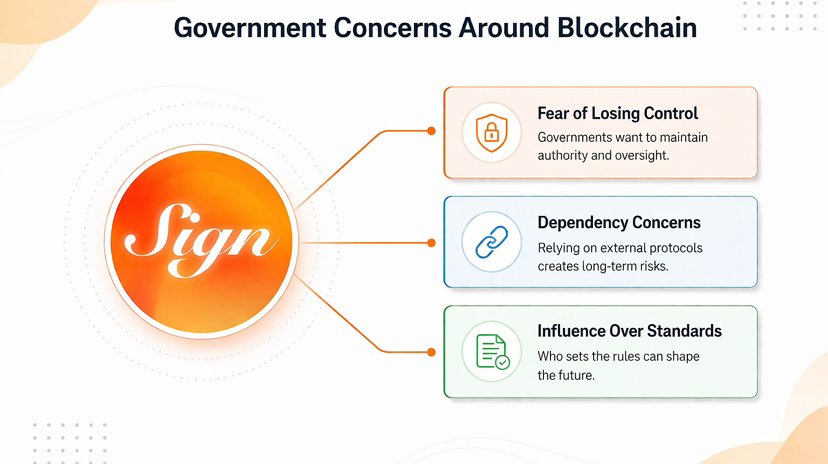
Governments worry about long-term control. They worry about relying on external protocols. They worry about how standards evolve and who influences them. Once a system becomes part of national infrastructure, it is difficult to change or reverse.
So instead of full adoption, what we see is gradual experimentation.
Pilot programs, limited deployments, and controlled use cases. Governments test at the edges before committing at the core. This is where Sign Protocol’s modular design becomes important. It allows integration into specific areas—identity, distribution, agreements—without requiring a complete system overhaul.
This lowers risk and makes adoption more realistic.
There is also a deeper layer to this.
Sign Protocol is not just solving technical problems—it is navigating political realities. At the center of every system is a simple but powerful question: who decides what is valid? Blockchain changes how that question is answered by introducing verifiable proof. But proof still needs issuers, and those issuers exist within power structures.
Sign Protocol does not ignore this. It builds around it.
It accepts that authority will exist, but it makes that authority transparent and verifiable. Instead of hiding trust inside closed systems, it exposes it in a structured way.
This is a more practical approach to change.
The idea that governments will suddenly adopt fully decentralized systems is unrealistic. Not because the technology is weak, but because the incentives don’t align. What is more likely is a gradual shift—systems that keep control where necessary but improve verification where possible.
Sign Protocol fits into this transition.
It does not promise a complete revolution. It enables gradual evolution.
And that may be why it matters more than it appears at first.
Government adoption of blockchain is not a myth because it will never happen. It is a myth because we misunderstand how it will happen. It will not be fast, clean, or fully decentralized. It will be gradual, shaped by compromises and real-world constraints.
And in that process, protocols like Sign are not forcing change.
They are quietly making it possible.