

I’ve been noticing something subtle over the past year that doesn’t get discussed enough: distribution in crypto is still fundamentally broken. Not in the obvious sense of “tokens go to the wrong people,” but in the deeper sense that we still don’t know who is actually on the other side of the transaction. Everything looks permissionless on the surface, but underneath, it’s chaotic, fragmented, and often inefficient.
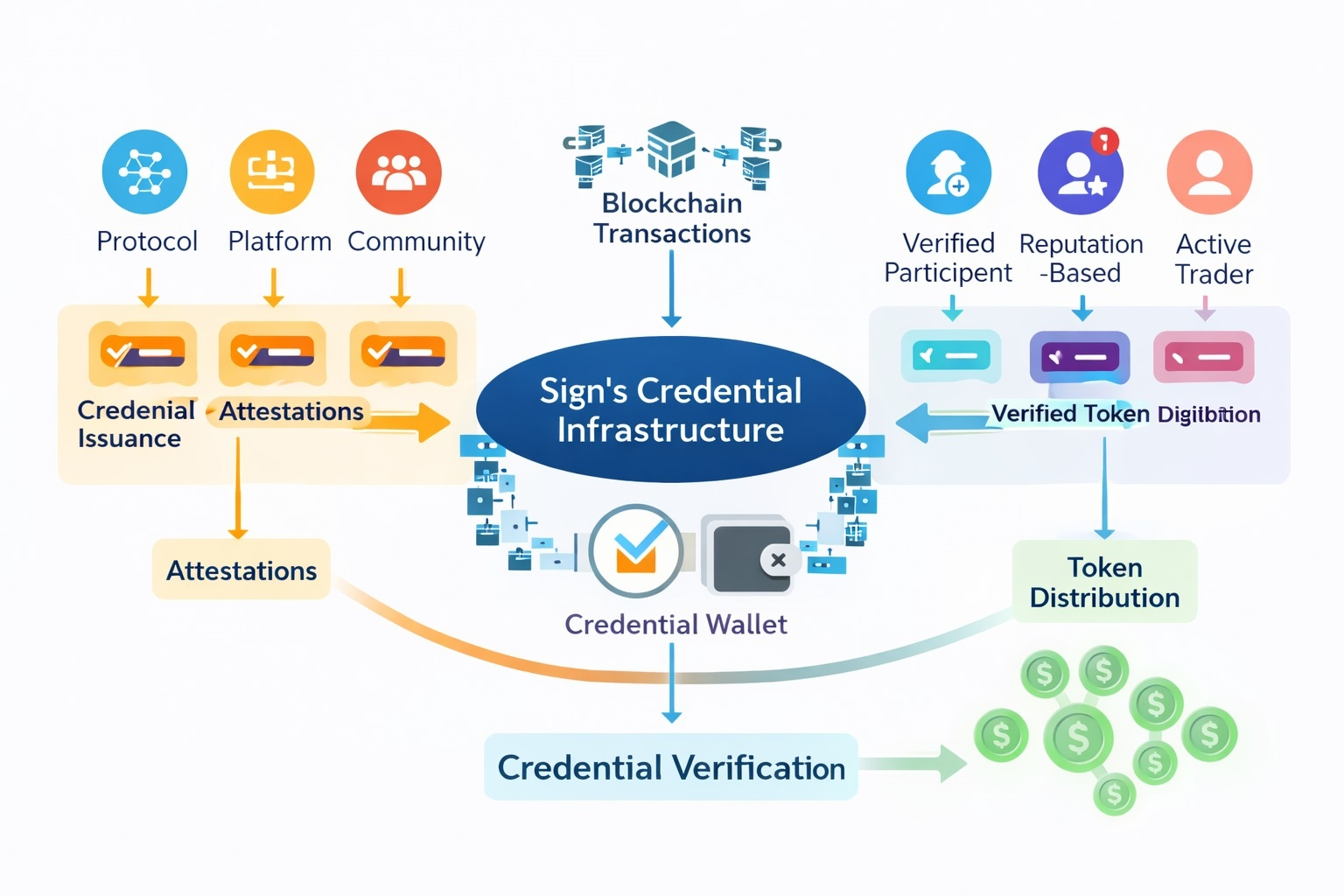
That’s the context in which I started paying attention to Sign and the idea behind $SIGN. Not as another identity project, because that narrative has already been overused, but as infrastructure that tries to fix a very specific bottleneck: how credentials move across systems in a way that can actually be trusted without slowing everything down.
When I look at why something like this exists now, it feels less like innovation and more like pressure building up over time. Airdrops became noisy. Sybil activity became normalized. Platforms started over-filtering real users just to avoid fake ones. At some point, the cost of not having reliable credential infrastructure became higher than the cost of introducing it. That’s usually when a new layer quietly becomes necessary.
What’s interesting about Sign is that it doesn’t try to reinvent identity in a philosophical sense. It focuses on verifiability. That difference matters. Instead of asking “who are you,” it leans more toward “what can be proven about you, and who attests to it.” In practice, that shifts the system from static identity to dynamic credentials.
The way I understand the mechanism is fairly straightforward. Different entities—protocols, platforms, or even communities—issue attestations. These attestations become portable proofs that can be reused across ecosystems. So instead of repeatedly verifying the same behavior or status, the system allows that information to move with the user.
What makes this more than just a data layer is the way it connects to distribution. Once credentials are standardized and portable, token distribution stops being guesswork. Campaigns don’t need to rely purely on wallet history or surface-level metrics. They can target users based on verified participation, behavior, or reputation.
That’s where I see the real shift. Not in identity itself, but in how value is allocated.
From a user perspective, interacting with something like Sign doesn’t feel dramatically different at first. You still connect a wallet, you still participate in campaigns, and you still receive tokens. But under the hood, what’s happening is more structured. Your actions are being turned into reusable credentials rather than isolated events.
Over time, that changes incentives. Instead of farming across dozens of platforms with disposable wallets, there’s a reason to build continuity. Your past activity starts to matter in a persistent way. It’s not just about being early; it’s about being provably engaged.
Of course, this comes with trade-offs, and I think it’s important not to ignore them. Any system that introduces structured credentials also introduces a form of filtering. Even if it’s decentralized, it still creates layers of inclusion and exclusion. The question isn’t whether that happens, but how transparent and flexible those layers are.
There’s also the risk of over-standardization. If too many systems rely on the same credential frameworks, you start to get convergence around a few dominant definitions of “valid users.” That can be efficient, but it can also reduce diversity in how ecosystems evaluate participation.
When I think about the role of $SIGN in all of this, it doesn’t feel like a typical utility token. It’s closer to an economic coordination layer. If credentials are the data, then the token becomes part of how that data is validated, used, and incentivized across networks.
In practical terms, the value of $SIGN should correlate with how widely this credential infrastructure is adopted. Not in a speculative sense, but in a usage sense. If more protocols rely on these attestations for distribution, access control, or rewards, then the token naturally becomes more embedded in the system.
What I would watch closely is on-chain behavior tied to credential issuance and usage. If activity starts clustering around specific types of attestations—like participation proofs or reputation scores—that would signal real demand. On the other hand, if usage remains shallow or isolated to campaigns, it would suggest the infrastructure hasn’t fully crossed into necessity yet.
Another angle that stands out to me is the regional narrative being hinted at, particularly around Middle East economic growth. That’s not just marketing language. Regions that are building digital-first economies often need flexible identity systems that don’t rely on legacy infrastructure. If Sign can position itself as a neutral credential layer in those environments, it gains a very different kind of relevance.
Still, I don’t think this is something that will play out quickly. Infrastructure rarely does. It tends to be invisible until it suddenly isn’t. Most people won’t notice credential systems until they start affecting who gets access, who gets rewarded, and who gets filtered out.
Right now, it feels early. Not in terms of concept, but in terms of integration. The pieces are there, but the ecosystem hasn’t fully aligned around using them at scale. That’s usually the hardest part.
What keeps me interested is not whether Sign “wins” as a project, but whether this model of portable, verifiable credentials becomes unavoidable. If it does, then projects like @SignOfficial aren’t just participants in the market—they’re shaping the rules that distribution follows.
And if distribution rules change, everything downstream changes with it.
I’m not fully convinced yet, but I’m paying attention in a different way than I was a few months ago. That shift alone usually means something is starting to matter.
#SignDigitalSovereignInfra $SIGN @SignOfficial
