
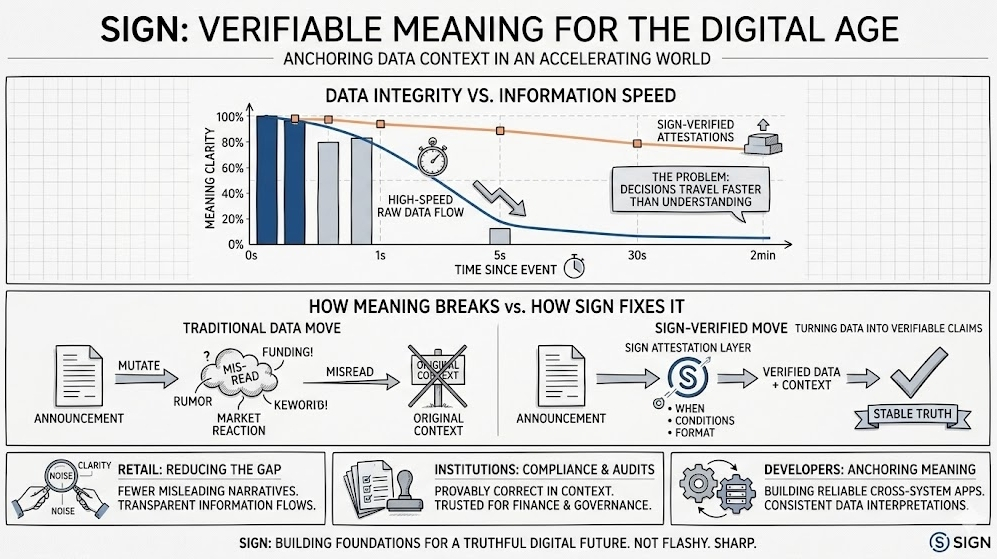
Something feels off in today’s digital world. Data moves fast. Too fast sometimes. But meaning? That gets lost. Twisted. Misread. And honestly… that’s where real damage starts.
That’s where SIGN steps in.
Not loud. Not flashy. But sharp.
SIGN is not just another blockchain project trying to chase hype cycles. It’s trying to solve something deeper. Something most people ignore until it breaks everything — the integrity of meaning.
Let me explain.
We live in a time where decisions travel faster than understanding. A funding round gets announced. Prices jump. A government approval hits headlines. Markets react in seconds. But the actual decision? The conditions behind it? The signatures, the approvals, the logic… that part stays hidden. Or worse, it changes as it moves.
And that’s dangerous.
SIGN is built around a simple but powerful idea — data should not lose its meaning when it moves.
Sounds basic. But it’s not.
At its core, SIGN focuses on structured attestations. That means instead of just storing raw data, it stores verified claims with context. Who approved something. Under what conditions. At what time. In what format. It’s like turning every important piece of data into a verifiable statement that cannot quietly mutate.
Because here’s the truth —
Data doesn’t fail when it disappears.
It fails when its meaning changes.
That line hits harder the more you think about it.
Now connect this with current market trends.
We’re entering a phase where AI, DeFi, and institutional capital are all colliding. Systems are getting complex. Cross-chain activity is rising. Regulations are tightening. And trust? It’s fragile.
Developers today face a real problem. They can build powerful apps. But ensuring that data remains consistent across systems? That’s messy. APIs break. Interpretations differ. One small mismatch can cascade into big failures.
SIGN gives developers a way to anchor meaning. Not just data. That’s a subtle shift. But a very important one.
For retail traders, the impact is more indirect. But still real.
Think about it. How many times have you seen announcements that move markets… only to later realize the details were misunderstood? Or incomplete? Or just… misleading?
SIGN could reduce that gap. It could bring clarity where noise usually wins. And in a market driven by narratives, clarity is power.
Institutions see this differently.
They care about compliance. Audit trails. Verifiable records. SIGN fits naturally here. It offers a way to create data that is not just stored, but provably correct in context. That’s huge for finance, governance, and cross-border systems.
But let’s not pretend it’s all smooth.
There are challenges.
Adoption is the biggest one. Systems don’t change overnight. Convincing developers to rethink how they structure data is not easy. There’s also the question of standardization. If different platforms use different schemas, fragmentation can creep in again.
And then there’s the quiet risk —
What if people ignore meaning even when it’s preserved?
Technology can solve structure. But human behavior… that’s a different game.
Still, SIGN is moving. Slowly. Carefully. Building infrastructure instead of noise.
And that matters.
Because in this market, loud projects often fade. The quiet ones? They build foundations.
Here’s something personal.
I don’t think SIGN is trying to “win the market” in the usual sense. It feels like it’s trying to fix a layer most people don’t even see yet. And that’s why it’s interesting.
There’s a calm confidence in it. No rush. No forced hype. Just a steady attempt to make digital truth… stay true.
And maybe that’s exactly what this space needs right now.
#SignDigitalSovereignInfra @SignOfficial $SIGN
