
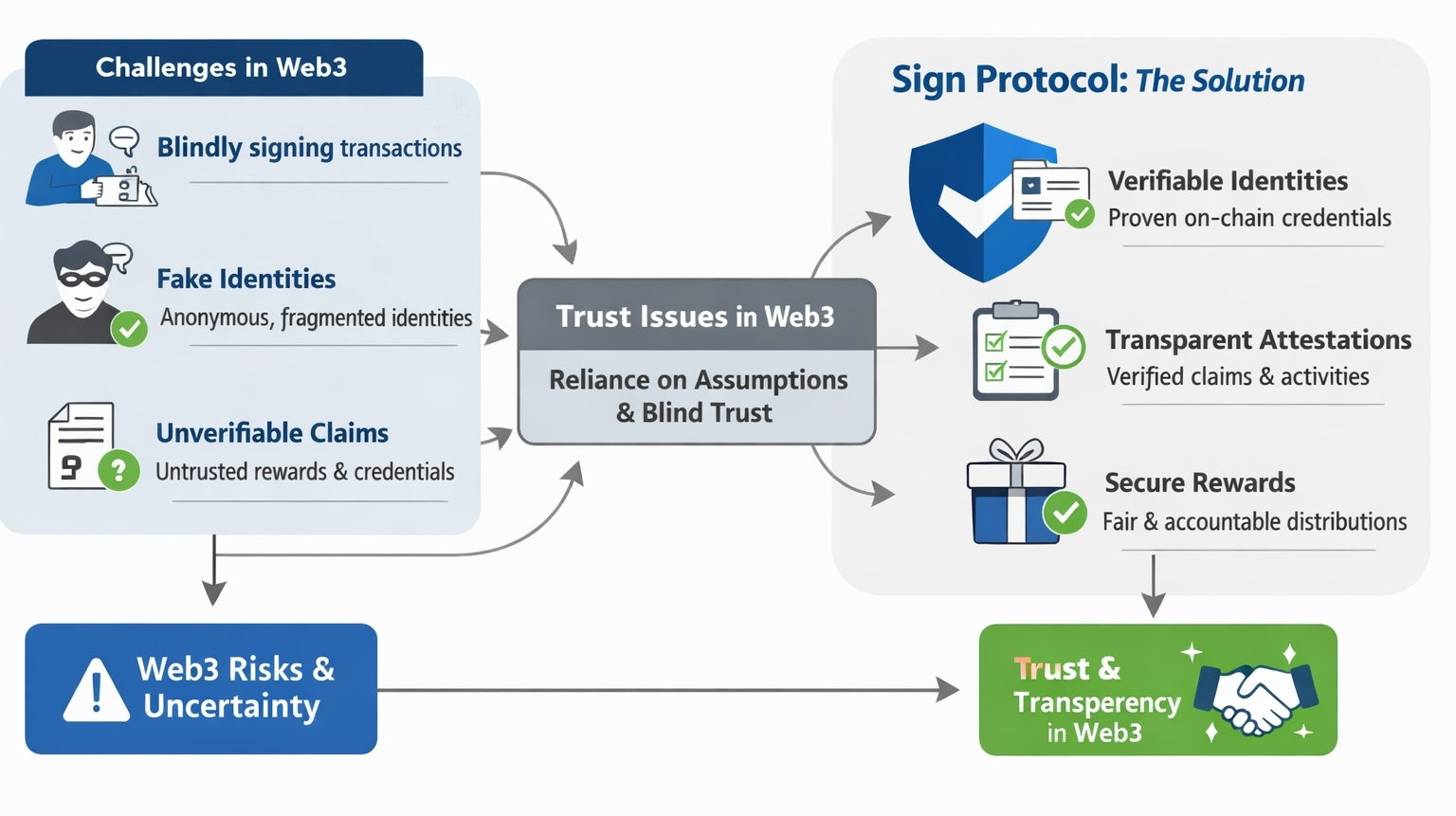

Web3 was introduced as a vision where users could interact online without relying on centralized institutions. The promise was simple: a digital ecosystem where trust is no longer assumed but replaced by transparent and verifiable systems. Yet, despite years of development, the reality is far from this ideal. Trust hasn’t disappeared; it has simply shifted to new, often opaque forms.
For most users today, interacting with Web3 still requires a degree of blind trust. Transactions are signed without fully understanding their implications. Protocols claim legitimacy without providing verifiable proof. Identities are fragmented, often pseudonymous, and easy to manipulate. Airdrops, rewards, and governance participation rely on assumptions rather than clear evidence. In short, the system still asks users to trust platforms and communities in ways that were meant to be unnecessary.
Identity is one of the biggest gaps. While anonymity has its benefits, it also allows for manipulation. A single user can control multiple wallets, claim rewards multiple times, or influence governance without accountability. This creates inefficiencies and can undermine the credibility of projects that try to reward meaningful participation.
Equally important is the issue of verifiable credentials. In traditional systems, certifications, IDs, and official proofs establish trust. Web3 lacks a standardized approach to this. Even when activities are recorded on-chain, they are often not structured in a way that others can easily verify. Reputation, credibility, and real participation become murky, leading to fragmented communities and unfair distribution mechanisms.
Sign Protocol addresses these challenges directly. Rather than attempting to remove trust entirely, it focuses on making trust provable. The concept is straightforward: any claim, credential, or action should be verifiable by anyone, without relying on intermediaries or assumptions.
@SignOfficial uses attestations, which are recorded statements on-chain. These attestations can represent identity, achievements, ownership, or participation. By structuring data in this way, Sign Protocol ensures that critical information can be verified reliably across platforms. Users and applications no longer have to guess or rely on reputation alone—they can check the proof themselves.
The implications for Web3 are significant. Attestations create a foundation of accountability and transparency that has been missing. They allow fairer airdrops, more reliable governance, and more meaningful reputation systems. Instead of relying on social hype or speculative signals, networks can reward real engagement and verified participation.
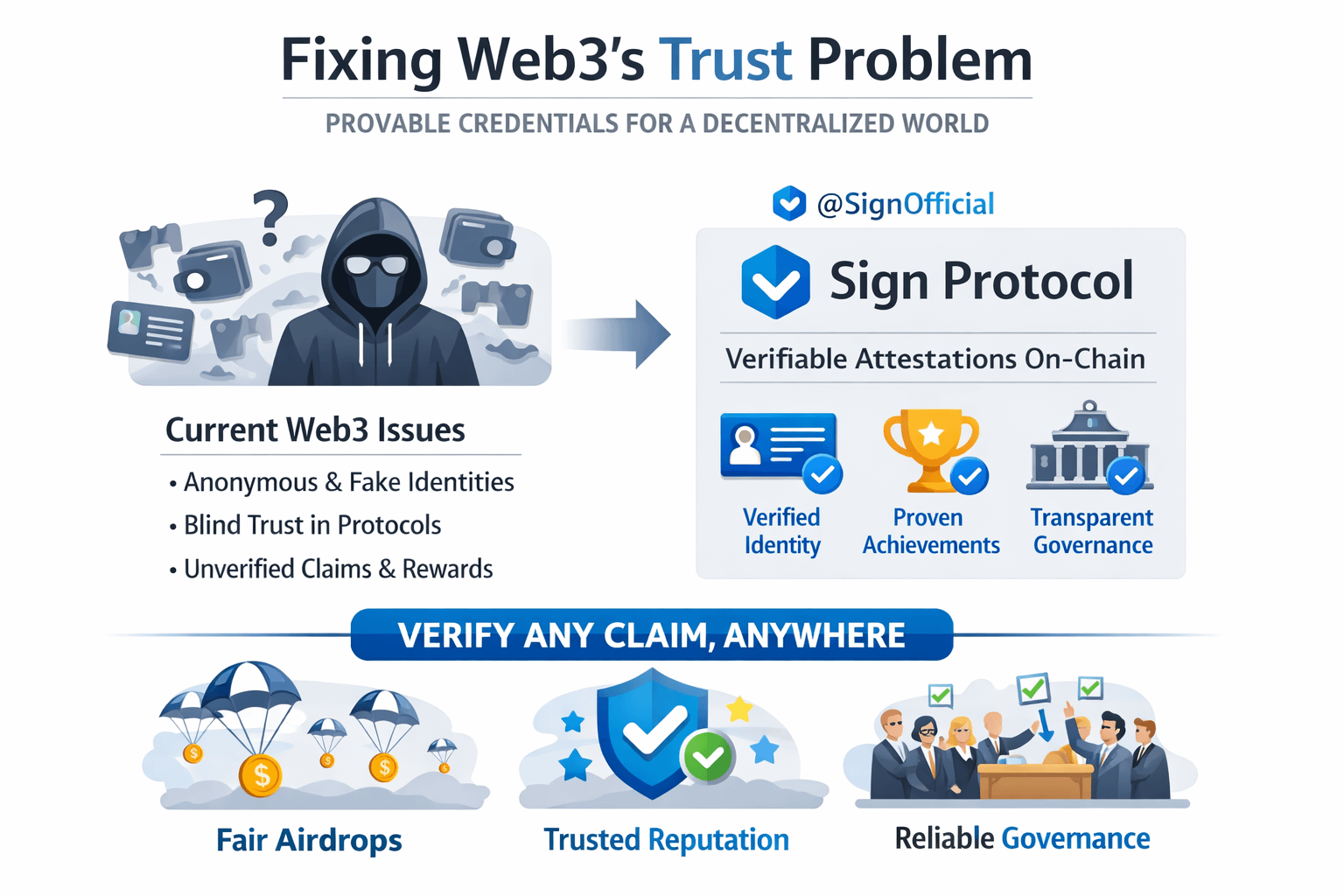
$SIGN itself plays a crucial role within this framework. Unlike tokens that rely solely on speculation, SIGN is connected to the network’s core infrastructure. It supports the creation and validation of attestations and underpins the functioning of verifiable identity and credential systems. Its value comes from usage rather than hype, aligning incentives with real ecosystem activity.
Recent developments in 2026 highlight both challenges and opportunities for Sign Protocol. A significant token unlock increased the circulating supply, creating short-term market volatility. Such events test whether a token’s value is supported by real demand or speculative interest. Despite these fluctuations, there has been sustained interest and strong momentum in the market, reflecting growing awareness of the protocol’s utility.
Sign Protocol has also made progress in expanding its capabilities. Cross-chain compatibility has improved, and the range of potential attestation use cases continues to grow. This positions the project not only as a tool for crypto-native applications but also as a potential bridge between decentralized networks and traditional systems. Governments and institutions, for example, are exploring blockchain-based identity solutions, where verifiable credentials could play a transformative role.
The broader lesson is that trust cannot simply be eliminated—it must be redesigned. Blind trust is unreliable. Verifiable trust, on the other hand, creates stronger, more resilient networks. By converting claims into proof and making data transparent, protocols like Sign Protocol minimize the risk of exploitation and build ecosystems that reward genuine participation.
Challenges remain, of course. Adoption is one of the most significant hurdles. For the protocol to succeed, developers need to integrate it into their applications, and users must see tangible value in participating. Market volatility can also affect perception, sometimes overshadowing underlying technological progress. Furthermore, competition in decentralized identity, zero-knowledge systems, and reputation management is increasing. Sign Protocol will need consistent execution and real-world adoption to stand out.
Despite these obstacles, the project is well-positioned within the current evolution of Web3. The focus of the industry is shifting from attention and hype to utility and infrastructure. Projects that enable other systems, rather than merely being standalone assets, are gaining long-term relevance. If Sign Protocol can establish itself as a standard for verifiable data, it may become a foundational layer for the next generation of decentralized applications.
This transition reflects a broader understanding: Web3 doesn’t require the elimination of trust but rather its reconfiguration. Systems must provide ways to verify claims, credentials, and identities without relying on centralized authorities. By doing so, the ecosystem can support fairer, more transparent interactions and reduce the uncertainty that still discourages mainstream adoption.
#SignDigitalSovereignInfra embodies this vision. Its attestation-based model allows users and systems to verify information independently, creating accountability at every layer. While still in the early stages, the approach aligns closely with the direction the industry is moving: toward infrastructure that emphasizes proof over promise, utility over speculation, and transparency over assumptions.
Ultimately, the future of Web3 will hinge on the balance between decentralization and reliability. Open networks must also be trustworthy, and infrastructure that supports verification will be crucial. Projects like Sign Protocol, which prioritize verifiable trust, are likely to play a key role in shaping how digital ecosystems evolve.
The goal is not to eliminate trust entirely but to make it evidence-based. When trust is grounded in verifiable proof, digital systems can scale safely and reliably. This is the next step for Web3—moving beyond speculation, hype, and blind faith toward a future where users can participate with confidence, and where digital interactions are anchored in verifiable reality.
In this environment, Sign Protocol has the potential to become more than a token. It could serve as the backbone for identity, reputation, and verifiable credentials across blockchain networks. The project’s success will depend on execution, adoption, and the ability to deliver tangible benefits to both developers and users. But if these goals are met, it could transform the way trust functions in Web3, creating a foundation for more equitable and resilient digital ecosystems.

