
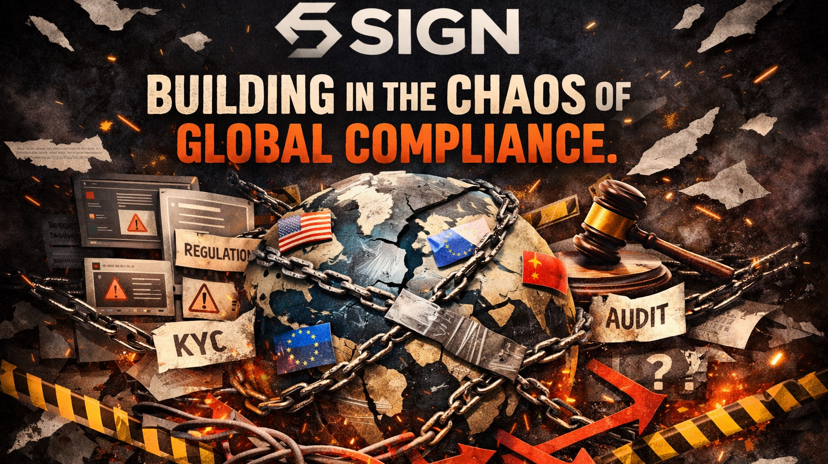
I’ve been burned enough times to flinch when someone says “global compliance layer.” Usually means the same thing: it works great right up until it doesn’t. Right up until some regulator you didn’t model decides your neat little flowchart is… non-compliant. Seen it. Fixed it. Hated it.
Early diagrams always lie. Clean boxes. Friendly arrows. Zero mention of the bureaucratic sludge waiting underneath. You deploy, things hum for a minute, then jurisdiction A wants hard KYC with audit trails that read like a novel, jurisdiction B shrugs and says “good enough,” jurisdiction C flips the table mid-quarter and now your “global” system is a legal minefield duct-taped together with policy exceptions and panicked Slack threads at 3am.And yeah—most teams dodge that. Or defer it. Or pretend some future standard will magically converge everything. It won’t.
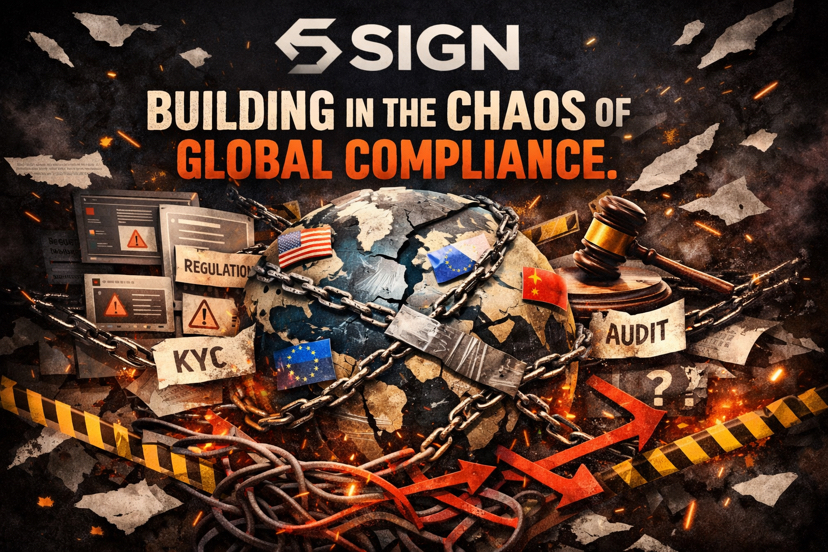
SIGN doesn’t pretend.Here’s the thing everyone misses: it admits the world is a dumpster fire of conflicting rules. Doesn’t try to clean it up. Doesn’t try to harmonize it into some fake universal standard that collapses the second it hits reality. It just builds with the mess in mind.
Which, honestly, is new.
Instead of forcing one definition of identity, one compliance schema, one blessed interpretation of “verified,” it treats disagreement like a core primitive. Not an edge case. Not a bug. The system starts from the assumption that nobody agrees and nobody will.
Because they won’t.
I’ve sat in enough cross-border compliance calls to know how this goes. Everyone says “verified,” but what they mean is “verified according to our rules, our thresholds, our liability model.” And the second that data crosses a border, it stops being truth and turns into a question. A bad one.
“Verified by who?”
That’s where things break. Not at data collection. Not even at transmission. At recognition. That ugly gap between something being cryptographically valid and institutionally accepted. That gap eats systems alive.
SIGN is trying to squeeze that gap without pretending it disappears.
Attestations are the lever. Not the buzzword version—the actual mechanics of it. Someone issues a claim. Not universal truth. A scoped statement: this entity meets our criteria, under our framework, at this point in time. You don’t force everyone else to agree. You force them to see it clearly. Source. Context. Rules behind it.
Then they decide.It’s not consensus. Never was. It’s conditional trust, dragging itself across borders with paperwork attached. Messy But real.
What SIGN seems to standardize isn’t meaning it’s expression. The shape of the claim, not the philosophy behind it. Which means a regulator in one region can ingest a claim from another without endorsing it, without pretending equivalence, but still process it. Evaluate it. Maybe even act on it if the risk model lines up.
That’s closer to how the world actually works. Not shared rules. Shared syntax.
Still complicated. Still fragile.
And it shifts the pain. You don’t delete complexity—you relocate it. Away from raw infrastructure, into interpretation layers, policy engines, human judgment calls that nobody wants to own. I’ve watched regulators take months to agree on definitions of words we thought were obvious. Now imagine that, but encoded.
Yeah.
Then there’s the power problem. Always is. If certain issuers become “trusted enough,” they start shaping access indirectly. Not by blocking transactions, but by defining which attestations get taken seriously. Same gatekeeping, different interface. Cleaner UI. Same gravity underneath.
So no, this isn’t some clean fix. It’s more like accepting the system is already broken and building something that doesn’t shatter immediately when two legal frameworks collide head-on.
I respect that. Reluctantly.
Because most “global” systems I’ve touched? They fail exactly there. Quietly at first. Then all at once.