
March 23, 2026. That’s when Sign Protocol quietly launched the Orange Basic Income program — up to 25 million $SIGN tokens in Season 1, with nine million earmarked specifically for wallets that actually hold their own SIGN long-term. No CEX custody, no shortcuts. I was staring at the dashboard around 2 AM, coffee gone cold, when the first self-custody attestations started ticking in. Nothing flashy. Just a steady pulse of on-chain proofs that someone, somewhere, had chosen to keep skin in the game.
It hit me then: this wasn’t marketing. It was the first real test of whether Sign Protocol attestations could quietly become the base layer primitive for identity systems. Not the loud “decentralized ID” narrative everyone pushes. The actual mechanism — schemas you define once, attestations that travel across thirty-plus chains, verifiable without asking permission from any single bridge or oracle.
the moment the dashboard refreshed
I had just closed a small position on another infra token when this landed. Felt like the chain was whispering instead of shouting. Sign Protocol’s whole design is built for exactly this: you create a schema, anyone attests to it, and the proof lives forever on whatever chain the user chooses. No wrapping. No extra trust assumptions.
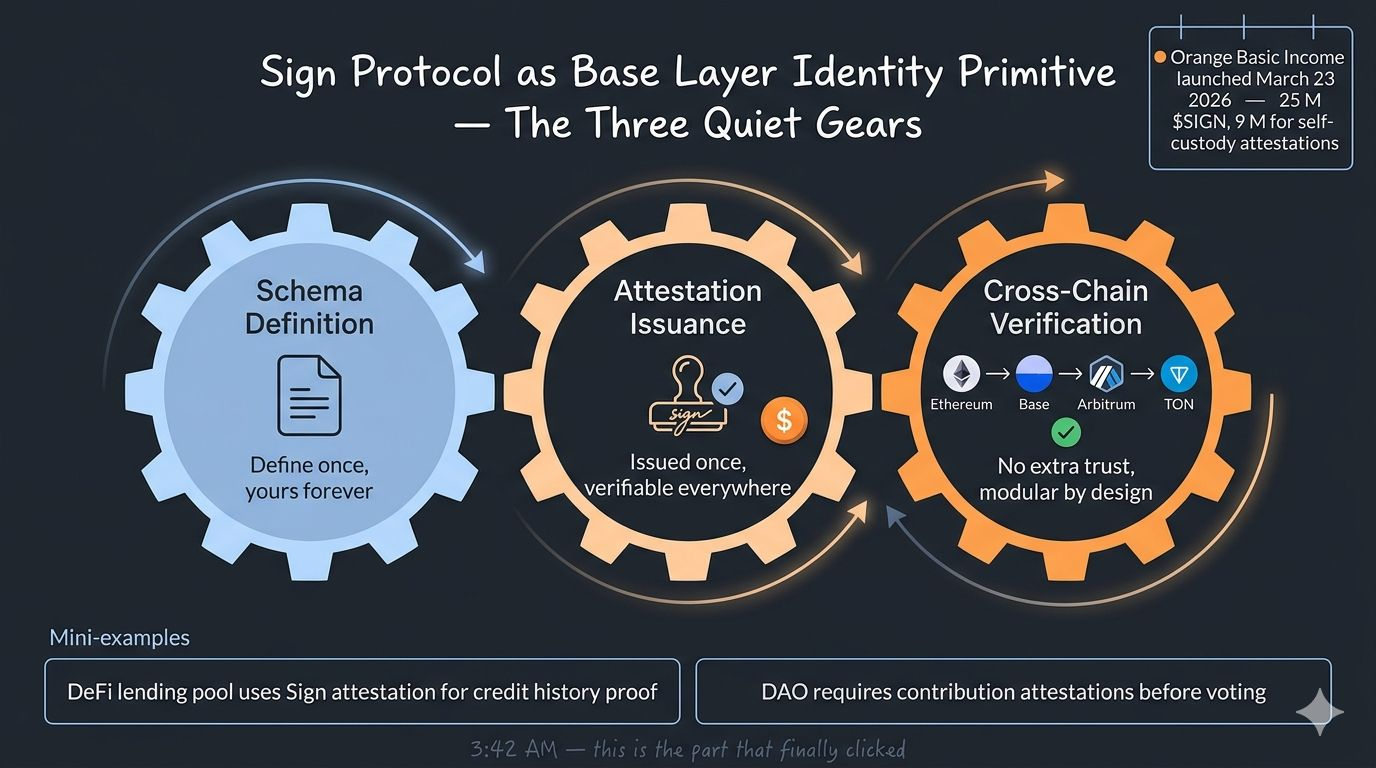
Last week I watched a small DeFi protocol use a Sign attestation to gate a liquidity incentive — not a soul needed to re-KYC. One click, one verification, done. Same week, a governance DAO started requiring attestations of past contribution history before letting new delegates vote. Clean. Frictionless. The kind of thing that makes you pause and wonder why we ever needed centralized identity providers in the first place.
Here’s the quiet part that still bugs me, though.
honestly the part that still bugs me
I’ve been running my own test schema for weeks now — simple “self-custody duration” attestations tied to the Orange Basic Income logic. It works. Perfectly. But every time I move the proof from Base to Arbitrum, there’s still that one extra confirmation step that feels inherited from the underlying messaging layers. Nothing breaks, but it’s not invisible yet. Hmm… maybe that’s the point. The protocol isn’t pretending to be magic. It’s just relentlessly modular.
That’s the simple conceptual model I keep coming back to: three quiet gears.
First gear — schema definition, yours forever.
Second gear — attestation issuance, cryptographically signed once.
Third gear — cross-chain verification that doesn’t require the user to trust the bridge.
Turn them together and you get something that feels like actual digital sovereignty. Not the buzzword version. The boring, reliable one.
3:42 AM and this finally clicked
I poured another coffee and pulled up two other examples playing out right now. One lending pool on a newer L2 started using Sign attestations to prove real-world credit history without exposing the data — just a yes/no proof. Borrowers showed up who never would have touched DeFi before. Second, a small nation-state pilot (yeah, the kind everyone whispers about but rarely names) began experimenting with Sign schemas for citizen credentials. Not full rollout yet, but the test attestations are already live.
Both cases make the same point: once you have a neutral, omni-chain attestation layer, identity stops being a product and becomes infrastructure. The kind of primitive that sits underneath everything else — governance, rewards, compliance, even basic access control.
Of course I have my skepticism. We’ve seen “base layer” claims before. Plenty of projects promised the same thing and ended up as another wrapper. What makes me think Sign Protocol is different? The incentive alignment feels tighter this time. The Orange Basic Income rewards aren’t just farming points — they’re explicitly rewarding the behavior that makes the whole attestation graph healthier: long-term, self-custodied participation.
Still, the chain doesn’t care about my feelings. It only cares about what actually gets attested and verified.
the part i keep turning over
Late-night thought: if Sign Protocol does become that base layer primitive, most of us won’t even notice. We’ll just stop copy-pasting passport photos and start carrying a single verifiable claim that works everywhere. The trader in me wonders what that does to the power dynamics in the next cycle. The builder in me wonders how many teams are already quietly integrating it while the rest of us debate narratives.
Either way, the attestations keep landing. The schemas keep getting used. And the Orange Basic Income clock is already running.
What happens when the first major protocol makes a Sign attestation mandatory for participation? That’s the question I can’t stop turning over at 4 AM.
Curious how others are seeing it — drop your on-chain observations below. No hype, just the mechanics that actually stuck with you.
@SignOfficial #SignDigitalSovereignInfra