
I’m watching how this idea keeps showing up in conversations, I’m waiting for it to feel as simple as people make it sound, I’m looking at how easily everyone accepts that identity can be packaged and passed around, I’ve been noticing how the word “trust” gets used like a finished product instead of something fragile, I focus on the parts that feel slightly off, even if I can’t fully explain why.
SIGN—the Global Infrastructure for Credential Verification and Token Distribution—sounds big, almost reassuring. Like something solid you can lean on. But when I sit with it for a while, it starts to feel less like a finished system and more like something still being figured out in real time. People talk about it as if it’s already stable, already fair, already working the way it should. I’m not sure it is.
I keep thinking about what it actually means to “verify” a person. Not just technically, but in a real, human sense. Can a system really confirm who someone is, or does it just confirm what’s been recorded about them? There’s a difference there, and it feels easy to ignore. A credential might say something is true, but who decided that in the first place? And what happens if they were wrong—or biased—or just incomplete?
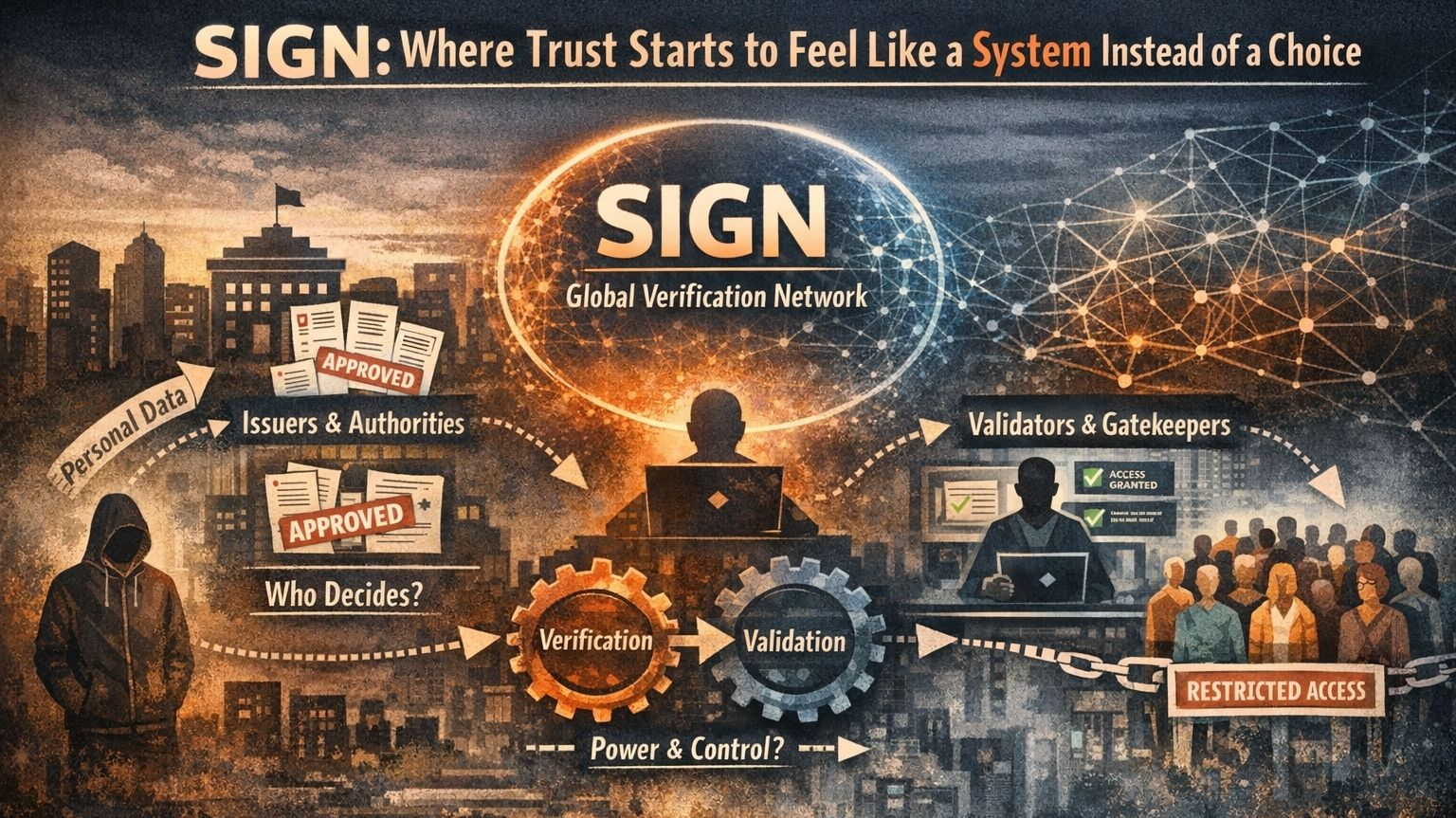
The more I think about it, the more it feels like trust hasn’t disappeared… it’s just been moved. Instead of trusting people directly, we’re trusting the system that represents them. And then trusting the people who built that system. And the ones who maintain it. It starts to stack up in a way that feels a bit uncomfortable, even if everything looks clean on the surface.
I also can’t stop thinking about what this does to people over time. If everything important about you—your skills, your history, your identity—gets turned into credentials and tokens, does that slowly become the only version of you that matters? What happens to the parts that don’t fit neatly into a system like that? The informal, the personal, the things that can’t be easily verified?
There’s also this quiet pressure behind it all. No one says it directly, but it’s there. If a system like SIGN becomes widely used, then not being part of it might start to feel like being invisible. Like not having the right kind of proof. At first it’s optional, then it’s convenient, and then… it’s just expected. I’m not sure when that shift happens, but it feels like it would be hard to notice until it’s already happened.
And then there’s the question of who really benefits. On the surface, it’s everyone—faster verification, less fraud, more clarity. But underneath that, there’s influence. The ones who issue credentials, the ones who validate them, the ones who set the rules—they’re not just participants. They’re shaping what counts as real. And that kind of influence doesn’t usually stay neutral for long.
I try to give it the benefit of the doubt. Maybe it does make things better. Maybe it solves problems we’ve struggled with for a long time. But even then, I can’t shake the feeling that something important is being simplified too much. That in trying to make trust efficient, we might be making it less human.
The system looks strong from the outside. Clean. Logical. Reliable. But the more I think about it, the more I notice how much it depends on things you don’t immediately see—decisions, assumptions, power structures quietly sitting in the background. It doesn’t feel broken, exactly. Just… not as solid as it first appears.
So I keep thinking about it, turning it over in my mind, trying to understand what it really means to build something like SIGN. And the more I do, the less certain I feel—not in a dramatic way, just in that quiet, persistent way where something doesn’t fully add up, even if everything looks like it should.